Hindu shopkeeper’s cloth shop looted and burned during anti-Hindu violence in Nuh, Haryana
 Nuh, Haryana, India
  30 July, 2023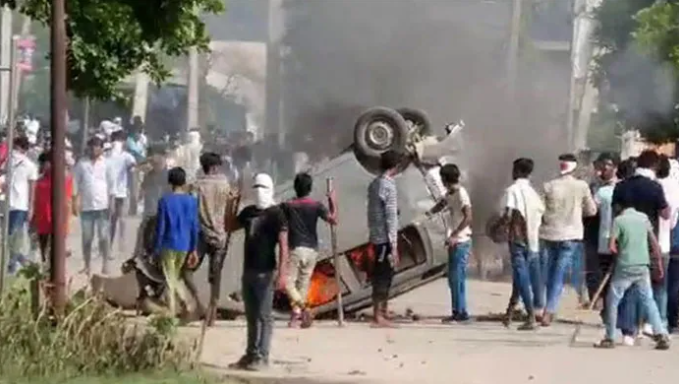
Case Summary
In Nuh, Mewat (Haryana), a Muslim mob attacked thousands of Hindu devotees participating in the Jalabhishek Yatra on Shravan Somvar. Among the many victims was Omkesh Kumar, a resident of village Maalab, who filed an FIR under Sections 148, 149, 395, and 436 of the IPC. Kumar reported that his cloth shop in Jumma Bazaar, opposite Shamshan Ghat Mandir on Old Delhi–Alway Road, was looted and then set ablaze by rioters. Goods worth nearly ₹9–10 lakh were reduced to ashes. He requested the police to identify the culprits through CCTV footage installed around the shop. The attack on 31st July targeted Hindu devotees attending the Brijmandal Jalabhishek Yatra. Eyewitness accounts, FIRs, and complaints suggest that the assault was not spontaneous but pre-planned. According to reports, provocative videos were circulated on social media in the days leading up to the procession, inciting violence against Hindus. The Hinduphobia Tracker has documented the anti-Hindu Nuh violence.
Why it is Hate Crime ?
This case has been added to the tracker under the prime category- Attack not resulting in death. The sub-category relevant in this case is- Communal clash/ attack. Communal clash is a form of collective violence that involves clashes between groups belonging to different religious identities. For a communal clash between Hindus and non-Hindus to qualify as a religiously motivated hate crime, the trigger of the violence itself would have to be anti-Hindu in essence. For example, if there is a Hindu religious procession that comes under attack from a non-Hindu mob and after the initial attack, Hindus retaliate in self-defence, leading to a communal clash between the two religious communities. While at a later stage, both communities are involved in the clash/violence, the initial trigger of the violence was by the non-Hindu mob against the Hindus and therefore, it could safely be termed as an anti-Hindu violence. Further, the trigger would also have to be religiously motivated. In the cited example, the attack by the non-Hindu mob was against religious processions and therefore, can be concluded to be religiously motivated. In some cases, the trigger may be non-religious, however, it develops into religious violence against Hindus at a later stage. In such cases too, the foundational animosity towards Hindus becomes the motivating factor of the crime and therefore, it would be classified as a religiously motivated hate crime against Hindus under this category. The other sub-category selected is- Attacked for Hindu identity. In several cases, Hindus are attacked merely for their Hindu identity without any perceived provocation. A classic example of this category of religiously motivated hate crime is a murder in 2016. 7 ISIS terrorists were convicted for shooting a school principal in Kanpur because they got ‘triggered’ seeing the Kalava on his wrist and tilak that he had put. In this, the Hindu victim had offered no provocation except for his Hindu religious identity. The motivation for the murder was purely religious, driven by religious supremacy. Such cases where Hindus are targeted merely for their religious identity would be documented as a hate crime under this category. In this case, the looting and burning of Omkesh Kumar’s cloth shop cannot be seen in isolation. It took place during the Brijmandal Jalabhishek Yatra, a Hindu religious procession that came under attack by a Muslim mob. The violence against Kumar’s property was part of this larger assault, whose trigger was explicitly anti-Hindu. His shop was not randomly targeted but attacked in the backdrop of an organised assault on Hindu devotees and symbols. The attack fits the definition of a communal clash because the first act of violence originated from the non-Hindu mob against a Hindu religious procession, and from there it spread to include targeted looting and arson of Hindu-owned shops. This makes the incident a clear case of a religiously motivated hate crime. Kumar’s shop was singled out because of his Hindu identity. He did not provoke the mob, nor was his shop attacked due to personal enmity or business rivalry. The fact that rioters broke the lock, looted goods worth nearly ₹9–10 lakh, and then deliberately set the shop on fire shows intent to destroy Hindu livelihood and symbols. The shop’s location near the Shamshan Ghat Mandir further highlights that it was attacked in the context of anti-Hindu violence. Thus, the only “reason” for this crime was Kumar’s identity as a Hindu shopkeeper. Hence, this case is classified as a hate crime.
Victim Details
Total Victim
1
Deceased
0
Gender
- Male 1
- Female 0
- Third Gender 0
- Unknown 0
Caste
- SC/ST 0
- OBC 0
- General 0
- Unknown 1
Age Group
- Minor 0
- Adult 1
- Senior Citizen 0
- Unknown 0


Case Status
Complaint filed


Perpetrators Details
Perpetrators
Muslim Extremists
Perpetrators Range
Unknown
Perpetrators Gender
male
 Sources




