Muslim cleric issues genocide threat against Hindus: invokes 1947-style violence over Waqf law
 Aligarh, Uttar Pradesh, India
  2 April, 2025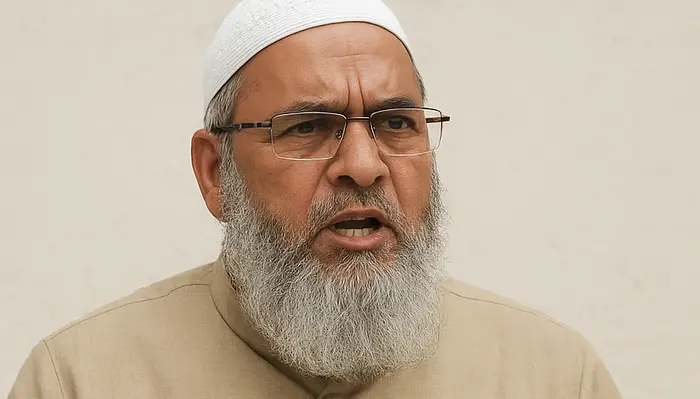
Case Summary
In Aligarh, a Muslim cleric from Aligarh threatened 1947-style violence in response to the Waqf Amendment Act. A video of his statement had gone viral on social media. He had remarked that the situation could resemble that of 1947 due to the Waqf law. Reports indicated that he is the metropolitan president of Jamiat Ulema, and his name is Mufti Akbar Qasmi. While addressing the issue, he had asserted that if the country was to be made ‘beautiful’ again, the law needed to be revoked. Otherwise, he warned, Muslims might take to the streets, potentially leading to a repetition of the events of 1947. He had further declared that he would rather sacrifice his life than bow down and vowed to continue fighting against the law for generations. The Vishva Hindu Parishad (VHP) had strongly opposed the statement and demanded action against the cleric. The organisation had accused Mufti Akbar Qasmi of making divisive remarks and attempting to instigate unrest. According to the VHP, his comments were detrimental to national unity and posed a serious threat to the country’s integrity. The demand for legal action had gained traction among various nationalist groups, who had condemned his remarks as inflammatory.
Why it is Hate Crime ?
This case has been added as a religiously motivated hate crime under the prime category- Hate speech against Hindus, of the database. Under this, the first sub-category selected is- Call for genocide/violence against Hindus/specific sects of Hindus. Hate speech is defined as any speech, gesture, conduct, writing, or display that is prejudicial against a specific individual and/or group of people, which is leading to or may lead to violence, prejudicial action or hate against that individual and/or group. Often, animosity against Hindus or a specific panth/sampradaya/group of Hindus or a specific ideology they hold manifests itself into hate speech and calls for genocide/violence against that specific section of Hindus. For example, it has often been seen that those who hold animosity against the Hindu faith use specific sects/sampradaya/pant of Hindus as a proxy to express hate against Hindus as a whole. It has been seen that the word ‘Hindutva’ has been used to call for violence against those who say they believe in ‘Hindutva’. It is observed that ‘Hindutva’ is only used as a proxy to call for violence against Hindus as a whole, as seen in the Dismantling Global Hindutva conference where speakers admitted that ‘Hindutva’ cannot be eradicated till ‘Hinduism’ is eradicated. The eradication of an entire faith, in turn, is a genocidal call against the entire community that practices that faith. Further, it is also observed that violence against a specific section of Hindus is made, justifying these calls by weaving exaggerated tales of historical injustices. Often, those who hold animosity towards Hindus and their faith attempt to make their animosity more palatable by justifying their hate for a specific section, claiming that they are against that particular section because of their faith in the broader community and the religion they process. Such calls for violence against specific sections of Hindus, as mentioned, is a proxy for their animosity against the entire community and the faith they profess, and therefore, would be considered hate speech under this category. The second sub-category selected here- Violent threats. Violent threats, explicit, implicit or implied, is the most dangerous form of hate speech since it goes beyond discriminatory and prejudicial language to express the intent of causing harm to an individual or a group of people based on their religious identity and faith. There could be several different kinds of threats that are issued to Hindus based on religious animosity. An explicit threat would mean the direct threat of violence towards an individual Hindu, a group of Hindus or Hindus at large. Physical violence, death threats, threats of destruction of property belonging to Hindus and threats of genocide would mean explicit threats against Hindus for their religious identity. Implicit threats may not be a direct threat but implied through the use of symbols of actions – for example – in the Nupur Sharma case, other than explicit threats, there were also implicit threats when Islamists took to the streets to burn and beat her effigies. It implies that they want to do the same to Nupur Sharma – thereby is considered an implicit threat. Violent threats can be delivered in person, through letters, phone calls, graffiti, or increasingly through social media and other online platforms. It would be important to understand that a threat – explicit or implicit, online or offline – to an individual who happens to be a Hindu does not qualify as a religiously motivated threat. Such a threat, while vile and dangerous, could be owing to non-religious reasons and/or personal animosity. To qualify as a religiously motivated threat, it would need to exhibit an indication that the individual is being targeted for religious reasons and/or owing to his/her religious identity as a Hindu. Mufti Akbar Qasmi’s statement, threatening 1947-style violence over the Waqf Amendment Act, qualifies as a hate crime because it seeks to incite communal unrest and instil fear by invoking historical trauma. By explicitly referring to the violent events of Partition and warning of their potential recurrence, the cleric's words go beyond political dissent and enter the realm of targeted intimidation. His remarks threaten public order and sow division along religious lines against Hindus by implying mass violence as a form of resistance. Such rhetoric is not only irresponsible but also dangerous, as it encourages communal polarisation and undermines democratic discourse by normalising the threat of violence as a political tool. The Partition of 1947 witnessed horrific anti-Hindu violence, especially in regions that became part of Pakistan. Countless Hindus were murdered, raped, or forcibly converted, and millions were driven from their ancestral homes. Temples were desecrated, and entire communities were wiped out in the name of religious cleansing. This dark chapter in Bharat's history remains a painful memory for those Hindus who suffered and continues to serve as a reminder of the catastrophic consequences of communal hatred. Mufti Akbar Qasmi’s statement is distinctly anti-Hindu because it weaponises the memory of one of the most brutal episodes of anti-Hindu violence in history—the Partition—to threaten a repeat of such atrocities if the Waqf Amendment Act is not revoked. By referencing 1947, he is not merely warning of protest but deliberately invoking a time when Hindus were targeted, slaughtered, and displaced on a massive scale. This is not a general expression of dissent but a communal threat directed at the Hindu population and the democratic state. His words imply that any move perceived to limit Islamic institutional privileges could justify mass violence against Hindus, making the statement both a form of communal intimidation and a call for anti-Hindu mobilisation. Disclaimer: It is important to clarify that the report does not specify the exact date when the genocidal calls were delivered. Therefore, for documentation purposes, we have recorded the date based on when the incident was reported in the media.


Case Status
Unknown


Perpetrators Details
Perpetrators
Muslim Extremists
Perpetrators Range
One Person
Perpetrators Gender
male
 Sources




