Western media blames Hindus and Chhaava movie for Nagpur violence, downplays and whitewashes Muslim mob attack targeting Hindus
 Nagpur, Maharashtra, India
  17 March, 2025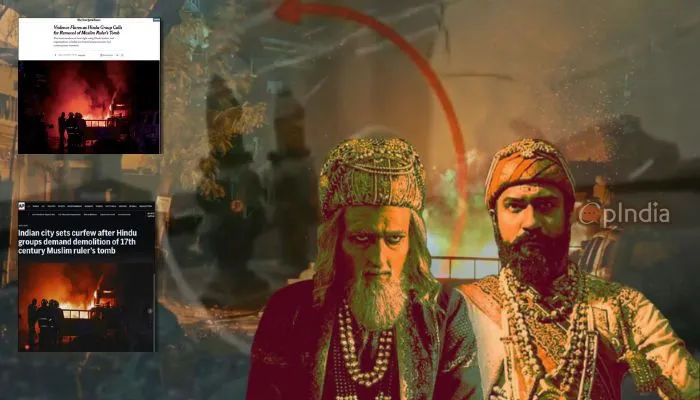
Case Summary
In Nagpur, Hindus were subjected to brutal violence by radical Muslim mobs following demands by Hindu organisations for the removal of Aurangzeb’s tomb in Sambhaji Nagar. The violence escalated after an unverified rumour spread that Hindu groups had burned the Quran during the protests. Using this as a pretext, Muslim mobs launched a violent assault on the Hindu community, sparking further communal clashes. However, the authorities later confirmed that the Nagpur violence was a pre-planned attack on Hindus. Several eyewitness accounts revealed that Muslim mobs chanted religious slogans while selectively targeting Hindus, their vehicles, and properties. Despite this, several Western media outlets attempted to shift the blame onto Hindus and the film Chhaava, completely whitewashing and downplaying the violence perpetrated by Muslim mobs. Chhaava is a Bollywood movie which portrays the life and brutal martyrdom of Chhatrapati Sambhaji Maharaj, a Maratha king, at the hands of Mughal emperor Aurangzeb, for refusing to convert to Islam. The British Broadcasting Corporation (BBC) published a report titled “Curfew in India city after violence over Mughal emperor Aurangzeb’s tomb”, falsely implying that riots erupted after VHP and Bajrang Dal members burned an effigy of Aurangzeb and demanded the removal of his tomb. They also misquoted Maharashtra's Chief Minister Devendra Fadnavis, attempting to blame the film Chhaava for inciting violence. The report stated: “The trigger for this week’s violence has been a recent Bollywood film about Sambhaji, a Maratha ruler who clashed with Aurangzeb but lost and its graphic depiction of him being tortured.” However, CM Fadnavis never blamed Chhaava, its lead actor Vicky Kaushal, or even Hindus for the Nagpur violence. Instead, while addressing the Vidhan Sabha, he clarified that the violence was a pre-planned conspiracy to disturb communal harmony in the city, citing the presence of trolleys filled with stones at the riot sites. He also said that Chhaava had brought to light the true history of Chhatrapati Sambhaji Maharaj, stirring emotions against Aurangzeb and exposing the admiration some sections of society still hold for the Mughal tyrant. Fadnavis stated, “I am not blaming any cinema or movie, but ‘Chhaava’ has brought to us the true history of Chhatrapati Samhaji Maharaj. The movie has undoubtedly galvanised public opinion against Mughal emperor Aurangzeb, and even those who harbour love and admiration for him.” Similarly, the US-based news agency Associated Press (AP) blamed Hindus for the anti-Hindu violence committed by Muslims in Nagpur. Their report falsely claimed: “Authorities imposed an indefinite curfew in parts of a western Indian city on Tuesday, a day after sectarian clashes were sparked by Hindu nationalist groups who want to demolish the tomb of a 17th-century Muslim Mughal ruler.” Authored by Sheikh Saaliq, the propaganda-laden article suggested that ‘clashes’ erupted due to Hindu demands to remove Aurangzeb’s grave, deliberately omitting the fact that Muslim mobs had launched the violence, specifically targeting Hindus and the police. The AP article further attempted to evoke sympathy for the Muslim ‘minority,’ suggesting that scorn for Aurangzeb had grown under Prime Minister Narendra Modi and falsely implying that Muslims in India were “at the receiving end of violence from Hindu nationalists.” This blatant misrepresentation aligns with AP’s well-documented history of whitewashing Islamist violence. The same news agency had infamously embedded photojournalists with Hamas terrorists during the October 7, 2023, massacre of Israelis, effectively legitimising their propaganda. Sky News, another Western media outlet, also attempted to shift the blame onto Hindus and Chhaava, claiming that the film had incited communal tensions. Their report misleadingly stated: “Muslims, who make up 14% of the population, feel they have been targeted by right-wing mobs tacitly supported by the government.” However, Sky News did not highlight the brutal attacks by Muslim rioters against Hindus amidst chants of Islamic slogans, clearly depicting the communal nature of their attack. The New York Times (NYT) also distorted the events, falsely portraying Hindu groups as the instigators of violence in Nagpur. Their report declared: “A hard-line Hindu group’s call for the removal of the tomb of a 17th-century Mughal ruler has ignited tensions with Muslims in the western Indian state of Maharashtra, leading to communal violence and the imposition of a curfew.” This was a deliberate attempt to vilify Hindus while whitewashing the Muslim aggressors. NYT also misquoted CM Fadnavis and insinuated that the Chhaava movie had inflamed communal tensions. Their article falsely claimed: “The trouble started on Monday, which, according to the Hindu calendar, is the birth anniversary of Chhatrapati Shivaji, a valorised Hindu king who fought Aurangzeb.” However, NYT completely ignored multiple local eyewitnesses who had confirmed that Muslim mobs were selectively attacking Hindus and their properties while chanting Islamic slogans. These mobs arrived fully armed and well-prepared for violence against Hindus. This blatant misrepresentation aligns with NYT's well-documented history of glorifying radical Khalistani terrorists (Sikh separatists) and downplaying the religious persecution and genocide of Bangladeshi Hindus in Bangladesh as a 'political conflict'. The Nagpur violence was a pre-planned anti-Hindu attack. Despite all evidence pointing to the same thing, Western media outlets engaged in biased reporting, portraying Muslim aggressors as victims and Hindu victims as instigators, showcasing their prejudice for the Hindu community.
Why it is Hate Crime ?
This case has been added to the tracker under the primary category- Hate Speech against Hindus. Within this, the subcategory selected is- Anti-Hindu subversion or prejudice. Within this, the tertiary category selected is- Anti-Hindu fake news or downplaying. Hate speech is defined as any speech, gesture, conduct, writing, or display that is prejudicial against a specific individual and/or group of people, which is leading to or may lead to violence, prejudicial action or hate against that individual and/or group. Media plays a specific and overarching reach in perpetuating prejudicial attitudes towards a community owing to unfair, untrue coverage and/or misrepresentation/misinterpretation, selective coverage and/or omission of facts of/pertaining to issues affecting a specific religious group. This type of bias can dehumanise the victim group, making it easier for others to justify harmful actions against them, which aligns with the objectives of hate speech laws aimed at preventing such harm. It is often observed that the media takes a prejudicial stand against the Hindu community driven by their need to shield the aggressor community which happens to be a numeric minority, however, is the one perpetrating violence against Hindus. For example, the media is often quick to contextualise religiously motivated crimes against Hindus, omit or misrepresent facts that point towards religiously motivated hate crimes, justify and/or downplay religiously motivated hate crimes or simply present fake news to stereotype Hindus. Such media bias leads to the denial of persecution and is often used to dehumanise Hindus, leading to justification for violence against them. For example, the media covered several fake allegations of Hindus targeting Muslims and forcing them to chant Jai Shree Ram. Most of these cases were proved false and fabricated after police investigation. These fake news reports were subsequently never retracted or clarified. Such fake news led to the justification of violence and dehumanisation of Hindus based on the argument that since Hindus targeted Muslims and forced them to chant Jai Shree Ram, the dehumanisation of Hindus and violence against them was par for the course and merely a retaliation. Such media bias leads to prejudicial portrayal of Hindus and offers a justification for violence against them and therefore, is considered hate speech under this category. The Western media's misleading and biased coverage of the Nagpur violence demonstrates a clear attempt to shift the blame onto Hindus and the Chhaava movie, a movie on the life of Chhatrapati Samabhaji Maharaj, king of the Maratha Empire, while downplaying the Muslim-led attacks, thereby contributing to the broader pattern of anti-Hindu prejudice in mainstream media. By falsely insinuating that Hindu protestors were responsible for the violence, the media publications deliberately distorted the reality of the incident. The fact that the report avoided explicitly mentioning the role of the Muslim mob in the attacks—despite eyewitness testimonies confirming their violent aggression—reveals a deliberate effort to whitewash anti-Hindu violence. It's also important to state that the media's act of blaming the Chhaava movie, which portrays the life and brutal martyrdom of Chhatrapati Sambhaji Maharaj at the hands of Aurangzeb, for refusing to convert to Islam, reflects a deliberate pattern of unjustly portraying Hindus as ‘instigators’ of their own persecution. Suggesting that the mere telling of historical truth in Chhaava provoked Muslim mobs is not only distorted reasoning—it amounts to justifying the violence and denying Hindus the right to remember their history, honour their heroes, and speak of the atrocities they faced under Islamic invaders. By framing Hindu cultural expression as a provocation, Western media narratives implicitly delegitimise Hindu voices while excusing aggression by Muslim radicals, exposing a deeper current of anti-Hindu hostility. Additionally, the narrative manipulation by the Western media is not just a case of journalistic bias but an active act of misinformation that fuels hostility against Hindus. By framing Hindus as the instigators while ignoring key details, such as the Muslim mob chanting Islamic slogans, burning Ram Navami decorations, and targeting Hindu properties, the media outlet engaged in anti-Hindu subversion. This biased reporting not only obscures the truth but also emboldens radical Muslims by legitimising their actions and erasing the suffering of the Hindu victims. Given the deliberate distortion of facts, the suppression of eyewitness testimonies, the downplaying of a communal attack specifically targeting Hindus, and the misplaced attempt to blame both Hindus and the film Chhaava, the Western media’s coverage amounts to an act of anti-Hindu hate speech, subversion, and systemic media bias, thereby warranting its inclusion in the hate crime database.


Case Status
Unknown


Perpetrators Details
Perpetrators
Others
Perpetrators Range
Unknown
Perpetrators Gender
unknown
 Sources




