Hindus in Bilaspur targeted for conversion through deceptive Christian prayer meetings
 Bilaspur, Chhattisgarh, India
  19 March, 2025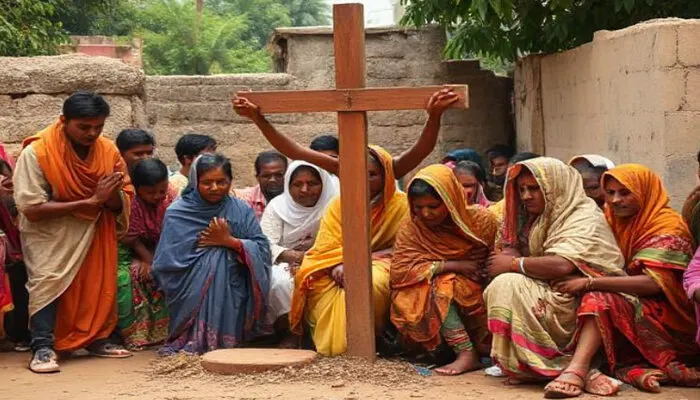
Case Summary
In Bilaspur, Chhattisgarh, Hindus were being lured and converted to Christianity under the guise of attending “prayer meetings.” According to reports, a Christian prayer gathering was held at Preeti Bhawan near Rajendra Nagar Chowk, where members of Christian missionary groups actively attempted to convert Hindus by providing inducements. These meetings were organised twice a week, every Thursday and Sunday evening, using microphones and sound systems to attract large crowds. Under the pretext of prayer, targeted proselytisation took place. Upon receiving information about the ongoing conversions, Hindu organisations reached the location and alerted the Civil Line Police. The police, along with senior officials, arrived promptly and conducted an inquiry. Individuals involved in the conversion activities were detained and taken to the police station for further investigation. Following a formal complaint from a Hindu woman who had been targeted through these prayer meetings, the police arrested G Joy Daniel, Ashirwad Baghel, and Suhas, members of the Christian community. A case was registered, and authorities confirmed that further legal action would follow a detailed probe. Hindu activist Ram Singh reported that 30 to 40 people were present during the conversion activities, where training sessions were also held to promote the conversion of Hindus. He added that such deceptive practices had been ongoing at Preeti Bhawan for nearly a year under the false cover of prayer meetings.
Why it is Hate Crime ?
This case has been added to the tracker under the primary category of: - Predatory proselytisation. Within it, the sub-category selected is: - Proselytisation by grooming, brainwashing, manipulation or subtle indoctrination, with the tertiary category being: - Pattern of targeting Hindus. Religious brainwashing essentially means the often subtle and forcible indoctrination to induce someone to give up their religious beliefs to accept contrasting regimented ideas. Religious grooming or brainwashing also involves propaganda and manipulation. It involves the systematic effort, driven by religious malice and indoctrination, to persuade “non-believers’ to accept allegiance, command, or doctrine to and of a contrasting faith. Cases of such grooming or brainwashing are far more nuanced than direct threats, coercion, inducement and violence. In such cases, it is often seen that there is repeated, subtle and continual manipulation of the victim to induce disaffection towards their own faith and acceptance of the contrasting faith of the perpetrator. While subtle indoctrination is widely acknowledged as predatory, an element which is often understated in such conversions or the attempts of such conversion is the role of loyalty and trust which might develop between the perpetrator and the victim. Fiduciary relationships are often abused to affect such religious conversion. For example, an educator transmitting religious doctrine of a competing faith to a Hindu student. The Hindu student is likely to accept what the teacher is transmitting owing to existence of the fiduciary relationship. The exploitation of the fiduciary relationship to religiously indoctrinate victims would also be included in this category. Since the underlying animosity towards the victim’s faith forms the basis of predatory proselytization, such cases are considered religiously motivated hate crimes. The second sub-category selected is: - Conversion/ attempts to convert by inducement. Predatory Proselytisation is not just limited to threat, harassment, force and violence, but it also has contours of stealth. In several cases, the Hindu victim is exploited to convert, with non-Hindus taking advantage of their poverty. In such cases, the Hindu victim who is suffering financially is offered monetary benefits, including lucrative offers for jobs, health treatment, education, etc, to induce the victim into changing his/her religion. In such cases, the religious identity of the victim and the aim to disenfranchise him from his faith form the heart of the crime. Also, taking advantage of and exploiting an individual’s economic vulnerabilities is widely acknowledged as exploitation, forms of which are often penalised by law. Such cases therefore are considered religiously motivated hate crimes since the victim’s religious identity forms the very heart of the crime itself. In this case, Christian missionary groups systematically lured Hindu individuals under the false pretext of prayer meetings. These were not simple gatherings for worship, but carefully organised events aimed at promoting Christianity. The repeated meetings, use of sound systems, and emotionally manipulative environments indicate a long-term and calculated attempt to erode the Hindu identity of the attendees. Offering incentives to encourage conversion, particularly when directed at individuals who are vulnerable or in need, shows that these incentives are not acts of kindness or charity. Instead, they are calculated moves to exploit vulnerable Hindus because of their religion. By providing inducements to Hindus to change their faith, the accused were effectively blackmailing those who might have been desperate for assistance. Such instances are seen in many cases where members of Christian missionary groups target socially and economically vulnerable Hindus to further their agenda of religious conversions. This form of coercion strips people of their agency and dignity and enforces forced conversions. These are not random or isolated incidents, but rather cases deeply rooted in religious animosity towards Hindu victims. The Christian faith, by its very theological foundations, places a strong emphasis on proselytisation. In pursuit of conversion objectives, Christian evangelists often employ unethical means, ranging from psychological pressure and misinformation to inducements such as money or jobs. These tactics are designed not as acts of charity but as tools to engineer religious change under the guise of social upliftment, particularly among vulnerable and underprivileged communities. This is not an isolated incident but part of a structured and ideologically driven campaign that targets Hindus. The sustained use of inducement, grooming, and manipulation to achieve religious conversions illustrates a deeply rooted hostility toward the Hindu faith and community, making this a clear instance of a religiously motivated hate crime. Disclaimer: The case mentions that between 30 to 40 individuals were baptised by the accused, but does not provide an exact number. For documentation purposes, we have recorded the maximum count of 40 victims in the database. It is also stated that both men and women were among those baptised, though no specific gender breakdown is provided. Therefore, we have evenly divided the count, recording 20 male and 20 female victims for the sake of consistency in documentation.
Victim Details
Total Victim
40
Deceased
0
Gender
- Male 20
- Female 20
- Third Gender 0
- Unknown 0
Caste
- SC/ST 0
- OBC 0
- General 0
- Unknown 40
Age Group
- Minor 0
- Adult 0
- Senior Citizen 0
- Unknown 40


Case Status
Arrested


Perpetrators Details
Perpetrators
Christian Extremists
Perpetrators Range
From 2 To 5
Perpetrators Gender
male
 Sources




