Hindu community subjected to violent threats by Muslim political leader in Maharashtra
 Nanded, Maharashtra, India
  24 November, 2024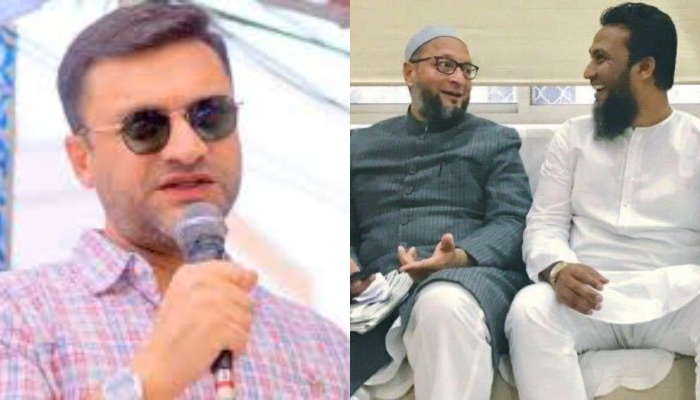
Case Summary
In Nanded, Maharashtra, the Hindu community was subjected to violent threats by a Muslim politician named Syed Moin, associated with the AIMIM party. According to media reports, an old video of Syed Moin resurfaced and went viral on social media during the Maharashtra Assembly elections in November 2024. In this video, Syed Moin repeated the violent anti-Hindu statements once voiced by AIMIM leader Akbaruddin Owaisi in 2012. At the time, Akbaruddin Owaisi had stated: “In India, we (Muslims) are 25 crores and you (Hindus) are 100 crores. If you remove the police from the country for 15 minutes, then you will know who is powerful.” Syed Moin openly endorsed and reiterated this message, declaring: “Fifteen minutes are remaining. I am also a slave of Akbaruddin Owaisi. I also endorse his statement. Think whatever you want. I am the one who hits the last ball for six.” His words reinforced the bigotry and animosity Owaisi directed towards the Hindu community. Reports also stated that previously on 22nd September 2024, Syed Moin organised a rally, followed the next day by another rally on 23rd September 2024 led by Imtiaz Jaleel. Both marches travelled from Chhatrapati Sambhajinagar to Maharashtra’s capital, echoing “Sar Tan Se Juda” chants, calls for beheading anyone accused of insulting Prophet Mohammad. These slogans were raised in reaction to speeches by Nitesh Rane and Ramgiri Maharaj, described as ‘anti-Islamic’ by AIMIM leaders. During these gatherings, Syed Moin and Imtiaz Jaleel incited Muslim crowds to commit violence against Hindus, urging them to behead those accused of insulting the Prophet of Islam.
Why it is Hate Crime ?
This case has been added to the tracker under the primary category- Hate Speech against Hindus. Within this, the subcategory selected is- Violent threats. Violent threats, explicit, implicit or implied, is the most dangerous form of hate speech since it goes beyond discriminatory and prejudicial language to express the intent of causing harm to an individual or a group of people based on their religious identity and faith. There could be several different kinds of threats that are issued to Hindus based on religious animosity. An explicit threat would mean the direct threat of violence towards an individual Hindu, a group of Hindus or Hindus at large. Physical violence, death threats, threats of destruction of property belonging to Hindus and threats of genocide would mean explicit threats against Hindus for their religious identity. Implicit threats may not be a direct threat but implied through the use of symbols of actions – for example – in the Nupur Sharma case, other than explicit threats, there were also implicit threats when Islamists took to the streets to burn and beat her effigies. It implies that they want to do the same to Nupur Sharma – thereby is considered an implicit threat. Violent threats can be delivered in person, through letters, phone calls, graffiti, or increasingly through social media and other online platforms. It would be important to understand that a threat – explicit or implicit, online or offline – to an individual who happens to be a Hindu does not qualify as a religiously motivated threat. Such a threat, while vile and dangerous, could be owing to non-religious reasons and/or personal animosity. To qualify as a religiously motivated threat, it would need to exhibit an indication that the individual is being targeted for religious reasons and/or owing to his/her religious identity as a Hindu. In this case, Muslim politician Syed Moin repeated the infamous 2012 anti-Hindu statement of AIMIM leader Akbaruddin Owaisi, who declared that if the police were removed for fifteen minutes, Muslims would demonstrate their strength over Hindus. By proudly endorsing this violent speech, calling himself a “slave” of Owaisi, and pledging his support for such rhetoric, Syed Moin reinforced and legitimised hatred against Hindus. His words were not casual references but direct encouragement of communal violence, designed to instil fear in the Hindu community. Such rhetoric qualifies as hate speech because it explicitly targets Hindus as a group and presents violence against them as justified and desirable. The reaction of the Muslim crowd contributed even more to the anti-Hindu statements of Syed Moin. Instead of rejecting or condemning Moin’s words, the Muslim audience cheered and applauded, treating threats against Hindus as entertainment and affirmation of communal strength. This reaction illustrated the extent of indoctrination and hostility within the gathering, where hatred of Hindus was normalised and celebrated. The collective support amplified Moin’s hate speech, transforming it from the outburst of one politician into a public display of anti-Hindu bigotry motivated by religious animosity. This was not an isolated instance. Just weeks earlier, in September 2024, Syed Moin, alongside AIMIM MP Imtiaz Jaleel, led demonstrations from Chhatrapati Sambhajinagar to Maharashtra’s capital. At these rallies, Muslim crowds openly raised “Sar Tan Se Juda” slogans, explicit calls for beheading anyone accused of insulting the Prophet of Islam. Far from discouraging such violent slogans, Syed Moin and his associates provoked and encouraged them, weaponising blasphemy accusations as a tool to incite hostility towards Hindus. These deliberately orchestrated demonstrations further exposed his pattern of targeting Hindus through religiously motivated incitement. Taken together, Syed Moin’s words, the crowd’s reaction, and his history of supporting violent demonstrations formed a textbook case of anti-Hindu hate speech. His rhetoric was motivated by religious animosity, aimed at dehumanising Hindus, legitimising violence against them, and instilling fear within the Hindu community. This was not politics; it was targeted hate against the Hindu community for their religious identity, making it an instance of religiously motivated hate speech. Therefore, this case is being added to the hate crime database. Disclaimer: Media reports do not specify the exact date on which the perpetrator made these remarks. They only indicated that the statements were made during November 2024, and coverage of the issue emerged after an old video resurfaced and went viral. The reports in question were published on 25th February 2025. For the purposes of documentation, we are using 25th November 2024 as the indicative date of the incident. Hinduphobia Tracker records the date when the hate speech was delivered, rather than the date on which it was later reported by the media.


Case Status
Unknown


Perpetrators Details
Perpetrators
Muslim Extremists
Perpetrators Range
One Person
Perpetrators Gender
male
 Sources




