Hindu victims of Jamui violence blamed by Bihar minister for reciting Hanuman Chalisa without 'taking permission'
 Jamui, Bihar, India
  18 February, 2025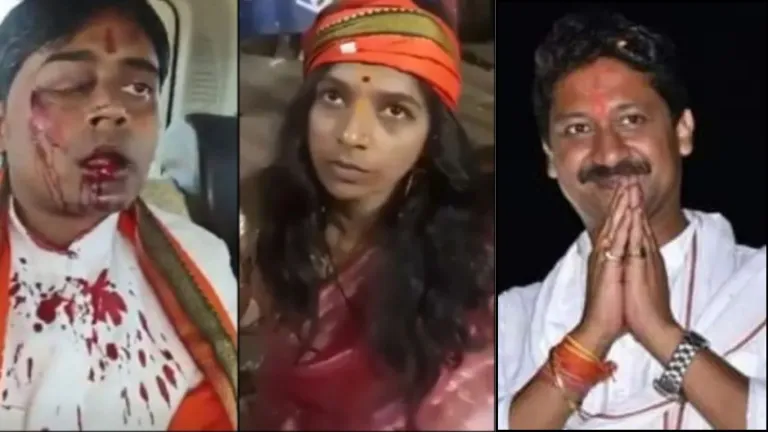
Case Summary
A group of Hindu activists from the Hindu Swabhiman organisation gathered in Jamui for a recitation of the Hanuman Chalisa. On their return journey, a Muslim mob near a mosque in a Muslim-majority area vandalised their vehicles and attacked them with bricks. The attackers shouted ‘Allah Hu Akbar’ as they assaulted the Hindu devotees. Many Hindus were severely injured in the attack, including women and children. After this violent incident, the Hindu victims of the Jamui attack were blamed by Sumit Kumar Singh, the science and technology minister in the Bihar government. Minister Sumit Singh insisted that no licence had been obtained for the Hanuman Chalisa recitation and asserted that the event had been organised in a planned manner. He claimed Hanuman Chalisa was not usually recited on Saturdays and Sundays, nor was Khichdi Prasad distributed, implying that those who performed the recitation were responsible for the violence. Ultimately, the Hindu victims were blamed for the attack perpetrated by the Muslim mob. Sumit Kumar Singh said, “Brother, why did you go there? You were there... tell us this? Why did you go there? What did you go there to do? And if you went there, did you inform the administration about it? Did you get a licence for it? If we do any Jagran or anything at home, we take a licence for that.” He further stated, “If such an incident had happened after obtaining a licence, then we would have believed that the people there are guilty, who attacked them.” He continued, “You cannot just go and start reading Hanuman Chalisa at odd hours, there is no restriction on reading, though. Those who went there are not greater devotees of Hanuman than I am…they make a drama by opening the Chalisa book and reading out loud, Hanuman Chalisa cannot be read like this.”
Why it is Hate Crime ?
The case has been added to the tracker under the primary category- Hate Speech against Hindus. Within this, the subcategory selected is- Denial or mocking of genocide/large-scale persecution. Denial or mocking of genocide/large-scale persecution/ethnic cleansing refers to the act of denying or minimizing the fact of the ethnic cleansing and/or genocide and/or religious persecution of Hindus. This often involves denying the scale, mechanisms, religious intent, or even the occurrence of the ethnic cleansing and/or genocide and/or religious persecution of Hindus. Hate speech of this kind involves the dissemination of falsehoods that deny or distort established historical facts or mock the suffering of Hindus by saying that they deserved the persecution, motivated by Hinduphobia. Denying such atrocities is not only about the denial of facts or rewriting/revising history, but it also delegitimises the religiously motivated persecution of Hindus, the religious hate/motivation/animosity that led to the persecution, and dehumanises Hindus as a religious group. Such denial of ethnic cleansing and/or genocide and/or religious persecution of Hindus not only denies the suffering but also paves the way for future/present atrocities and hate speech, inciting prejudice and violence against Hindus. It also provides a justification for violence by delinking religious animosity from religiously motivated crimes committed against Hindus. Since such denial and/or mocking of genocide/ethnic cleansing/atrocities motivated by religious animosity leads to present and future ramifications of creating more hate speech, violence, dehumanisation and delegitimisation, it would be considered hate speech under this category. The other subcategory selected in this case is- Anti-Hindu slurs, mocking faith. Anti-Hindu slurs and the deliberate mocking of the Hindu faith owing to religious animosity involve the usage of derogatory terms, stereotypes, or offensive references to religious practices, symbols, or figures. One of the common anti-Hindu slurs used against Hindus is “cow-worshipper” and “cow piss drinker”. The intention of using this term is to demean and mock Hindus as a group and their religious beliefs since Hindus consider the cow holy. Additionally, some symbols and the slurs attached to them have a historical context that exacerbates the insult, hate, stereotyping, dehumanisation and oppression against Hindus. Cow worship has been used for centuries to denigrate Hindus, insult their faith and oppress Hindus specifically as a religious group. There has been overwhelming documentation about how cow slaughter has been used to persecute Hindus with cow meat being thrown in temples and places of worship. There has also been overwhelming documentation where cow meat (beef) has been force-fed to Hindus to either forcefully convert them to Islam or denigrate their faith. Apart from cow worship, the Swastika – which holds deep religious significance for the Hindus – has also been misinterpreted and distorted to use as a slur against Hindus. Similarly, the worship of the Shivling has been used by supremacist ideologies and religions to denigrate Hindus owing to religious animosity. Such slurs and denigration stem out of inherent animosity and hate towards Hindus and their faith, therefore, it is categorised as hate speech targeted at Hindus specifically owing to their religious identity. This incident in Jamui stood out as a blatant example of an anti-Hindu hate crime. Hindu devotees—including women and children—were returning from Hanuman Chalisa recitations when they were brutally attacked by a Muslim mob. As they passed through a Muslim-majority area near a mosque, the mob surrounded their convoy and launched a vicious assault with bricks and stones, leaving many seriously injured. In the aftermath, instead of expressing sympathy or extending support, the accused, Sumit Kumar Singh, the technology minister in the Bihar government, placed the blame squarely on the Hindu victims. He questioned why they had entered the Muslim majority area and insisted that chanting Hanuman Chalisa required a licence, which they had not obtained. By refusing them assistance and choosing to justify the attack, the minister not only failed in his duty to protect citizens, but also delivered a chilling message: Hindus were to be held accountable for violence suffered simply for practising their faith. Sumit Kumar Singh compounded this injustice by stating that had the Hindus obtained a licence and then been attacked by Muslims, he would have considered taking action against the Muslim perpetrators. By suggesting that only 'officially sanctioned' religious practice deserved protection, he legitimised the assault. This represented a deeply troubling attitude—one that treated violence against Hindus as acceptable unless they strictly adhered to supposed bureaucratic procedures, undermining their fundamental rights to safety, dignity, and religious freedom. Such statements exposed a profound religious animosity. The minister’s refusal to hold the Muslim attackers accountable, his conditional sympathy, and his insistence on licensing a peaceful gathering collectively undermined the plight of the Hindu victims. His remarks made clear that Hindu religious practices were not to be considered legitimate or protected, which only served to normalise anti-Hindu hostility and sanction discrimination and violence against Hindus in the eyes of those in power. The minister’s response went further, laced with contempt and ridicule. Instead of condemning the brutality inflicted upon the victims, the accused mocked them, insinuating they were no greater devotees of Hanuman than himself, and dismissed their recitations at supposed unusual hours as mere theatrics. These words did not simply trivialise their suffering—they delegitimised the faith and traditions of Hindu devotees. Such actions represented instances of mocking the faith and beliefs of Hindu victims, amounting to hate speech against Hindus. Given that this incident meets the parameters of a religiously motivated hate speech, it is being added to the hate crime database.


Case Status
Unknown


Perpetrators Details
Perpetrators
State and Establishment
Perpetrators Range
One Person
Perpetrators Gender
male
 Sources




