Hindu devotees manhandled and assaulted by police officers in Hindu temples during Thaipoosam celebrations
 Tamil Nadu, India
  10 February, 2025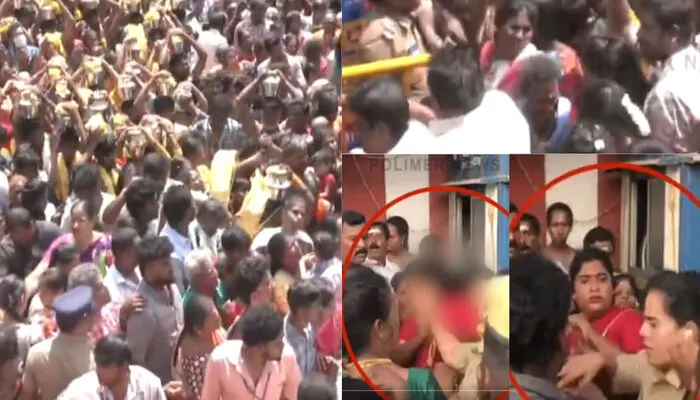
Case Summary
During the Thaipoosam festival in Tamil Nadu, Hindu devotees were manhandled and assaulted by police officers. Thaipoosam is one of the most important Hindu religious festivals celebrated in Tamil Nadu by devotees of Lord Murugan. On 11th February 2025, devotees visited various Murugan temples to observe the festival. They faced significant issues, including overcrowding and physical assault by the police and temple officials. Many of these temples were managed by the HR & CE department, an official government body. At the Kundrathur Murugan temple in Kanchipuram, devotees waited from 4 a.m. for darshan but endured severe hardship due to poor temple management. There was no drinking water available, and the overwhelming crowd led to chaotic conditions. A journalist covering the event had his identity card and mobile phone forcibly taken by temple staff. He faced threats from officials who were also photographing and intimidating those who questioned their actions. At the Siruvapuri Murugan temple, a few transgender devotees who attempted to enter via the VIP line were denied access, as that line was reserved exclusively for political VIPs on Thaipoosam. Police officers reportedly manhandled the transgender devotees, with one stating that she had recently undergone implant surgery yet was pushed, resulting in chest pain. A transgender woman said, “A lady officer came while this was happening and slapped me without any reason. However, news reports falsely stated that we were begging people for money, which was why the police slapped us. You can check the CCTV footage. If we stand in the regular queue, we face harassment from the general public, so we took the alternative queue. The male police officers pushed us and touched our chests. How can that be justified?” Other devotees stated that police officers manhandled and physically assaulted the crowd, including children. One devotee said, “A child was hurt, and no one attended to her. The police are failing in their duty. There are so many people here, and they are prioritising VIPs. When we questioned this, those who raised concerns were beaten. Meanwhile, at other locations, there were no police officers, yet huge crowds gathered. The police were all here attending to VIPs.” At Vadapalani Murugan Temple in Chennai, devotees faced hardships due to poor management by the HR & CE department. Women were seen fainting on the temple premises, and devotees were manhandled by officials. One devotee said, “Do they understand that it is a festival day? Shouldn’t appropriate safety measures be in place? The crowd is crushing an infant; an old person fainted due to the heat and crowd. There was no water or other facilities. There was no coordination. I don’t understand why this is happening. Everyone wants to have a peaceful darshan of the Lord. They could have installed barricades to ensure a single-file queue. Those paying to enter the temple received priority, while those in the free queue suffered, standing from 2 a.m. There were elderly people, women, and poor individuals. I urge the HR & CE department to take appropriate measures now before the crowd increases.” At Chennimalai Murugan Temple in Ottapparai, devotees faced challenges due to road construction near the temple, which caused significant inconvenience as that path was used to enter the temple.
Why it is Hate Crime ?
This case is being added to the tracker under the primary category- Restriction/ban on Hindu practices. Within this, the subcategory selected is- Administration restricting religious practice. In several cases, it is seen that the administration/state disallows a religious practice owing to prejudicial orders and concerns, targeted specifically against the Hindu community. Such restriction/prohibition would be considered documented as a hate crime because the orders are often a result of pressure by groups that harbour animosity towards Hinduism and Hindus. Often, the restriction by the authorities is driven by bias, hostility, or prejudice against the specific community being stopped from holding a religious practice, by pressure groups that harbour animosity towards Hindus, intrinsic to their faith. Since practices are intrinsic to the faith of the Hindus, such prejudicial restriction is considered a curtailing of the fundamental rights of the Hindu community. In several cases, for example, the authorities ban a Hindu religious practice due to pressure from groups opposed to the religion. In other instances the prohibition is selectively enforced against one religious group (Hindus) while others are allowed to proceed. There are still other cases where the authorities preemptively restrict a religious practice by Hindus because those who hold animosity towards Hindus may get “provoked” leading to them being violent, thereby assuaging the sentiments of those who hold animosity towards Hindus by curtailing the religious rights of Hindus. Such acts and orders are prejudiced, indicating discriminatory motives owing to the capitulation to groups that harbour animosity towards Hindus and therefore, would be categorized as a religiously motivated hate crime since the original pressure leading to the order itself is a result of hatred/bias/prejudice/religious hate against Hindus. Another subcategory selected is- Attack not resulting in death. Within this, the subcategory selected is- Attack against Hindu devotees. Hindu devotees are a few of the easiest targets of religiously motivated hate crimes because during the festival/procession/puja etc, for non-Hindus it is easy to profile their victims on the basis of religion. Hindu devotees come under attack on several occasions by individual non-Hindus or mobs of non-Hindus owing to their animosity against Hinduism, its symbols and tradition/practices. There are several instances of Hindu devotees being attacked while they worship in temples or temporary religious structures, during religious processions, doing bhajan/kirtan/puja in their own homes, in the residential society etc. These attacks are perpetrated by non-Hindus primarily because of their animosity towards Hindus and their faith. In some cases, the trigger for the violence may be non-religious, however, there are two elements that make these hate crimes. First, the Hindus who come under attack are attacked violently while indulging in religious activity. Whether they are in a place of worship or not is immaterial to the crime. When individuals are attacked while indulging in religious practices, the attack in itself is a hindrance to their freedom to practice religion and therefore constitutes a hate crime. Secondly, religious supremacist doctrines and ideologies deem religious practices of Hindus to be offensive ab initio since they are considered “sinful” by these ideologies, worthy to be annihilated by force or coercion. Driven by these religious supremacist ideologies and doctrines, the attacks against Hindu devotees stem from intrinsic animosity towards Hinduism. In some cases, the trigger for the violence may be non-religious, however, it develops into a religiously motivated crime during the course of the violence. Since these attacks stem from animosity towards Hindus and Hinduism, they are considered religiously motivated hate crimes under this category. In this case, it is first important to note that the Hindu temples in Tamil Nadu are controlled under the Hindu Religious and Charitable Endowments (HR & CE) Department, which is an official government body responsible for managing temple administration. This department, along with temple officials, controls the operations of many temples and their rituals. In this case, the HR & CE department officials, together with police officers, mistreated and manhandled Hindu devotees during the Thaipoosam festival. This abuse of power highlights the role of the state machinery in disrupting Hindu religious practices and causing distress to the worshippers, making it a hate crime targeting Hindus and their sacred festivals. There are several previous instances where the administration restricted the religious practices of Hindus by mismanaging temple crowds, denying access, and forcibly intervening in the temple rituals and queues. The physical assault on Hindu devotees by police officers, including the mistreatment of senior citizens, women, and even children, constitutes a gross violation of their fundamental right to religious practice. Moreover, the assault and inappropriate touching of transgender devotees further reveal a pattern of discrimination and religious animosity by the authorities. This targeted mistreatment, along with the disruption of religious observance and the heavy-handed policing and assault of devotees, demonstrates clear religious animosity towards Hindus and their faith. Hindu festivals are sacred and highly held in reverence; any attempt to disrupt them showcases deep-seated animosity towards the Hindu community. Therefore, the actions of the HR & CE officials and police officers constitute a hate crime, motivated by hostility towards the Hindu community and their faith. Given that this case meets the parameters of a hate crime, it is being added to the hate crime database.


Case Status
Unknown


Perpetrators Details
Perpetrators
State and Establishment
Perpetrators Range
Unknown
Perpetrators Gender
unknown
 Sources




