Students suspended by missionary school for chanting "Jai Shri Ram"
 Jhansi, Uttar Pradesh, India
  30 November, 2023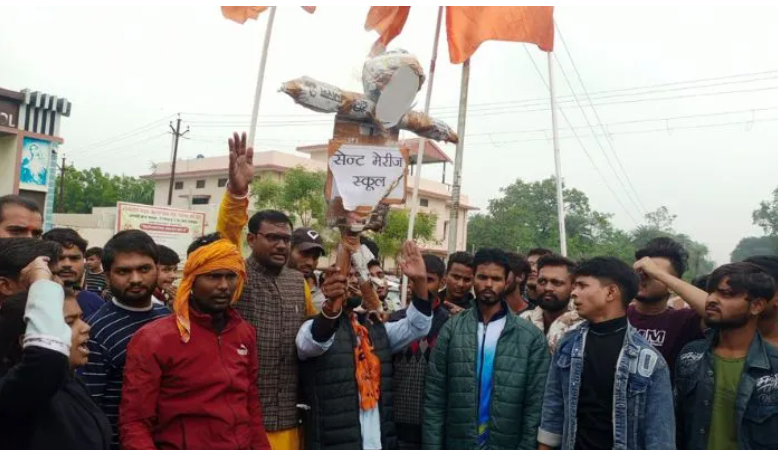
Case Summary
St. Mary Missionary School in Mauranipur town, Jhansi district, Uttar Pradesh, suspended four students for uttering "Jai Shri Ram" on the school premises. During an assignment where students were tasked with writing essays on topics of their choice, three boys and one girl chose to write about the construction of the Ram Mandir in Ayodhya. They recited their essays, concluding with the sacred chant "Jai Shri Ram," during the school prayer. Upon hearing the Hindu religious slogan, the school administration decided to suspend the students for a duration of 8 days and contacted their parents. The four students were also forced to submit a written apology, vowing to never chant "Jai Shri Ram" within the school premises. Following the news of the suspension, members of Akhil Bharatiya Vidyarthi Parishad (ABVP) and other Hindu organisations staged a protest outside the school. They raised chants of “Jai Shri Ram,” burned an effigy of the principal, and demanded that the suspensions be revoked. To pacify the situation, Mauranipur tehsildar Madan Mohan Gupta and a police team led by Laxmikant Gautam arrived at the school. Authorities deployed additional police personnel to prevent any law and order disruptions. Gupta confirmed that a committee was formed to investigate the incident and take appropriate action. Meanwhile, the school administration denied all allegations in writing.
Why it is Hate Crime ?
As per case specifics, it has been placed under the sub-category- 'Restriction on expression of Hindu identity', under the prime category- 'Restriction/ban on Hindu practices' of the hate tracker. An example of the state-affected prejudicial and targeted orders against the Hindu community would be a government denying the right of a Hindu or a group of Hindus to hold a religious procession owing to the animosity of non-Hindu groups. Denial of the religious right of the Hindus to assuage the non-Hindu group which harbours animosity to a point where it could lead to violence against Hindus is not only a failure of law and order but is a prejudicial order against Hindus, denying them their fundamental rights to express their religious identity. An example of a hate crime against Hindus by a non-Hindu would be a non-Hindu institution forcing its Hindu employees to abandon religious symbols that a Hindu would wear as an expression of faith owing to inherent prejudice against the faith professed by the victim or a non-Hindu group of people restricting a Hindu group from constructing a place of worship simply because the demography of the area in which the temple is being built is dominated by non-Hindus. Such actions are driven by religious animosity and/or prejudice against Hindus and their faith and would therefore be categorized as a hate crime. In this case, the Hindu students were suspended by a Christian Missionary-run convent school for chanting the 'Jai Shri Ram' slogan. "Jai Shri Ram" is a religious chant that is widely used in Hinduism as an expression of devotion to Lord Rama. Chanting this phrase is a form of religious expression, and penalizing someone for it could be seen as infringing on their right to religious freedom. Further, restricting someone from chanting a Hindu religious slogan can also be considered a prejudicial order denying the Hindu community its fundamental rights. Since the arbitrary action taken against the Hindu students was prejudicial to the rights of Hindus and stems from animosity and prejudice against Hindu beliefs, this case is being categorised as a religiously motivated hate crime. Another primary category that this case is being added to is 'Predatory Proselytisation' under the sub-category 'Proselytisation by brainwashing, grooming, manipulation or subtle indoctrination'. Religious brainwashing essentially means the often subtle and forcible indoctrination to induce someone to give up their religious beliefs to accept contrasting regimented ideas. Religious grooming or brainwashing also involves propaganda and manipulation. It involves the systematic effort, driven by religious malice and indoctrination, to persuade “non-believers’ to accept allegiance, command, or doctrine to and of a contrasting faith. Cases of such grooming or brainwashing are far more nuanced than direct threats, coercion, inducement and violence. In such cases, it is often seen that there is repeated, subtle and continual manipulation of the victim to induce disaffection towards their own faith and acceptance of the contrasting faith of the perpetrator. While subtle indoctrination is widely acknowledged as predatory, an element which is often understated in such conversions or the attempts of such conversion is the role of loyalty and trust which might develop between the perpetrator and the victim. Fiduciary relationships are often abused to affect such religious conversion. For example, an educator transmitting religious doctrine of a competing faith to a Hindu student. The Hindu student is likely to accept what the teacher is transmitting owing to existence of the fiduciary relationship. The exploitation of the fiduciary relationship to religiously indoctrinate victims would also be included in this category. Since the underlying animosity towards the victim’s faith forms the basis of predatory proselytization, such cases are considered religiously motivated hate crimes. The case reveals that the Hindu victims were minors, indicating a lack of consent and genuine change of conscience. It is a well-established fact that children are more susceptible to manipulation since they are still developing emotionally, cognitively, and socially. Their brains are not fully matured, making them more vulnerable to influence and less capable of critically evaluating information. Moreover, subtle manipulation tactics can be difficult to detect, especially when employed by trusted authority figures in positions of influence. This makes it challenging for parents, to identify and address instances of religious manipulation in schools. In this case, the accused, teachers in a position of trust, demonstrated a clear animosity towards Hinduism by suspending students for chanting Jai Shri Ram - a manifestation and expression of their faith. The teachers essentially covertly tried to push the children towards Christianity by distancing them from their religion and practices. This sort of harassment is rooted in animosity towards the victim’s religious identity and is therefore documented as a religiously motivated hate crime in this Hindu hate tracker.
Victim Details
Total Victim
4
Deceased
0
Gender
- Male 3
- Female 1
- Third Gender 0
- Unknown 0
Caste
- SC/ST 0
- OBC 0
- General 0
- Unknown 4
Age Group
- Minor 4
- Adult 0
- Senior Citizen 0
- Unknown 0


Case Status
Unknown


Perpetrators Details
Perpetrators
Christian Extremists
Perpetrators Range
N/A
Perpetrators Gender
unknown
 Sources




