Malayalam actors Sumi Rashik and Vishnu K Vijayan post Eid special music video glorifying conversion of Hindu woman by their Muslims partners, netizens attack
 Kerala, India
  21 April, 2023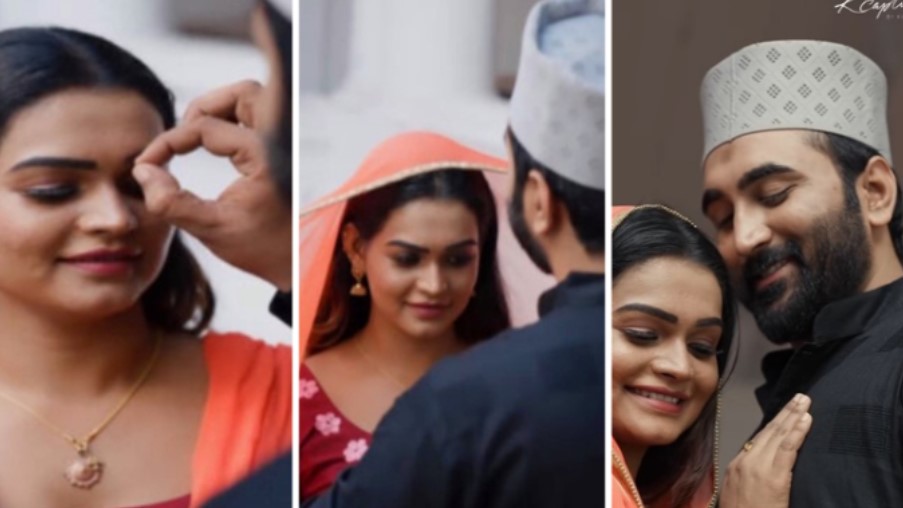
Case Summary
On the occasion of Eid-ul-Fitr, Malayalam actors Sumi Rashik and Vishnu K Vijayan took to Instagram to share a music video by Juneberry Bridal Makeover and shot by Kcaptures to extend Ramzan wishes to their fans. Netizens were outraged at how the music video not only normalised but also encouraged the conversion of Hindu women to Islam by Muslim men in the name of love. In the first scene of the video, Vishnu K Vijayan is seen wearing a black kurta pyjama and Kufi (an Islamic prayer cap), and performing Namaz. The girl, dressed in a red and yellow South Indian style lehnga choli peeps into the room. For the next few seconds, the duo are shown romancing each other. In the next scene, the Hindu girl approaches her Muslim boyfriend in the Salwar Kameez outfit he gifted her. The man drapes the girl’s dupatta on her head like a veil and removes the bindi the girl wears on her forehead. “Love sees no religion yet a religious boy has to convert the girl before accepting her.” tweeted popular X user The Hawk Eye. While there is nothing wrong with two adults from different religions falling in love, the fact that the Hindu girl is transformed into a Muslim girl by her Muslim lover who removes her bindi and puts a hijab on her presents a problematic depiction. The original post was taken down after backlash.
Why it is Hate Crime ?
This case has been added to the hate tracker under the prime category of 'Hate speech against Hindus'. Under this, the sub-category selected is- Denial or mocking of historical genocide- Denial or mocking of historical genocide refers to the act of denying or minimizing the historical fact of the ethnic cleansing and/or genocide and/or historical religious persecution of Hindus. This often involves denying the scale, mechanisms, religious intent, or even the occurrence of the ethnic cleansing and/or genocide and/or historical religious persecution of Hindus. Hate speech of this kind involves the dissemination of falsehoods that deny or distort established historical facts or mock the suffering of Hindus by saying that they deserved the persecution, motivated by Hinduphobia. Denying such atrocities is not only about the denial of historical facts or rewriting/revising history, but it also delegitimises the religiously motivated persecution of Hindus, the religious hate/motivation/animosity that led to the persecution, and dehumanises Hindus as a religious group. Such denial of historical ethnic cleansing and/or genocide and/or historical religious persecution of Hindus not only denies the suffering but also paves the way for future/present atrocities and hate speech, inciting prejudice and violence against Hindus. It also provides a justification for violence by delinking religious animosity from historical religiously motivated crimes committed against Hindus. Since such denial and/or mocking of historical genocide/ethnic cleansing/atrocities motivated by religious animosity leads to present and future ramifications of creating more hate speech, violence, dehumanisation and delegitimisation, it would be considered hate speech under this category. The Eid special music video posted by Malayalam actors Sumi Rashik and Vishnu K Vijayan, which glorified the religious conversion of Hindu women by their Muslim partners, can be seen as an act of denying the historical context of religious persecution and forced conversions that Hindu women have endured. Love Jihad or Grooming Jihad, as OpIndia likes to call it, is a phenomenon in which Muslim men prey on helpless Hindu women, entice and deceive them, convert them to Islam against their will, torture and rape them, and then either kill or leave them. By romanticising such conversions, the video disregards the painful history of forced religious conversion, abduction, and violence faced by Hindu women during periods of Islamic invasion and rule. This act trivializes the collective trauma and struggles that Hindu women have faced throughout history, including during the Mughal era and even in modern times. Such portrayals are not just insensitive but are rooted in an animosity that undermines the significance of historical genocide and erases the suffering that Hindu women endured under religious oppression. As a result, this case has been documented in this hate tracker.


Case Status
Unknown


Perpetrators Details
Perpetrators
Others
Perpetrators Range
N/A
Perpetrators Gender
both
 Sources




