Hindu devotees targeted during Navratri: Muslim mob hurl pieces of meat at religious procession
 Delhi, Delhi, India
  2 October, 2024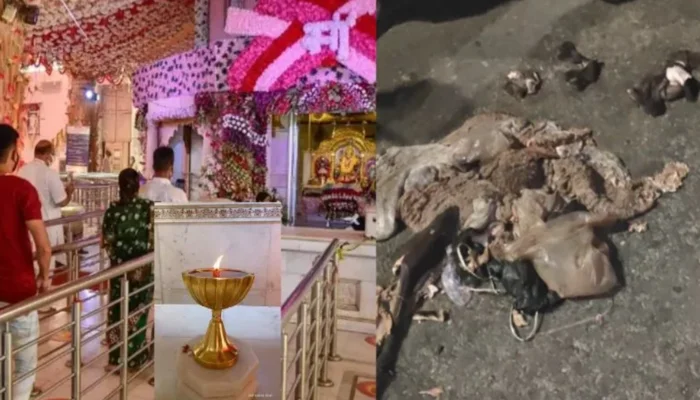
Case Summary
In Delhi’s Tees Hazari area, Hindu devotees participating in a religious procession were targeted by Muslims who hurled pieces of meat at them in a deliberate attempt to desecrate the religious event. According to reports, the incident happened on October 3, 2024. The Hindu devotees were carrying the sacred 'Jyoti' from the revered Jhandewala Devi Mandir as part of the annual religious tradition. As the devotees were returning home with the Jyoti, they were targeted by a group of Islamists who desecrated the procession by throwing meat pieces directly on the sacred flame. This has been a long-standing tradition during the sacred festival of Navratri in Delhi. Devotees visit temples to worship the sacred Jyoti, a manifestation of Devi Maa. After offering prayers, they bring the sacred Jyoti back to their homes or villages in an attempt to portray their devotion. This act was seen not just as a disruption of a peaceful religious practice, but as a deliberate attempt to insult and provoke Hindu devotees. It caused outrage among the Hindu community, and they demanded stronger protection of Hindu practices and accountability from those attempting to incite communal tensions through such provocations.
Why it is Hate Crime ?
This case has been added to the tracker under the primary category of: - Attack on Hindu religious representations. Within it, the sub-category selected is: - Defiling religious customs. Sanatan Dharma is not a religion of one book, which is to say that while it has religious scriptures that form the central tenets of the faith, there are several traditions followed through thousands of years, mostly passed from generation to generation orally. There are several such customs and traditions that are followed by various Hindus and Hindu sects. Defiling of these traditions and customs is a breach of an individual or group’s religious practices. Such practices can range from dietary restrictions like not eating non-vegetarian food for a certain period of the year, not eating non-vegetarian food at all, not eating beef since the cow is considered holy in Hinduism, the sanctity of religious customs followed in the house (like many ISCKON devotees), etc. Any malicious action leading to the breach of such traditions or defilement of these traditions owing to animosity towards the faith or for the sake of activism stems not only from the lack of faith in the religion itself but also from disregard for the faith of the devotees who follow the customs/traditions and implicit bias against the faith, the tradition itself. Since these specific traditions are central to the faith of the devotees of that specific sect of Hindus, any non-compliance with these traditional rules would be considered a religiously motivated hate crime. The other sub-category relevant here is: - Desecration of Hindu religious symbol. Icons and symbols or a religious representation of a spiritual ideal are widely revered in Hinduism. Iconography is of vital significance in the Hindu milieu. It helps connect people’s spiritual beliefs with the real world. Iconography within the Hindu faith takes several shapes and forms. Murtis are of most significance to Hindus, to which daily rituals, prayers and offerings are done. Besides the murtis, there are several other symbols which have deep significance in the Hindu faith – the Om and Swastika for example. Since these Hindu religious symbols hold paramount importance in Hinduism, any desecration of symbols, icons, murtis, religious representations and manifestations, is driven by animosity towards the faith itself which manifests itself through these murtis, icons and symbols. Therefore, any desecration of these Hindu religious symbols and representations is considered religiously motivated hate crimes under this category. The second primary category relevant here is- Attack not resulting in death and within this, the first sub-category selected is- Attack on religious procession. The outward celebration and display of religious symbols in an intrinsic part of Hinduism. Religious processions on various festivals are age-old traditions and a way to manifest faith and form a part of the religious practices of Hindus. On several occasions, such religious processions come under attack by non-Hindu mobs, in a manifestation of their animosity towards Hinduism and their practices. The reasons cited for such violent attacks are many and range from crossing a non-Hindu resident-dominated area to playing loud music, crossing from an area where there is a religious structure of another faith etc. The violent attacks are triggered by the outward display of religiosity by Hindus. The attacks are mainly a manifestation of religious supremacist doctrine which believes that idolatry, essentially the Hindu faith, is one that deserves to be annihilated since the very tenets of Hinduism, its practices and traditions are considered a sin in those doctrines. Since these attacks emanate from intrinsic and doctrinal animosity towards Hindus and Hinduism, it is considered a religiously motivated hate crime under this category. The second sub-category within the above stated primary category is- Attack against Hindu devotees. Hindu devotees are a few of the easiest targets of religiously motivated hate crimes because during the festival/procession/puja etc, for non-Hindus it is easy to profile their victims on the basis of religion. Hindu devotees come under attack on several occasions by individual non-Hindus or mobs of non-Hindus owing to their animosity against Hinduism, its symbols and tradition/practices. There are several instances of Hindu devotees being attacked while they worship in temples or temporary religious structures, during religious processions, doing bhajan/kirtan/puja in their own homes, in the residential society etc. These attacks are perpetrated by non-Hindus primarily because of their animosity towards Hindus and their faith. In some cases, the trigger for the violence may be non-religious, however, there are two elements that make these hate crimes. First, the Hindus who come under attack are attacked violently while indulging in religious activity. Whether they are in a place of worship or not is immaterial to the crime. When individuals are attacked while indulging in religious practices, the attack in itself is a hindrance to their freedom to practice religion and therefore constitutes a hate crime. Secondly, religious supremacist doctrines and ideologies deem religious practices of Hindus to be offensive ab initio since they are considered “sinful” by these ideologies, worthy to be annihilated by force or coercion. Driven by these religious supremacist ideologies and doctrines, the attacks against Hindu devotees stem from intrinsic animosity towards Hinduism. In some cases, the trigger for the violence may be non-religious, however, it develops into a religiously motivated crime during the course of the violence. Since these attacks stem from animosity towards Hindus and Hinduism, they are considered religiously motivated hate crimes under this category. This case has been added to the tracker because pieces of meat were thrown at the Hindu religious procession by Muslim individuals in a deliberate attempt to defile the sacred Hindu tradition and provoke the Hindu devotees. It was a deliberate act and a targeted attempt to desecrate a deeply revered practice that holds immense spiritual value in Hinduism. The Jyoti, carried with devotion during Navratri, holds profound spiritual significance as it's a manifestation of Devi Maa and represents purity, divine light, and inner spiritual strength. Thus, the deliberate throwing of meat on the sacred Jyoti is a blatant act of desecration, meant to provoke Hindus and mock their age-old customs. It reflects a deep-rooted animosity that Muslims have towards the Hindu faith and its religious and spiritual practices. Desecrating the Jyoti, which is considered a living representation of the goddess, is no different from defiling a Murti and should be treated with the same seriousness. It is a symbolic hate crime intended to humiliate, demean and challenge the Hindu community. This was not a random or misguided act, but a calculated and ideologically rooted expression of religious hatred. In Islamic theology, idol worship, referred to as Shirk, is regarded as the gravest sin. The Qur'an strictly condemns it, and Islamic teachings emphasise the complete rejection of any practice associated with idol worship. Muslims are taught from a young age that idolatry is an unforgivable sin. While this belief is central to Islamic faith, it has also led, historically and in contemporary times, to intolerance and hostility towards idol-worshipping religions, especially Hinduism. When individuals publicly mock Hindu deities, it reflects more than personal disrespect—it is often the manifestation of deep-seated theological contempt against Hindu practices, stemming from the Islamic doctrinal view that idol worship is impure and offensive. Such actions target the identity, beliefs, and dignity of Hindus. Mockery of deities is a deliberate attack on the religious sentiments of the Hindus that stem from the intrinsic animosity against the religion. Further, the fact that this incident happened during Navratri, a sacred time for fasting, prayer and devotion, only underscores the malicious intent behind the act. It was not just an insult to their faith but an attack on their fundamental right to religious expression. They reveal a larger pattern of organised hostility against Hindus, where sacred symbols, rituals and spaces are intentionally targeted to instil fear, provoke outrage, and challenge the very existence of Sanatan Dharma in the public sphere. This is why this incident warrants inclusion in the Hinduphobia Tracker.


Case Status
Unknown


Perpetrators Details
Perpetrators
Muslim Extremists
Perpetrators Range
Unknown
Perpetrators Gender
unknown
 Sources




