Hindu family lured with inducements, physically assaulted for resisting conversion by Christian missionaries
 Burhanpur, Madhya Pradesh, India
  20 June, 2025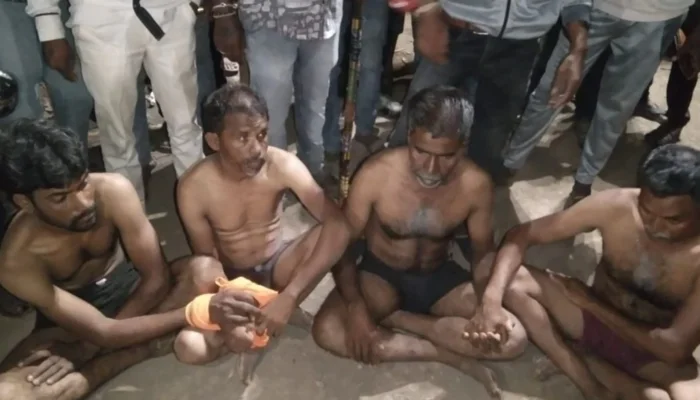
Case Summary
In Haidarpur village of Burhanpur district, Madhya Pradesh, a tribal Hindu family was lured for conversion on the pretext of medical treatment by Christian missionaries. They were also offered inducements such as free housing, education, and monthly financial assistance in order to convert. They were physically assaulted when they resisted the conversion attempt. According to the complaint filed by the victim, Baliram Bardole and his wife Anita have been moving through various villages, preaching Christianity for some time. Anil, a resident of Haidarpur, stated that his wife, Radha, was seriously ill. Christian missionaries, including Baliram Bardole and Anita, manipulated him by claiming they could cure her. Convinced by their words, Anil, along with his friend and cousin, took Radha to Baliram’s house. There, the accused began chanting mantras for healing and pressured the family to convert to Christianity by offering material benefits. The accused told them that if they converted to Christianity, the family would receive monthly financial support, assistance to build a house, and free education for their children. Anil opposed the conversion attempt and said that they were misleading innocent tribals and using deceit to convert them. When Radha's condition showed no improvement, Anil tried to take his wife back home, at which point the accused became angry and physically assaulted them. Furthermore, when Anil's friend and cousin tried to intervene, they were also physically assaulted. The next morning, Anil reported the incident to the police and filed a formal complaint. As of the date of writing this report, six people — Baliram, Anita, Gana, Vilas Pit Gasla, Say Singh, and Kala Bai — had been arrested by the police under the Madhya Pradesh Religious Freedom Act, 2021, along with other relevant sections of the Bharatiya Nyaya Sanhita (BNS). The investigation was underway.
Why it is Hate Crime ?
This case has been added to the tracker under the primary category of: - Predatory Proselytisation. Within it, the sub-category selected is: - Conversion/ attempts to convert by inducement. Predatory Proselytisation is not just limited to threat, harassment, force and violence, but it also has contours of stealth. In several cases, the Hindu victim is exploited to convert, with non-Hindus taking advantage of their poverty. In such cases, the Hindu victim who is suffering financially is offered monetary benefits, including lucrative offers for jobs, health treatment, education, etc, to induce the victim into changing his/her religion. In such cases, the religious identity of the victim and the aim to disenfranchise him from his faith form the heart of the crime. Also, taking advantage of and exploiting an individual’s economic vulnerabilities is widely acknowledged as exploitation, forms of which are often penalised by law. Such cases therefore are considered religiously motivated hate crimes since the victim’s religious identity forms the very heart of the crime itself. The second sub-category selected is: - Harassment, threats, coercion for conversion. Harassment covers a wide range of behaviours of an offensive nature. It is commonly understood as behaviour that demeans, humiliates, and intimidates a person, including threats and coercion. Harassment and threats, in this case, find their root on discriminatory grounds which has the effect of nullifying a person’s rights or infringing upon his freedom to exercise his right specifically owing to the victim’s religious identity. Verbal and physical threats and psychological or physical harassment are often used against Hindu victims because they choose to practice their professed religion. Religious harassment also includes forced and involuntary conversions by harassment, threats or coercion. Coercion includes intimidatory tactics like force-feeding a Hindu victim beef to convert to another religion, forceful circumcision etc. In several cases documented, non-Hindu perpetrators or those who harbour specific animosity towards Hinduism, harass victims simply based on their religious identity. Such cases often also include harassment to ensure the Hindu victim abandons his/her professed religion and adopts the religion of the perpetrator. Such cases where Hindu victims are harassed to convert to the perpetrator’s religion are rooted in animosity towards the victim’s religious identity and are therefore documented as religiously motivated hate crimes. The third sub-category relevant here is - Proselytisation by grooming, brainwashing, manipulation or subtle indoctrination, with the tertiary category being: - Pattern of targeting Hindus. Religious brainwashing essentially means the often subtle and forcible indoctrination to induce someone to give up their religious beliefs to accept contrasting regimented ideas. Religious grooming or brainwashing also involves propaganda and manipulation. It involves the systematic effort, driven by religious malice and indoctrination, to persuade “non-believers’ to accept allegiance, command, or doctrine to and of a contrasting faith. Cases of such grooming or brainwashing are far more nuanced than direct threats, coercion, inducement and violence. In such cases, it is often seen that there is repeated, subtle and continual manipulation of the victim to induce disaffection towards their own faith and acceptance of the contrasting faith of the perpetrator. While subtle indoctrination is widely acknowledged as predatory, an element which is often understated in such conversions or the attempts of such conversion is the role of loyalty and trust which might develop between the perpetrator and the victim. Fiduciary relationships are often abused to affect such religious conversion. For example, an educator transmitting religious doctrine of a competing faith to a Hindu student. The Hindu student is likely to accept what the teacher is transmitting owing to existence of the fiduciary relationship. The exploitation of the fiduciary relationship to religiously indoctrinate victims would also be included in this category. Since the underlying animosity towards the victim’s faith forms the basis of predatory proselytization, such cases are considered religiously motivated hate crimes. The second primary category selected here is: - Attack not resulting in death. Within it, the sub-category selected is: - Attacked for opposing radicals or trying to save victim. In several cases, Hindus are attacked for opposing religiously motivated crimes being committed against a fellow Hindu or simply for voicing an opinion opposing radical elements, who either have in the past or continue to persecute Hindus. In such cases, the initial attack against the victim, against which the Hindu was trying to defend the victim, would also need to be classified as a religiously motivated hate crime. Since the initial crime itself was religiously motivated and the subsequent crime of attempting to save the victim or speaking against the radical elements ends up inviting a violent attack, it would also be classified as a religiously motivated hate crime under this category. This case has been added to the tracker because a Hindu family was lured, deceived and offered inducements such as money, education, housing, and other benefits by Christian missionaries to facilitate conversion. The missionaries focused their efforts on Hindus who were poor and economically backwards by offering inducements to facilitate conversion to Christianity. Such acts exploit the economic and social vulnerabilities of individuals as a means to draw them away from their religious identity. Offering incentives to encourage conversion, particularly when directed at individuals who are vulnerable or in need, shows that these incentives are not acts of kindness or charity. Instead, they are calculated moves to exploit vulnerable Hindus because of their religion. By providing inducements to Hindus to change their faith, the accused were effectively blackmailing those who might have been desperate for assistance. Such instances are seen in many cases where members of Christian missionary groups target socially and economically vulnerable Hindus to further their agenda of religious conversions. This form of coercion strips people of their agency and dignity and enforces forced conversions. These are not random or isolated incidents, but rather cases deeply rooted in religious animosity towards Hindu victims. The targeting of Hindus under the guise of spiritual healing or chanting of mantras is usually driven by religious animosity and aimed at brainwashing Hindus into converting to Christianity. These healing practices have no scientific basis, thus resulting in no improvement in the patient's health. These so-called spiritual healing sessions frequently serve as the first step in the process of conversion and act as a soft entry point for ideological indoctrination. In this case, the family was emotionally manipulated into believing that chanting Christian prayers would cure the wife’s illness. The second step in the process of proselytisation was the promise of material benefits, including financial support, housing, and education. When both emotional manipulation and material promises failed to result in conversion, they resorted to physical violence, which was the final step in predatory proselytisation. This escalation from subtle psychological manipulation to outright violence reflects a structured and phased approach often used in predatory proselytisation. The Christian faith, by its very theological foundations, places a strong emphasis on proselytisation. In pursuit of conversion objectives, Christian evangelists often employ unethical means, ranging from psychological pressure and misinformation to inducements such as money or jobs. These tactics are designed not as acts of charity but as tools to engineer religious change under the guise of social upliftment, particularly among vulnerable and underprivileged communities. The recurring pattern of targeting Hindus under such pretences is what classifies this case as a religiously motivated hate crime, driven by antagonism towards a Hindu religious identity.
Victim Details
Total Victim
4
Deceased
0
Gender
- Male 3
- Female 1
- Third Gender 0
- Unknown 0
Caste
- SC/ST 4
- OBC 0
- General 0
- Unknown 0
Age Group
- Minor 0
- Adult 4
- Senior Citizen 0
- Unknown 0


Case Status
Arrested


Perpetrators Details
Perpetrators
Christian Extremists
Perpetrators Range
From 5 to 10
Perpetrators Gender
both
 Sources




