Hindu men targeted in Bareilly by self-declared Muslim vigilante group Haidari Dal for associating with Muslim women
 Bareilly, Uttar Pradesh, India
  8 June, 2025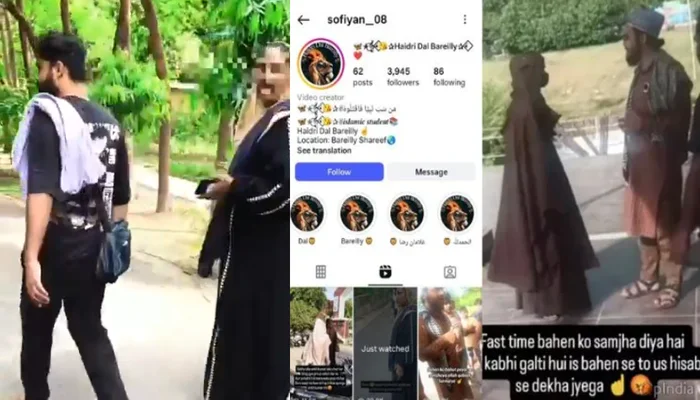
Case Summary
In Uttar Pradesh's Bareilly district, various Hindu men in consensual interfaith relationships with a Muslim woman have been harassed by a group known as the Haidari Dal, consisting of Muslim individuals, who engage in moral policing against interfaith couples involving Muslim women and non-Muslim men, mostly Hindus. In a video that surfaced on June 7 2025, the day of Bakrid, a group of youths belonging to the Haidari Dal was seen confronting a Hindu youth in Bareilly's Gandhi Udyan (park). They were seen questioning young women from a specific community who were sitting with men from another community, asking them their names, religion, and addresses in a manner meant to shame and intimidate them. The members of this Muslim gang shot a video zooming in on a Hindu boy’s tilak in an attempt to incite communal hatred and vilify him for merely being in the presence of a Muslim woman. The video was later uploaded on Instagram, where it quickly went viral. According to the reports, this group, Haidari Dal, has been engaged in systematic harassment of interfaith couples, especially Hindu men with Muslim women. Whenever they see a Muslim woman in the company of a non-Muslim man, even in a friendly or non-romantic relationship, they start recording videos of them without their consent, interrogate them, harass them, and shame them through social media. In some videos, they can be seen asking a Muslim woman's personal details in an attempt to dox her and intimidate the couple. Dozens of such videos have been uploaded from an Instagram ID, sofiyan_08, which is linked to the group, spreading the harassment campaign further. The videos often include threatening language such as “we will not let the honour of the hijab be auctioned,” as if having a consensual relationship with a Hindu man is blasphemous. As of the date of writing this report, Himanshu Patel, leader of a local Hindu organisation, filed a complaint against this group. The police registered a case at the Kotwali police station under BNS 196 (promoting enmity between different groups), and launched an investigation and on June 8. Two accused, Shahbaz Raza alias Sufiyan, a resident of Mallpur Bhuta, and Sameer Raza, were arrested and sent to jail. However, other suspects, including Mufti Khalid (a resident of Puranpur) and Riyazuddin (a resident of Majhua under Faridpur police station), remain absconding. Police said their teams are actively conducting raids to trace and arrest them. Meanwhile, authorities are also investigating the sources of financial support to Haidari Dal and identifying those who may have contributed funds to the organisation.
Why it is Hate Crime ?
This case has been added to the tracker under the primary category of: - Men attacked for being associated with non-Hindu women. Within it, the sub-category selected is: - Attacked/killed for being associated or suspicion of being associated with Muslim woman. There have been several cases documented of Hindu men/boys being attacked specifically by Muslim groups/mobs for merely being associated or suspicion of being associated or being seen with a Muslim woman in public. In most of such cases, the Hindu man is not in a relationship with the Muslim woman, however, the mob proceeds to threaten and/or assault the Hindu man for merely being associated with the Muslim woman in any capacity. The rise of such crimes stems from a particularly sinister campaign run by several Muslim ideologues and activists. The campaign claims that Hindu men are attempting to ‘lure’ Muslim women into relationships to ensure that Muslim women leave their faith and follow Hinduism. The propaganda has been spearheaded with the help of WhatsApp groups and the extensive use of social media, sans evidence of the same. In many cases, pamphlets were fabricated to lend credence to this campaign. The root of this campaign lies in the fact that several cases of sectarian crimes against Hindu women in relationships with Muslim men have been documented. In such cases, Hindu women have often been forced/pressured to convert to Islam, assaulted, threatened and even murdered owing specifically to their religious identity and their refusal to give up that religious identity to adopt Islam. To delegitimize the suffering of Hindu women when such sectarian crimes are committed against them, the theory of ‘Bhagwa Love Trap’ was floated by sections of the Muslim community. As this theory gained traction, Muslim mobs started targeting Hindu men who were seen with Muslim women. In several such cases, the Hindu man was assaulted merely for offering to drop a Muslim woman in his vehicle or being friends. The differentiating factor between such cases and legitimate cases of Hindu women being targeted while in a relationship with Muslim men is that there is no sectarian violence, and force/pressure to convert. The nature of sectarian violence against Hindu women is not about two adults in a consensual relationship, working together, studying together, or even marrying each other where religious considerations are declared. In this category of crimes, it is pertinent to remember that in none of the cases, there is an element of the Hindu man masking his identity or forced religious conversion. Such cases are driven by specific religious motivations and against the religious identity of the victim and are therefore qualified as hate crimes. This case has been added to the tracker because multiple Hindu men were targeted and harassed solely for being seen in the company of Muslim women by a group of Muslim men affiliated with the Haidari Dal. The incident was not triggered by any inappropriate behaviour or public misconduct but solely by the religious identities of the individuals involved. It is important to note that most of their victims were adults who were with each other out of their own free will. The Haidari Dal took offence at the fact that a Muslim girl, visibly wearing a burqa, was in the company of a Hindu boy, which they specifically highlighted by zooming in on the boy’s tilak. This was not a random act but a targeted attempt to incite communal hatred and was designed to dehumanise, vilify, and publicly shame him. By zooming in on the tilak, they intended to frame him as a part of a broader conspiracy of Bhagwa love trap and the group sought to portray him as a threat to Islam, using his religious symbols to justify public humiliation and targeting. Thus, the video and zooming on the tilak was weaponised to push this propaganda, portraying Hindu boys as conspirators, while completely ignoring the right of individuals to choose their friendships or relationships freely. This wasn’t about concern for the girl’s safety or consent, it was about enforcing religious control through fear and intimidation. The act of filming the incident, interrogating the couple, and uploading the video online was a deliberate effort to shame, threaten and send a message: that interfaith interaction, especially if it involves a Hindu man and Muslim woman, would not be tolerated. This was not an isolated act; there have been many such groups across different states involved in such activities. These are targeted acts driven by a deeply ingrained hostility toward the Hindu identity of the boy. The harassment is deliberate, unprovoked, and carried out with the intent to publicly enforce a discriminatory belief system that denies Hindu men the right to freely associate with Muslim women. The justification for such actions stems from the conspiracy theory of ‘Bhagwa Love Trap’, which is explicitly rooted in anti-Hindu sentiment. This false narrative vilifies Hindu men by portraying them as predators targeting Muslim women, despite no basis in reality. IIt is a dishonest Islamist counter to the international phenomenon of Grooming Jihad/Love Jihad, which is often weaponised to legitimise violence against Hindus, as seen in this case, where a group of Muslim men took it upon themselves to stop them in the middle of the road and threaten and assault them for simply being friends. Their actions underscore a discriminatory mindset that seeks to target individuals based solely on their religious affiliation, irrespective of the situation. Such incidents highlight the systematic and deliberate nature of religious intolerance, deeply rooted in hatred for Hindus and their faith. Considering these factors, the case has been categorised as a religiously motivated hate crime, driven by the perpetrators' hostility toward the Hindu community and its beliefs.


Case Status
Case sub-judice


Perpetrators Details
Perpetrators
Muslim Extremists
Perpetrators Range
N/A
Perpetrators Gender
male
 Sources




