Hindu devotees assaulted, sacred flag desecrated during religious gathering in Barabanki, UP
 Bara Banki, Uttar Pradesh, India
  19 May, 2025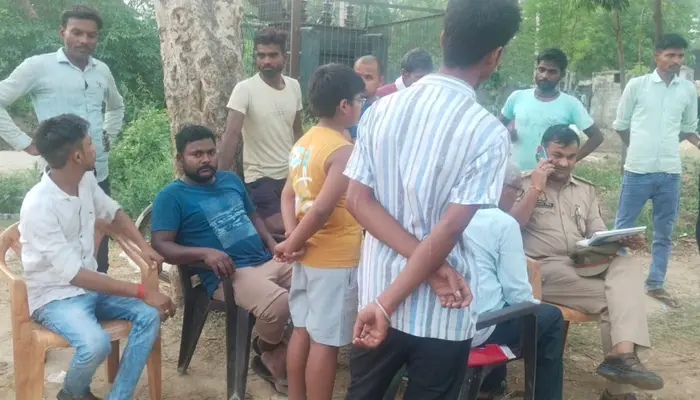
Case Summary
In Barabanki’s Safdarganj police station area, a Muslim woman vandalised a Hindu religious flag. The woman, with her family, also disrupted a community feast (Bhandara) organised by the Hindu villagers. Police arrived and brought the situation under control. The incident took place at the kutiya (hermitage) of Baba Prem Das, where Hindu villagers had organised prayers and the community feast. Devotees were actively preparing for the event when, at around 4 p.m., Rahmat Ali— an illegal occupant of land where the old, dilapidated kutiya had once stood—arrived at the site with his family, carrying sticks. According to villagers, Rahmat Ali and his wife aggressively intervened, and his wife tore down the religious flag installed at the event and began hurling verbal abuse. She also attacked devotees involved in the preparations. The act sparked confrontation, and members of both communities soon gathered at the site, leading to a tense face-off. Eyewitness Bablu, a local resident, stated that the clash began when Rahmat Ali's wife arrived just as the religious flag was being hoisted. She broke the flag and assaulted some of the attendees, which led to a heated exchange and physical altercations between the two sides. Upon receiving information, police from the Safdarganj station reached the site and calmed the situation. Officers intervened to prevent the incident from escalating further and ensured that the bhandara proceeded smoothly under their supervision. Station House Officer Arun Pratap Singh called the act of vandalism a minor dispute and claimed that it was resolved in time. He added that in light of the prevailing tension, a police force was deployed in the village as a precautionary measure to maintain peace and prevent any further disturbance. The event was eventually concluded peacefully in the presence of the police.
Why it is Hate Crime ?
This case has been added to the tracker un the primary category of - Attack on Hindu religious representations. The other sub-category selected is - Desecration of Hindu religious symbols. Icons and symbols or a religious representation of a spiritual ideal are widely revered in Hinduism. Iconography is of vital significance in the Hindu milieu. It helps connect people’s spiritual beliefs with the real world. Iconography within the Hindu faith takes several shapes and forms. Murtis are of most significance to Hindus, to which daily rituals, prayers and offerings are done. Besides the murtis, there are several other symbols which have deep significance in the Hindu faith – the Om and Swastika for example. Since these Hindu religious symbols hold paramount importance in Hinduism, any desecration of symbols, icons, murtis, religious representations and manifestations, is driven by animosity towards the faith itself which manifests itself through these murtis, icons and symbols. Therefore, any desecration of these Hindu religious symbols and representations is considered religiously motivated hate crimes under this category. The other primary category selected is - Attack resulting in death. The sub-category selected is - Communal clash/attack. Communal clash is a form of collective violence that involves clashes between groups belonging to different religious identities. For a communal clash between Hindus and non-Hindus to qualify as a religiously motivated hate crime, the trigger of the violence itself would have to be anti-Hindu in essence. For example, if there is a Hindu religious procession that comes under attack from a non-Hindu mob and after the initial attack, Hindus retaliate in self-defence, leading to a communal clash between the two religious communities. While at a later stage, both communities are involved in the clash/violence, the initial trigger of the violence was by the non-Hindu mob against the Hindus and therefore, it could safely be termed as an anti-Hindu violence. Further, the trigger would also have to be religiously motivated. In the cited example, the attack by the non-Hindu mob was against religious processions and therefore, can be concluded to be religiously motivated. In some cases, the trigger may be non-religious, however, it develops into religious violence against Hindus at a later stage. In such cases too, the foundational animosity towards Hindus becomes the motivating factor of the crime and therefore, it would be classified as a religiously motivated hate crime against Hindus under this category. The other sub-category selected is - Attack against Hindu devotees. Hindu devotees are a few of the easiest targets of religiously motivated hate crimes because during the festival/procession/puja etc, for non-Hindus it is easy to profile their victims on the basis of religion. Hindu devotees come under attack on several occasions by individual non-Hindus or mobs of non-Hindus owing to their animosity against Hinduism, its symbols and tradition/practices. There are several instances of Hindu devotees being attacked while they worship in temples or temporary religious structures, during religious processions, doing bhajan/kirtan/puja in their own homes, in the residential society etc. These attacks are perpetrated by non-Hindus primarily because of their animosity towards Hindus and their faith. In some cases, the trigger for the violence may be non-religious, however, there are two elements that make these hate crimes. First, the Hindus who come under attack are attacked violently while indulging in religious activity. Whether they are in a place of worship or not is immaterial to the crime. When individuals are attacked while indulging in religious practices, the attack in itself is a hindrance to their freedom to practice religion and therefore constitutes a hate crime. Secondly, religious supremacist doctrines and ideologies deem religious practices of Hindus to be offensive ab initio since they are considered “sinful” by these ideologies, worthy to be annihilated by force or coercion. Driven by these religious supremacist ideologies and doctrines, the attacks against Hindu devotees stem from intrinsic animosity towards Hinduism. In some cases, the trigger for the violence may be non-religious, however, it develops into a religiously motivated crime during the course of the violence. Since these attacks stem from animosity towards Hindus and Hinduism, they are considered religiously motivated hate crimes under this category. In this case, a religious flag was vandalised during a Hindu bhandara (community feast) directly constitutes an attack on Hindu religious symbols. In Hindu tradition, flags, murtis, and symbols such as the Om or Swastika are not merely decorative but are sacred manifestations of the divine. Vandalising such a symbol during a religious function is an intentional desecration and reflects hostility towards the religious sentiment and the faith itself. The individuals gathered as devotees and were engaged in the preparation and celebration of a religious ritual. They were attacked while engaged in this religious activity. The assailants, armed with sticks, targeted them precisely at the site of religious worship. According to eyewitnesses, verbal abuse and physical assault began when devotees opposed the desecration of the flag. The confrontation escalated only when the Hindu devotees tried to protect the sacred symbol and oppose the disruption. Hence, the attack was not just on the symbols or the event, but also on those who stood up against this act of religious desecration. There was no provocation from the devotees or the organisers of the event that justified the presence or aggression of the attackers. The sole “trigger” for the violence was the visibility of Hindu identity through the flag, the rituals, and the gathering. The woman and her family arrived with sticks at a Hindu event, broke a Hindu symbol, and began assaulting Hindus who were conducting prayers. Such behaviour demonstrates an underlying animosity directed not at individuals for personal reasons, but at people identified as Hindus because of their visible religious expression. It is important to mention here that there was no instigation or provocation on the part of the Hindu devotees. The only visible “trigger” was their open and collective expression of Hindu faith, marked by the rituals, religious symbols, and the gathering itself. The violence was initiated by the Muslim accused, and the Hindu side merely responded in self-defence after being attacked. While one might argue that the immediate cause was a land dispute, a recurring pattern is evident, where visible expressions of Hindu faith, such as organising religious events or displaying Hindu flags, are met with disproportionate and targeted violence from members of the Muslim community. In this instance, the Hindu religious gathering was perceived as provocative, triggering the violence. The assault on devotees, desecration of the religious flag, and disruption of the event represent not just a physical attack but a violation of the spiritual and cultural rights of Hindus. Such acts infringe upon their fundamental right to religious freedom, and therefore, this incident has been classified as a hate crime against Hindus.


Case Status
Complaint filed


Perpetrators Details
Perpetrators
Muslim Extremists
Perpetrators Range
Unknown
Perpetrators Gender
both
 Sources




