Hindu man arrested on allegation of 'blasphemy' by the Bangladesh police
 Sylhet Division, Bangladesh
  10 May, 2025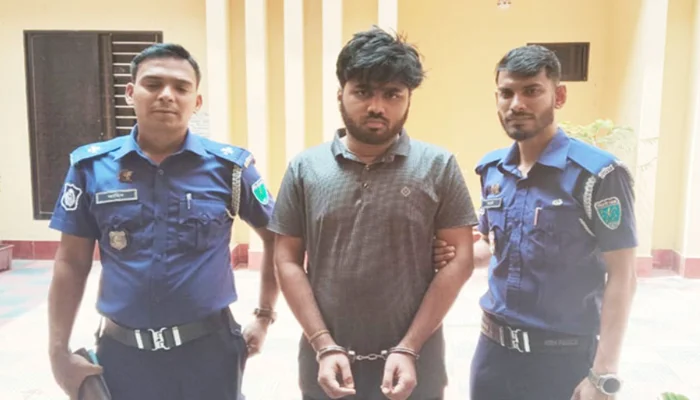
Case Summary
A 23-year-old Hindu boy named Bikash Dhar Deepto was arrested in Moulvibazar, Bangladesh, on allegations of making derogatory statements about Prophet Muhammad in a Facebook post. Bikash is a student of Economics at the Shahjalal University of Science and Technology. It is being claimed that he had made a Facebook post on 11th May in which he labelled Muslims as militants and insulted the Prophet. He has since apologised for the alleged post. This incident sparked widespread unrest in the area, leading to accusations of blasphemy against him. As of the date of writing this report, the police have arrested Bikash under Bangladesh's Cyber Security Act for allegedly hurting religious sentiments. The case was still under investigation. This case occurs amidst the strengthening of blasphemy laws in Bangladesh, which are increasingly being used to target its Hindu minorities. In November 2024, the Bangladesh High Court also recommended strengthening the Cyber Security Act to include life imprisonment and the death penalty for blasphemy cases, further creating an atmosphere of fear in the minorities of Bangladesh.
Why it is Hate Crime ?
This case has been added to the tracker under the primary category of: - Attack not resulting in death. Within it, the sub=category selected is: - Attacked over 'Blasphemy. Blasphemy essentially refers to the desecration of anything which is held sacred/holy to a group of people. However, for religious supremacist groups, the elements of ‘blasphemy’ are ever-changing, shifting and expanding – leading to infringement on the rights of other religious groups, freedom of speech and expression, threats and even physical violence. There are instances where blasphemy is also used as a dog whistle to target Hindus owing to intrinsic animosity towards Hinduism. There are several instances where stating truths as mentioned in the non-Hindu doctrine itself has led to unmitigated violence against Hindus. There have also been instances where non-Hindus have themselves created a ‘blasphemous’ situation, like placing a Quran in a temple, to use it as an excuse to attack Hindus. Essentially, Blasphemy charges are often made up and/or are used to shut down any form of criticism of non-Hindu faiths and as a tool to target Hindus. Any physical violence over Blasphemy charges against Hindus is fundamentally based on animosity for Hindus and their faith, owing to religious supremacist ideologies; therefore, such attacks would be documented as religiously motivated hate crimes under this category. This case has been added to the tracker due to the arrest of a Hindu youth, Bikash Dhar Deepto, over allegations of insulting the Prophet Muhammad and making derogatory remarks about Muslims in a Facebook post. Although the post has since been deleted and the youth has publicly apologised, his arrest underscores how blasphemy accusations are often selectively applied against religious minorities. Blasphemy laws, particularly in Muslim-majority countries like Bangladesh and Pakistan, are routinely weaponised to persecute Hindus. These laws frequently result in false or exaggerated accusations, enabling state-sanctioned or mob-led persecution. Even when there is no incitement to violence or the accused expresses remorse, as in this case, the mere allegation is enough to spark outrage and legal action, often placing minority individuals at serious risk. Islamists have historically used blasphemy charges as a pretext to incite violence, settle personal scores, or intimidate Hindus into silence and submission. The disproportionate targeting of Hindus under these laws is not accidental but driven by deep-rooted religious prejudice, with blasphemy allegations serving as a tool of social control and communal suppression. This incident also reflects the deteriorating security environment for minorities in Bangladesh following the fall of the Sheikh Hasina government. In the current political vacuum, radical Islamic elements have gained influence, fuelling a sharp rise in anti-Hindu hostility and violence. Minority communities now face intensified marginalisation, and cases like this reveal how legal instruments such as blasphemy laws are manipulated to maintain a climate of fear and exclusion. The arrest of Bikash Dhar Deepto is not an isolated incident but a part of a larger, entrenched pattern of systemic religious persecution. Accusations, often flimsy or fabricated, are used to legitimise hate crimes and social ostracism, making it imperative to view this case through the broader lens of rising intolerance and targeted hostility against Hindus in the region.
Victim Details
Total Victim
1
Deceased
0
Gender
- Male 1
- Female 0
- Third Gender 0
- Unknown 0
Caste
- SC/ST 0
- OBC 0
- General 0
- Unknown 1
Age Group
- Minor 0
- Adult 1
- Senior Citizen 0
- Unknown 0


Case Status
Arrested


Perpetrators Details
Perpetrators
Muslim Extremists
Perpetrators Range
N/A
Perpetrators Gender
unknown
 Sources




