Hindu sentiments outraged; Muslim man posted objectionable and provocative content against Hindus and Hinduism on social media
 Jashpur, Chhattisgarh, India
  8 May, 2025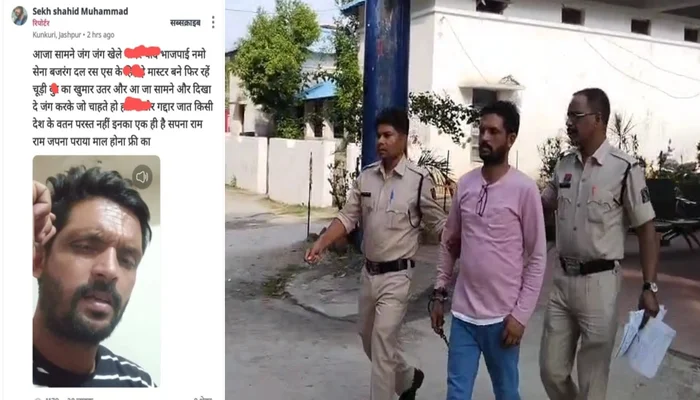
Case Summary
A Muslim man named Mohammad Shaheel Khan, a 27-year-old resident of Jharkhand, was arrested for disseminating objectionable and provocative content against Hindus and Hinduism on social media. Khan was residing in the Kunkuri area of Jashpur district, Chhattisgarh, at the time of his arrest. The content posted by Khan, including a video, contained violent threats directed towards Hindus. He also used derogatory terms, labelling Bajrang Dal, Yadavs, and Baniyas as "Hindu terrorists". Additionally, Khan also used the offensive slur "Ram Ram japna, paraya maal apna," which essentially implies that Hindus deceive people in the name of God for personal gain. As of the date of writing this report, police directed immediate action, and Khan was charged under relevant sections of the Indian Penal Code (BNSS). Following his arrest, Khan released a video apologising for his actions, expressing regret for hurting religious sentiments.
Why it is Hate Crime ?
This case has been added to the tracker un the primary category of - Hate Speech against Hindus. The sub-category selected here is - Anti-Hindu slurs, mocking faith. Anti-Hindu slurs and the deliberate mocking of the Hindu faith owing to religious animosity involve the usage of derogatory terms, stereotypes, or offensive references to religious practices, symbols, or figures. One of the common anti-Hindu slurs used against Hindus is “cow-worshipper” and “cow piss drinker”. The intention of using this term is to demean and mock Hindus as a group and their religious beliefs since Hindus consider the cow holy. Additionally, some symbols and the slurs attached to them have a historical context that exacerbates the insult, hate, stereotyping, dehumanisation and oppression against Hindus. Cow worship has been used for centuries to denigrate Hindus, insult their faith and oppress Hindus specifically as a religious group. There has been overwhelming documentation about how cow slaughter has been used to persecute Hindus with cow meat being thrown in temples and places of worship. There has also been overwhelming documentation where cow meat (beef) has been force-fed to Hindus to either forcefully convert them to Islam or denigrate their faith. Apart from cow worship, the Swastika – which holds deep religious significance for the Hindus – has also been misinterpreted and distorted to use as a slur against Hindus. Similarly, the worship of the Shivling has been used by supremacist ideologies and religions to denigrate Hindus owing to religious animosity. Such slurs and denigration stem out of inherent animosity and hate towards Hindus and their faith, therefore, it is categorised as hate speech targeted at Hindus specifically owing to their religious identity. The case qualifies as a religious hate crime because the hostility expressed by Mohammad Shaheel Khan was directed specifically at Hindus on the basis of their religious identity. The conduct was not limited to criticism of a particular individual, political disagreement, or criticism of the activities of a specific organisation. Instead, Hindus were explicitly identified as the target of threatening and derogatory content, making religion a central and identifiable basis of the hostility. The violent threats directed towards Hindus are particularly significant in establishing the hate-crime dimension. Threatening a religious community as a collective communicates hostility towards individuals because they belong to that community and creates an atmosphere of intimidation based on religious identity. The fact that the threats were directed at Hindus collectively, rather than at a particular person because of a personal dispute, demonstrates that the hostility extended beyond an individual grievance and was directed towards members of a defined religious group. The reference to Bajrang Dal, Yadavs and Baniyas as “Hindu terrorists” further demonstrates the use of religious identity as a basis for derogation. Although criticism of a political, social or religious organisation in itself would not necessarily constitute a hate crime, the expression went further by attaching a highly stigmatising and violent label to persons and groups identified with Hindu identity. By characterising Hindu-associated individuals as “terrorists”, the content portrayed them as inherently dangerous or illegitimate because of their association with Hinduism. This type of collective stereotyping contributes to the dehumanising or demonising portrayal of a religious community and strengthens the evidence that the hostility was religiously motivated. The use of the expression “Ram Ram japna, paraya maal apna” provides an additional and distinct religious dimension. The phrase invokes the name of Lord Ram and uses it in a derogatory context to portray Hindus as people who invoke God while engaging in deception and personal enrichment. This is not simply an insult directed at a named individual. It uses a recognised Hindu religious expression and a central figure of Hindu worship as the basis for portraying Hindus and their religious conduct negatively. Consequently, the statement attacks not only individuals but also the perceived moral character of Hindus through their religious practices and identity. The cumulative nature of the content is important. The material combined threats against Hindus, collective derogatory labelling and disparagement associated with Hindu religious belief. These elements reinforce one another and establish a consistent pattern of hostility towards Hindus as a religious community. The religious element therefore cannot reasonably be treated as incidental to the conduct. Hindu identity was expressly referenced and formed part of the substance of the offensive and threatening material. Taken together, the combination of explicit religious targeting, threats of violence, negative stereotyping and disparagement of Hindu religious identity provides a clear basis for classifying the incident as a religious hate crime against Hindus. Disclaimer: The Hinduphobia Tracker records incidents based on when an event occurred or when the victim's ordeal began. It is important to clarify that none of the media sources covering this case has specified the exact date when the accused posted those statements. Therefore, for documentation purposes, we have recorded the date based on when the incident was reported in the media, 9 May 2025.


Case Status
Arrested


Perpetrators Details
Perpetrators
Muslim Extremists
Perpetrators Range
One Person
Perpetrators Gender
male
 Sources




