Hindus assaulted for opposing pro-Pakistan posts shared by Muslim man following 'Operation Sindoor' launched to avenge Pahalgam Hindu massacre
 Meerut, Uttar Pradesh, India
  6 May, 2025
Case Summary
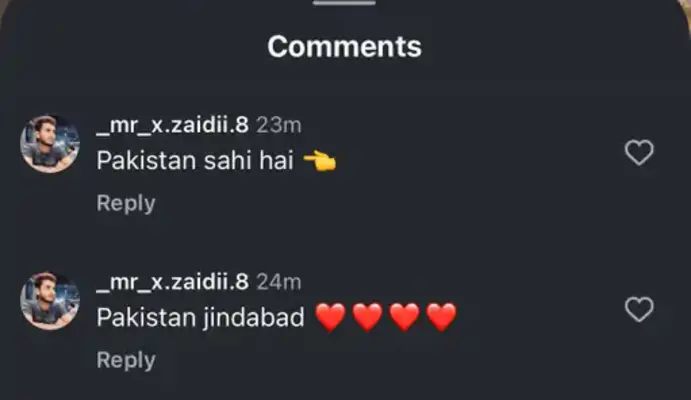
In Uttar Pradesh’s Meerut district, a Muslim youth posted slogans such as “Pakistan Zindabad” and “Pakistan is right” on his Instagram account. When confronted by Hindu activists, the Muslim man and his associates assaulted them and issued death threats. M Zaid worked at a Mayur salon in Prabhat Nagar, Meerut and has a history of sharing controversial posts. After Operation Sindoor, he shared a photo supporting Pakistan, featuring a young woman holding the Pakistani flag. When a mock drill was planned, following Operation Sindoor, to prepare for potential Pakistani retaliation, Zaid again posted slogans such as “Pakistan Zindabad” and “Pakistan is right” on his Instagram account. He also made multiple anti-India comments on the YouTube videos of the Pakistani YouTubers. The Times of India reported that when Vinod Jatav, the city secretary of the Bharatiya Janata Yuva Morcha, and his associates reached the salon to confront M Zaid, a group supporting the Muslim youth assaulted them and issued death threats. A formal complaint was filed at the police station, and Civil Lines Circle Officer Abhishek Tiwari confirmed that the arrest of 28-year-old Zaid was made following a complaint lodged by Vinod Jatav, the city secretary of the Bharatiya Janata Yuva Morcha. India carried out ‘Operation Sindoor’ on May 7, 2025, destroying nine terrorist camps in Pakistan in response to the Pahalgam terror attack. The Pahalgam Hindu massacre was a deadly Islamic terrorist attack that took place on April 22, 2025, in the Pahalgam region of Jammu and Kashmir, where Islamic terrorists specifically targeted Hindu tourists, asking their religion before executing them. India strongly condemned this act of Islamic terrorism, particularly emphasising the brutality of targeting people solely based on their religious identity. The military operation was a firm retaliation aimed at dismantling the terror camps in Pakistan harbouring and training Islamic terrorists responsible for the Pahalgam Hindu massacre.
Case Images
Why it is Hate Crime ?
This case has been added to the tracker un the primary category of - Hate Speech against Hindus. The sub-category selected here is - Anti-Hindu slurs, mocking faith. Anti-Hindu slurs and the deliberate mocking of the Hindu faith owing to religious animosity involve the usage of derogatory terms, stereotypes, or offensive references to religious practices, symbols, or figures. One of the common anti-Hindu slurs used against Hindus is “cow-worshipper” and “cow piss drinker”. The intention of using this term is to demean and mock Hindus as a group and their religious beliefs since Hindus consider the cow holy. Additionally, some symbols and the slurs attached to them have a historical context that exacerbates the insult, hate, stereotyping, dehumanisation and oppression against Hindus. Cow worship has been used for centuries to denigrate Hindus, insult their faith and oppress Hindus specifically as a religious group. There has been overwhelming documentation about how cow slaughter has been used to persecute Hindus with cow meat being thrown in temples and places of worship. There has also been overwhelming documentation where cow meat (beef) has been force-fed to Hindus to either forcefully convert them to Islam or denigrate their faith. Apart from cow worship, the Swastika – which holds deep religious significance for the Hindus – has also been misinterpreted and distorted to use as a slur against Hindus. Similarly, the worship of the Shivling has been used by supremacist ideologies and religions to denigrate Hindus owing to religious animosity. Such slurs and denigration stem out of inherent animosity and hate towards Hindus and their faith, therefore, it is categorised as hate speech targeted at Hindus specifically owing to their religious identity. The other sub-category selected is - Violent threats. Violent threats, explicit, implicit or implied, is the most dangerous form of hate speech since it goes beyond discriminatory and prejudicial language to express the intent of causing harm to an individual or a group of people based on their religious identity and faith. There could be several different kinds of threats that are issued to Hindus based on religious animosity. An explicit threat would mean the direct threat of violence towards an individual Hindu, a group of Hindus or Hindus at large. Physical violence, death threats, threats of destruction of property belonging to Hindus and threats of genocide would mean explicit threats against Hindus for their religious identity. Implicit threats may not be a direct threat but implied through the use of symbols of actions – for example – in the Nupur Sharma case, other than explicit threats, there were also implicit threats when Islamists took to the streets to burn and beat her effigies. It implies that they want to do the same to Nupur Sharma – thereby is considered an implicit threat. Violent threats can be delivered in person, through letters, phone calls, graffiti, or increasingly through social media and other online platforms. It would be important to understand that a threat – explicit or implicit, online or offline – to an individual who happens to be a Hindu does not qualify as a religiously motivated threat. Such a threat, while vile and dangerous, could be owing to non-religious reasons and/or personal animosity. To qualify as a religiously motivated threat, it would need to exhibit an indication that the individual is being targeted for religious reasons and/or owing to his/her religious identity as a Hindu. The other primary category selected is - of - Attack not resulting in death. The sub-category selected is - Attacked for opposing radicals or trying to save victim. In several cases, Hindus are attacked for opposing religiously motivated crimes being committed against a fellow Hindu or simply for voicing an opinion opposing radical elements, who either have in the past or continue to persecute Hindus. In such cases, the initial attack against the victim, against which the Hindu was trying to defend the victim, would also need to be classified as a religiously motivated hate crime. Since the initial crime itself was religiously motivated and the subsequent crime of attempting to save the victim or speaking against the radical elements ends up inviting a violent attack, it would also be classified as a religiously motivated hate crime under this category. The incident involved the violent assault and issuing of death threats by a group led by a Muslim youth, M Zaid, against Hindu activists after they confronted him over pro-Pakistan slogans and anti-India comments he had posted online. The provocation for the attack was Zaid’s repeated glorification of Pakistan and mocking of India following Operation Sindoor—India’s military response to the Pakistan-sponsored Pahalgam Hindu massacre. When Vinod Jatav, the city secretary of the Bharatiya Janata Yuva Morcha, and his associates visited the Mayur Salon in Prabhat Nagar to question Zaid about his posts, he and his supporters attacked them and threatened to kill them. Zaid had a history of posting content sympathetic to Pakistan and radical Islamist narratives. The assault was not a personal altercation but was clearly driven by religious hatred, targeting Hindu individuals specifically for standing up against Islamist radicalism and supporting India. The attack, combined with the timing and content of the posts, underscores the communal motivation behind the violence. Here, one could argue that the slogan of Pakistan Zindabad can be considered anti-India and pro-Pakistan, but not anti-Hindu. However, raising slogans such as Pakistan Zindabad not only show pro-Pakistan sentiments, but also anti-Hindu sentiments. It is pertinent to note that Muslim extremists harbour specific animosity towards Hindus and their faith and also view India as a Hindu collectivity. The very basis of the partition of India was that the Muslims believed that Islam was a nation unto itself, which could not survive with a Hindu collectivity like India. Further, Muslims often believe in transnational unity - or the Ummah - which is a belief that all Muslims across the world are a nation unto themselves and therefore, loyalty as far as the nation-state is concerned lies with the Muslim collectivity and not with a Hindu collectivity like India. This would also mean that the slogan Pakistan Zindabad is about hailing a Muslim collectivity and an expression of transnational loyalty and anti-Hindu sentiments. For that reason, any slogan which expresses transnational loyalty, faith in the Ummah, is automatically a slogan against Hindus and the Hindu collectivity. Thus, this case is added to the hate crime database.


Case Status
Case sub-judice


Perpetrators Details
Perpetrators
Muslim Extremists
Perpetrators Range
Unknown
Perpetrators Gender
male
 Sources




