Hindu deity insulted and compared to devil by a college professor
 Surguja, Chhattisgarh, India
  1 May, 2025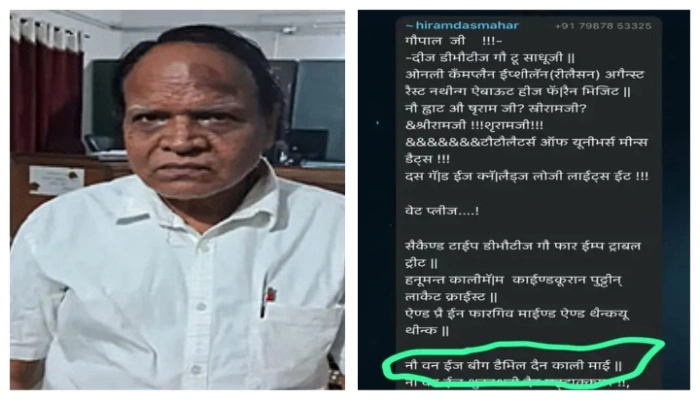
Case Summary
The Hindu deity Kali was insulted by a professor from PG College Ambikapur in Surguja, Chhattisgarh, resulting in his arrest for posting an offensive remark in the faculty WhatsApp group. The accused, H D Mahar, a Botany professor, had posted a message in the group stating, “No one is big devil than Kali Mai.” The post, written in English using Hindi script, sparked widespread outrage from his colleagues and various Hindu organisations. Police registered a complaint and arrested the professor on charges of hurting religious sentiments. He was subsequently produced before a local court and remanded to judicial custody. Following the incident, Mahar issued a public apology for hurting religious sentiments, stating that his post was misunderstood due to a grammatical error.
Why it is Hate Crime ?
This case has been added to the tracker under the primary category of: Attack on Hi du religious representations and within this, the sub-category selected is- Iconoclastic representation of Hindu Gods/Goddesses. An icon is a symbol of someone or something that is revered, or a religious representation of a spiritual ideal. Iconography is of vital significance in the Hindu milieu. It helps connect people’s spiritual beliefs with the real world. Iconography within the Hindu faith takes several shapes and forms. Murtis are of most significance to Hindus, to which daily rituals, prayers and offerings are done. Besides the murtis, there are several other symbols which have deep significance in the Hindu faith – the Om and Swastika for example. Any iconoclastic representation of these symbols, images and murtis is an affront to the religious beliefs and faith of the Hindu community itself since the symbols and icons are deeply religious in nature. In this sub-category of crime, we would record hate crimes and iconoclastic representations, in words, art, or any other form of representations of symbols that hold religious significance for the Hindu community. Since these symbols, icons and murtis are central to the Hindu faith, any iconoclastic representation of these symbols is born out of animosity towards the faith itself, manifesting itself through these symbols and therefore, these representations would be considered religiously motivated hated crimes. The second category selected here is- Hate speech against Hindus. Within it, the sub-category selected is: - Anti-Hindu slurs, mocking faith. Anti-Hindu slurs and the deliberate mocking of the Hindu faith owing to religious animosity involve the usage of derogatory terms, stereotypes, or offensive references to religious practices, symbols, or figures. One of the common anti-Hindu slurs used against Hindus is “cow-worshipper” and “cow piss drinker”. The intention of using this term is to demean and mock Hindus as a group and their religious beliefs since Hindus consider the cow holy. Additionally, some symbols and the slurs attached to them have a historical context that exacerbates the insult, hate, stereotyping, dehumanisation and oppression against Hindus. Cow worship has been used for centuries to denigrate Hindus, insult their faith and oppress Hindus specifically as a religious group. There has been overwhelming documentation about how cow slaughter has been used to persecute Hindus with cow meat being thrown in temples and places of worship. There has also been overwhelming documentation where cow meat (beef) has been force-fed to Hindus to either forcefully convert them to Islam or denigrate their faith. Apart from cow worship, the Swastika – which holds deep religious significance for the Hindus – has also been misinterpreted and distorted to use as a slur against Hindus. Similarly, the worship of the Shivling has been used by supremacist ideologies and religions to denigrate Hindus owing to religious animosity. Such slurs and denigration stem out of inherent animosity and hate towards Hindus and their faith, therefore, it is categorised as hate speech targeted at Hindus specifically owing to their religious identity. This case has been included in the tracker due to a professor’s derogatory and anti-Hindu remark targeting a revered Hindu deity, Goddess Kali. His statement, “No one is big devil than Kali Mai,” is not only deeply offensive but also indicative of a clear contempt for Hindu beliefs. As Kali is worshipped as a living deity by millions, equating her with a devil constitutes religious iconoclasm. The seriousness of the incident is heightened by the fact that the remark came from a professor at a government college, reflecting a disturbing misuse of institutional authority to denigrate religious sentiments. Such language fosters contempt, spreads misinformation, and reinforces harmful stereotypes about Hindu beliefs, contributing to a socially hostile and polarised environment. These actions are not merely offensive but are designed to provoke, ridicule, and marginalise a religious community, thereby disrupting communal harmony and inciting animosity. It is important to note that this is not an isolated act of expression but part of a troubling trend in which individuals in influential positions exploit their power to attack Hindu sentiments with impunity. Public mockery of sacred symbols and revered deities goes beyond legitimate criticism or free speech, it represents a targeted act of religious hostility that aims to delegitimise and dehumanise an entire faith tradition.


Case Status
Arrested


Perpetrators Details
Perpetrators
Others
Perpetrators Range
One Person
Perpetrators Gender
male
 Sources




