Hindu woman recounts targeted attack in Murshidabad: forced to erase sindoor, threatened with conversion
 Murshidabad, West Bengal, India
  18 April, 2025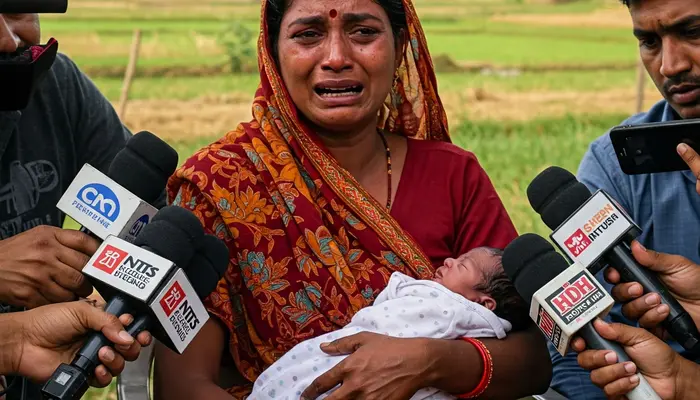
Case Summary
Amidst the anti-Hindu violence that Muslims unleashed in Murshidabad under the guise of protests against the newly enacted Waqf Amendment Act, Mamata Ghosh, a Hindu woman, one of the victims of the horror, provided a detailed account of anti-Hindu violence. While speaking to Panchjanya, she recounted, “They told me that they will forcibly make me a Muslim. They threatened to rape me and erase my sindoor (vermilion powder used by Hindu women)” “They (Muslims) told me that we will remove the existence of India and turn this place into Bangladesh…They made it clear that they do not want Hindus here,” she emphasised. On 11th April, 2025, Murshidabad district in West Bengal, which has a significant Muslim population, witnessed widespread violence, vandalism, arson, and targeted assaults against the Hindu community, all under the pretext of protests against the newly enacted Waqf Amendment Act. Following the conclusion of Jumma Namaz, Muslim mobs went on a rampage in the Suti and Samserganj areas, disrupting train services, damaging public infrastructure, and bringing normal life to a standstill. The office of the Block Development Officer (BDO) was vandalised with stones and sticks, creating an atmosphere of chaos and fear. However, what stands out is the deliberate and systematic targeting of the Hindu community under the guise of these protests. Local reports also suggested that Hindu temples were attacked and idols desecrated. Hundreds of Hindus have been compelled to flee their homes in West Bengal’s Murshidabad district in the wake of an Islamic onslaught carried out under the pretext of protests against the Waqf (Amendment) Bill 2025, an outbreak of violence that has already claimed three lives.
Why it is Hate Crime ?
This case has been added to the tracker under three prime categories. The first is- Predatory Proselytisation. The sub-category relevant in this case is- Harassment for conversion leading to exodus. There have been cases where the Hindus living in an area, often with a majority dwelling belonging to non-Hindus or those harbouring animosity towards the Hindu faith, the Hindu residents experience pressure and threats. The pressure, threats or coercion is employed with two aims – the non-Hindu residents of the area want the Hindu residents to either convert their religion to the religion of the dominant residents or leave the area and relocate, so the area could be turned into an exclusive ghetto for adherents of the non-Hindu faith or those who harbour animosity towards the Hindu faith. In several cases, the aim of exodus is explicit. However, in several cases, the demand for exodus of Hindu residents is not explicit, however, harassment by non-Hindu residents leaves the Hindu residents no option but to leave the area, thereby, turning the area into an exclusive ghetto of non-Hindu residents. In such cases, there are instances of harassment or threats to the Hindu residents explicitly. For example, in the Hauz Qazi case of 2019, the Muslim residents claimed that mob violence against the Hindu residents had been triggered by a parking dispute. However, the violence did turn religious with a temple being desecrated and being directed specifically against the Hindu residents. The Hindu residents of the area were clear that the violence was religiously motivated and one of the motives was to affect an exodus of the Hindu residents. In such cases, even though the perpetrators have not explicitly expressed the aim of affecting exodus, the given circumstances and harassment, coupled with prevailing circumstances and precedent point to the intention of exodus and therefore would be categorized under this sub-category. Such crimes are religiously motivated and therefore are hate crimes. The other relevant sub-category under the first category is- Harassment, threats, coercion for conversion. Harassment covers a wide range of behaviours of an offensive nature. It is commonly understood as behaviour that demeans, humiliates, and intimidates a person, including threats and coercion. Harassment and threats, in this case, find their root on discriminatory grounds which has the effect of nullifying a person’s rights or infringing upon his freedom to exercise his right specifically owing to the victim’s religious identity. Verbal and physical threats and psychological or physical harassment are often used against Hindu victims because they choose to practice their professed religion. Religious harassment also includes forced and involuntary conversions by harassment, threats or coercion. Coercion includes intimidatory tactics like force-feeding a Hindu victim beef to convert to another religion, forceful circumcision etc. In several cases documented, non-Hindu perpetrators or those who harbour specific animosity towards Hinduism, harass victims simply based on their religious identity. Such cases often also include harassment to ensure the Hindu victim abandons his/her professed religion and adopts the religion of the perpetrator. Such cases where Hindu victims are harassed to convert to the perpetrator’s religion are rooted in animosity towards the victim’s religious identity and are therefore documented as religiously motivated hate crimes. The second primary category selected is- Hate Speech against Hindus. The sub-category selected is- Violent threats. Violent threats, explicit, implicit or implied, is the most dangerous form of hate speech since it goes beyond discriminatory and prejudicial language to express the intent of causing harm to an individual or a group of people based on their religious identity and faith. There could be several different kinds of threats that are issued to Hindus based on religious animosity. An explicit threat would mean the direct threat of violence towards an individual Hindu, a group of Hindus or Hindus at large. Physical violence, death threats, threats of destruction of property belonging to Hindus and threats of genocide would mean explicit threats against Hindus for their religious identity. Implicit threats may not be a direct threat but implied through the use of symbols of actions – for example – in the Nupur Sharma case, other than explicit threats, there were also implicit threats when Islamists took to the streets to burn and beat her effigies. It implies that they want to do the same to Nupur Sharma – thereby is considered an implicit threat. Violent threats can be delivered in person, through letters, phone calls, graffiti, or increasingly through social media and other online platforms. It would be important to understand that a threat – explicit or implicit, online or offline – to an individual who happens to be a Hindu does not qualify as a religiously motivated threat. Such a threat, while vile and dangerous, could be owing to non-religious reasons and/or personal animosity. To qualify as a religiously motivated threat, it would need to exhibit an indication that the individual is being targeted for religious reasons and/or owing to his/her religious identity as a Hindu. The third category under which this case has been placed is- Attack not resulting in death. Under this, the first sub-category selected is- Attacked for Hindu identity. In several cases, Hindus are attacked merely for their Hindu identity without any perceived provocation. A classic example of this category of religiously motivated hate crime is a murder in 2016. 7 ISIS terrorists were convicted for shooting a school principal in Kanpur because they got ‘triggered’ seeing the Kalava on his wrist and tilak that he had put. In this, the Hindu victim had offered no provocation except for his Hindu religious identity. The motivation for the murder was purely religious, driven by religious supremacy. Such cases where Hindus are targeted merely for their religious identity would be documented as a hate crime under this category. The second sub-category selected is- Attacked to induce migration from non-Hindu dominated area. There have been cases where the Hindus living in an area, often with a majority dwelling belonging to non-Hindus or those harbouring animosity towards the Hindu faith, the Hindu residents experience threats and violence. The violence is employed with the aim of making the Hindus leave the area and relocate, so the area could be turned into an exclusive ghetto for adherents of the non-Hindu faith or those who harbor animosity towards the Hindu faith. In several cases, the aim of exodus is explicit. However, in several cases, the demand for exodus of Hindu residents is not explicit, however, violence by non-Hindu residents leaves the Hindu residents no option but to leave the area, thereby, turning the area into an exclusive ghetto of non-Hindu residents. In such cases, there are instances violence against the Hindu residents explicitly. For example, in the Hauz Qazi case of 2019, the Muslim residents claimed that mob violence against the Hindu residents had been triggered by a parking dispute. However, the violence did turn religious with a temple being desecrated and was directed specifically against the Hindu residents. The Hindu residents of the area were clear that the violence was religiously motivated and one of the motives was to affect an exodus of the Hindu residents. In such cases, even though the perpetrators have not explicitly expressed the aim of affecting exodus, the given circumstances and violence and precedent point to the intention of exodus and therefore would be categorized under this sub-category. Such crimes are religiously motivated and therefore are hate crimes. Here, the threats directed at Mamata Ghosh were not random acts of violence but were explicitly aimed at erasing her Hindu identity. She was not only subjected to violent intimidation and the threat of rape but was also told to remove her sindoor, a sacred marker of her faith and marital status, and was threatened with forced religious conversion. These threats were not isolated but came in the midst of a broader, systematic assault against the Hindu community during what was presented as a protest against the Waqf Amendment Act. The mobs made their intentions clear by declaring their desire to eliminate Hindus from the area and turn it into "Bangladesh", reflecting a deep-rooted animosity and an explicit campaign to drive Hindus out of their homes and neighbourhoods through fear and coercion. The deliberate targeting of individuals like Mamata Ghosh based on religious identity and the expressed intent to convert them through threats or violence points to a pattern of predatory proselytisation. Moreover, the broader atmosphere of terror—marked by rioting, arson, and attacks on public infrastructure—was used as a tool to instill fear in the Hindu population, compelling many to flee their homes in search of safety. This form of intimidation, coupled with explicit threats and harassment rooted in religious hatred, exemplifies how ideological hostility is weaponised to induce forced migration from non-Hindu-majority areas. Such orchestrated violence and threats form a clear pattern of anti-Hindu aggression, making this case a critical entry in the Hinduphobia Tracker.
Victim Details
Total Victim
1
Deceased
0
Gender
- Male 0
- Female 1
- Third Gender 0
- Unknown 0
Caste
- SC/ST 0
- OBC 0
- General 1
- Unknown 0
Age Group
- Minor 0
- Adult 1
- Senior Citizen 0
- Unknown 0


Case Status
Unknown


Perpetrators Details
Perpetrators
Muslim Extremists
Perpetrators Range
Unknown
Perpetrators Gender
male
 Sources




