Hindu sculptor and his son killed in their home by Muslim men amid large scale anti-Hindu violence in Murshidabad
 Murshidabad, West Bengal, India
  11 April, 2025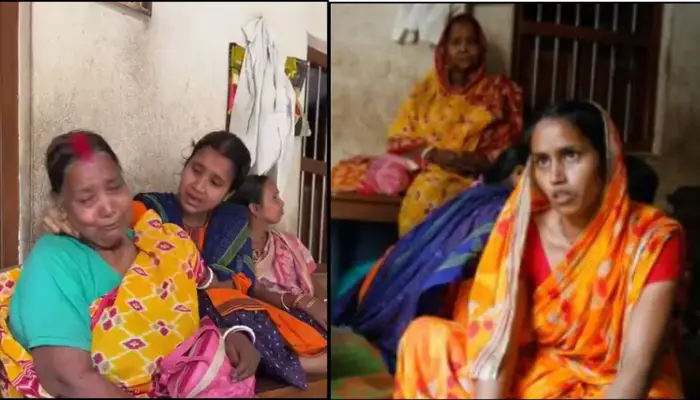
Case Summary
Amidst the wave of anti-Hindu violence unleashed by Muslim mobs in Murshidabad under the pretext of protesting the newly enacted Waqf Amendment Act, a Hindu man and his son were brutally beaten and then stabbed to death. The victims were identified as Hargovind Das and his son Chandan Das, both of whom were traditional sculptors who created idols of Hindu deities. Another person sustained a gunshot injury during the incident. The bodies of the father and son were found inside their home with multiple stab wounds. The attack not only resulted in their deaths but was also accompanied by looting, leaving the house ransacked. The family members recounted the horror of the event, stating that the assailants entered their home, plundered their belongings, and then carried out the fatal assault with knives. Following the murders, their families were forced to flee, unable even to perform the last rites properly, as they were unable to find a barber or priest willing to assist. The widows of the deceased, Pinky Das and Parul Das, wrote a four-page letter to the Governor of West Bengal, C.V. Ananda Bose, seeking protection and justice. In the letter, which they wrote from a hidden location, they described ongoing threats from members of the ruling party and police harassment. They explained that police had attempted to abduct them and that they had no choice but to go into hiding. The women stated, “We, the two widows of Hargobind Das and Chandan Das, write this letter with broken hearts and trembling hands, pleading for justice and protection.” The two women, now living in a safe house away from Murshidabad, reached Kolkata, where they shared their ordeal publicly in the presence of BJP leaders. They have also sent letters to judges of the Calcutta High Court and the Supreme Court, seeking intervention. Meanwhile, the West Bengal Police rejected the allegations, stating that officers had only visited the victims’ home following a complaint and did not find them there. Police further stated that the women were later located at another residence.
Why it is Hate Crime ?
This case has been added to the tracker under the prime category- Attack not resulting in death. The sub-category relevant in this case is- Attacked for Hindu identity. In several cases, Hindus are attacked merely for their Hindu identity without any perceived provocation. A classic example of this category of religiously motivated hate crime is a murder in 2016. 7 ISIS terrorists were convicted for shooting a school principal in Kanpur because they got ‘triggered’ seeing the Kalava on his wrist and tilak that he had put. In this, the Hindu victim had offered no provocation except for his Hindu religious identity. The motivation for the murder was purely religious, driven by religious supremacy. Such cases where Hindus are targeted merely for their religious identity would be documented as a hate crime. Under this category, cases where the attack led to the death of the Hindu victim/s would be documented. The second sub-category relevant here is- Attacked to induce migration from non-Hindu dominated area. There have been cases where the Hindus living in an area, often with a majority dwelling belonging to non-Hindus or those harboring animosity towards the Hindu faith, the Hindu residents experience threats and violence. The violence is employed with the aim of making the Hindus leave the area and relocate, so the area could be turned into an exclusive ghetto for adherents of the non-Hindu faith or those who harbor animosity towards the Hindu faith. In several cases, the aim of exodus is explicit. However, in several cases, the demand for exodus of Hindu residents is not explicit, however, violence by non-Hindu residents leaves the Hindu residents no option but to leave the area, thereby, turning the area into an exclusive ghetto of non-Hindu residents. In such cases, there are instances of violence against the Hindu residents explicitly. For example, in the Hauz Qazi case of 2019, the Muslim residents claimed that mob violence against the Hindu residents had been triggered by a parking dispute. However, the violence did turn religious with a temple being desecrated, and was directed specifically against the Hindu residents. The Hindu residents of the area were clear that the violence was religiously motivated and one of the motives was to affect an exodus of the Hindu residents. In such cases, even though the perpetrators have not explicitly expressed the aim of affecting exodus, the given circumstances and violence and precedent point to the intention of exodus and therefore would be categorized as a religiously motivated hate crime. Under this category, cases where the attack led to the death of the Hindu victim/s would be documented. The second prime category relevant here is- Hate speech against Hindus. Within this, the first sub-category selected is- Communal clash/attack. Communal clash is a form of collective violence that involves clashes between groups belonging to different religious identities. For a communal clash between Hindus and non-Hindus to qualify as a religiously motivated hate crime, the trigger of the violence itself would have to be anti-Hindu in essence. For example, if there is a Hindu religious procession that comes under attack from a non-Hindu mob, and after the initial attack, Hindus retaliate in self-defence, leading to a communal clash between the two religious communities. While at a later stage, both communities are involved in the clash/violence, the initial trigger of the violence was by the non-Hindu mob against the Hindus and therefore, it could safely be termed as an anti-Hindu violence. Further, the trigger would also have to be religiously motivated. In the cited example, the attack by the non-Hindu mob was against a religious procession and therefore, can be concluded to be religiously motivated. In some cases, the trigger may be non-religious, however, it develops into religious violence against Hindus at a later stage. In such cases too, the foundational animosity towards Hindus becomes the motivating factor of the crime and therefore, it would be classified as a religiously motivated hate crime against Hindus. Under this category, cases where the attack led to the death of the Hindu victim/s would be documented. The second sub-category selected under the category 'Hate speech against Hindus' is- Violent threats. Violent threats, explicit, implicit or implied, is the most dangerous form of hate speech since it goes beyond discriminatory and prejudicial language to express the intent of causing harm to an individual or a group of people based on their religious identity and faith. There could be several different kinds of threats that are issued to Hindus based on religious animosity. An explicit threat would mean the direct threat of violence towards an individual Hindu, a group of Hindus or Hindus at large. Physical violence, death threats, threats of destruction of property belonging to Hindus and threats of genocide would mean explicit threats against Hindus for their religious identity. Implicit threats may not be a direct threat but implied through the use of symbols of actions – for example – in the Nupur Sharma case, other than explicit threats, there were also implicit threats when Islamists took to the streets to burn and beat her effigies. It implies that they want to do the same to Nupur Sharma – thereby is considered an implicit threat. Violent threats can be delivered in person, through letters, phone calls, graffiti, or increasingly through social media and other online platforms. It would be important to understand that a threat – explicit or implicit, online or offline – to an individual who happens to be a Hindu does not qualify as a religiously motivated threat. Such a threat, while vile and dangerous, could be owing to non-religious reasons and/or personal animosity. To qualify as a religiously motivated threat, it would need to exhibit an indication that the individual is being targeted for religious reasons and/or owing to his/her religious identity as a Hindu. This incident is classified as a hate crime because the victims were targeted for their Hindu identity without any act of provocation or conflict. Both Hargovind Das and Chandan Das were known for making idols of Hindu deities, which strongly reflected their religious identity. The brutality of the attack, including looting and stabbing within their own home, points to the deliberate targeting of individuals based on their faith rather than any situational or personal dispute. The religious motivation behind such acts, particularly when combined with acts of public violence and communal unrest, places the case firmly within the scope of hate crime. This case reflects a pattern of violence motivated by religious intolerance. The father and son posed no threat or provocation; their presence as Hindu artisans in a communally charged atmosphere became the basis of the assault. Their murder was not a spontaneous act of rage—it was a targeted act of violence meant to send a chilling message to others in the Hindu community: that they are not safe in their own homes, in their own neighbourhoods. The aftermath of the attack reveals a deeper, more insidious motive—intimidation aimed at driving Hindus out of the area. The fact that the family could not even conduct the last rites due to fear, unavailability of priests, and social ostracisation speaks volumes about the hostile environment they were left in. That they had to flee and seek refuge elsewhere, forced to live in hiding, shows that the violence was not only meant to punish but to uproot. The resulting displacement of the victims’ families highlights how communal attacks often function as tools to alter the demographic character of an area by instilling fear and forcing minorities to migrate. Furthermore, the widows’ written plea from a hidden location, alleging threats from politically connected individuals and police intimidation, underscores the pervasive atmosphere of violent coercion. Their statement that police tried to abduct them, and their ongoing fear for safety, point to a broader strategy of silencing survivors and suppressing justice. Such threats are not incidental—they form part of a larger continuum of violence and persecution where victims and their families are terrorised into submission or displacement. Taken together, the killings, the fear-driven migration, the communal backdrop, and the credible threats post-incident clearly illustrate that this was not an isolated act of personal enmity but a deliberate, religiously motivated campaign of terror against the vulnerable Hindu families. For these reasons, this incident warrants inclusion in the Hinduphobia tracker.
Victim Details
Total Victim
4
Deceased
2
Gender
- Male 2
- Female 2
- Third Gender 0
- Unknown 0
Caste
- SC/ST 0
- OBC 0
- General 4
- Unknown 0
Age Group
- Minor 0
- Adult 4
- Senior Citizen 0
- Unknown 0


Case Status
Case sub-judice


Perpetrators Details
Perpetrators
Muslim Extremists
Perpetrators Range
Unknown
Perpetrators Gender
male
 Sources




