Muslim man murders Hindu farmer leader during temple fundraising
 Unnao, Uttar Pradesh, India
  13 January, 2024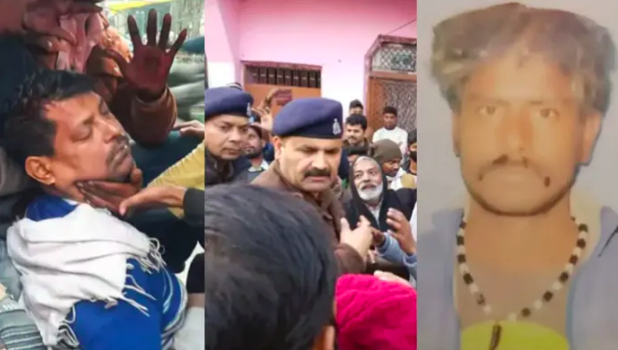
Case Summary
On January 14, 2024, in Unnao, Uttar Pradesh, one Kale Khan attacked farmer leader Vinod Kashyap and his brother Durga Shankar Kashyap while they were collecting donations for a village temple event. The event was scheduled for January 22 to mark the Pran Pratishtha ceremony at Bhavya Ram Mandir in Ayodhya. Vinod tragically passed away from his injuries at the hospital. Despite claims of communal tension, police denied any such angle, stating the altercation arose from a dispute over money. Khan allegedly attacked Vinod with a sword and Durga Shankar with a gun. Following the assault, Khan fired shots and fled. Vinod's wife filed a complaint against Khan, leading to police action. Locals protested the incident, blocking the Ganga bridge and demanding justice. Police assured thorough investigation and strict action against the culprits amidst heightened tensions in the area.
Why it is Hate Crime ?
Hindu devotees are a few of the easiest targets of religiously motivated hate crimes because during the festival/procession/puja etc, for non-Hindus it is easy to profile their victims on the basis of religion. Hindu devotees come under attack on several occasions by individual non-Hindus or mobs of non-Hindus owing to their animosity against Hinduism, its symbols, and traditions/practices. There are several instances of Hindu devotees being attacked while they worship in temples or temporary religious structures, during religious processions, doing bhajan/kirtan/puja in their own homes, in the residential society, etc. These attacks are perpetrated by non-Hindus primarily because of their animosity towards Hindus and their faith. In some cases, the trigger for the violence may be non-religious, however, there are two elements that make these hate crimes. First, the Hindus who come under attack are attacked violently while indulging in religious activity. Whether they are in a place of worship or not is immaterial to the crime. When individuals are attacked while indulging in religious practices, the attack in itself is a hindrance to their freedom to practice religion and therefore constitutes a hate crime. Secondly, religious supremacist doctrines and ideologies deem the religious practices of Hindus to be offensive ab initio since they are considered “sinful” by these ideologies, worthy to be annihilated by force or coercion. Driven by these religious supremacist ideologies and doctrines, the attacks against Hindu devotees stem from intrinsic animosity towards Hinduism. In some cases, the trigger for the violence may be non-religious, however, it develops into a religiously motivated crime during the course of the violence. Since these attacks stem from animosity towards Hindus and Hinduism, they are considered religiously motivated hate crimes. Under this category, cases where the attack led to the death of the Hindu victim/s would be documented. In this case, the Hindu victim was collecting funds for a local temple prayer ceremony to commemorate the consecration of Ram Temple in Ayodhya. The Muslims, enraged by the outward display of devotion in the area, attacked the Hindu devotees. Since the attack was against a Hindu devotee, involved in a religious fund-raiser with the locals alleging that to be the trigger of the violence, this case is being classified as a religiously motivated hate crime. It is, however, also true that the police in this case denied a 'communal angle' to the crime. However, merely the police alleging that there was no communal angle in cases where Hindus are attacked by Islamists cannot be reason enough to dismiss a case as a religiously motivated hate crime when there are other indications present. The police, in many such cases, where the motive behind the crime is obvious but not explicitly mentioned, deny that the crime committed was in any way motivated by a religious bias or say that there was ‘no communal angle’ to the crime. Several factors are generally at play here. Many a time the police downplay incidents of low-level communal crime because it is their jurisdiction that comes under question. The police also often say that there was ‘no communal angle’ to a crime when there was one because they wish to ensure that owing to the crime already committed, there is no further flare-up in the area. Likewise, the Left media and the leftist elite are also inclined to emphasize this "no communal angle" trope, especially wherever the victim of the crime is a Hindu. However, to determine whether such cases are religiously motivated hate crimes or not, one needs to understand what is a ‘communal angle’ in a crime. When we hear the phrase ‘communal angle’, the instant image that we have in mind is that of what happened during the Delhi Riots. There are crimes where the communal angle is glaringly obvious, like the Delhi Riots, and there are others, where the trigger of the communal crime could be extremely different and even seemingly benign. Take the example of Lotan Nishad for example. In April 2020, Lotan Nishad was sitting at a tea shop in the village at around 9.30 am. While reading the morning newspaper, he got into a verbal confrontation, over the role of Tablighi Jamaat in transmitting the Wuhan Coronavirus, with some people sitting there. Mohammad Sona, who was present there, began assaulting the victim. After some time Sona brought a gun and fired at him from close range. Nishad fell to the ground and started bleeding. He died. Immediately, after a statement by the police, the ‘liberal’ ecosystem began to peddle the ‘no communal angle’ trope. However, only a police statement or a media report, for instance, cannot be enough to determine whether there is a communal angle present in the crime that has been committed. In fact, to determine whether the crime is communal in nature or not, we need to give emphasis to the ground realities. For example in the case of Rinku Sharma, the Bajrang Dal activist who was mercilessly stabbed in his house in front of his family members in Delhi’s Mangolpuri area in the year 2021, the leftist media and the leftist ecosystem had tried to peddle that there was no communal angle to the crime. Even the police denied that the crime was communal in nature. However, Opindia spoke to several people who are on the ground with the family of Rinku Sharma and we were told that the communal tension in the area is palpable. The family of Rinku Sharma has said that the Muslims of the area held a grudge against Rinku ever since he celebrated the Ram Mandir verdict. Like the case of Rinku Sharma, those cases where even if the police have denied a communal angle or the leftist media have gone on an overdrive to peddle the ‘no communal angle’ trope, the ground reality, like the victim’s family or relative's testimonies, make it clear that there was an obvious religious bias that led to the crime, will be documented in this tracker. Similarly, in this case, the victim was collecting donations for a temple event to commemorate the Ram Mandir consecration, which the Islamists hold animosity against. The perpetrator was a Muslim history-sheeter and the locals too said that the murder was committed because of the Ram Mandir donation drive. Because of such clear markers, this case is being categorised as a religiously motivated hate crime regardless of the denial of 'communal angle' by the police.
Victim Details
Total Victim
2
Deceased
1
Gender
- Male 2
- Female 0
- Third Gender 0
- Unknown 0
Caste
- SC/ST 0
- OBC 0
- General 0
- Unknown 2
Age Group
- Minor 0
- Adult 2
- Senior Citizen 0
- Unknown 0


Case Status
Case sub-judice


Perpetrators Details
Perpetrators
Muslim Extremists
Perpetrators Range
One Person
 Sources




