Clashes erupt after Hindus participating in Kanwariya procession asked to stop playing DJ by Muslims participating in a Muharram procession
 Pilibhit, Uttar Pradesh, India
  28 July, 2023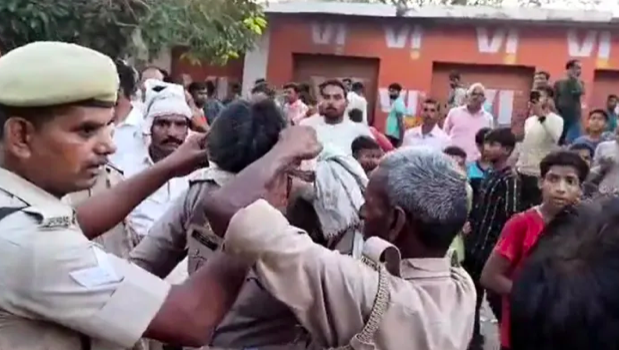
Case Summary
On July 29, the Bareilly Highway near Khamaria Bridge in Pilibhit was under the control of rioters for approximately five hours, during which stones were intermittently hurled. Police resorted to a lathi charge to disperse the rioters and bring the situation under control, allowing Tazias to be taken out afterwards. Additional police personnel were called from Bareilly. The conflict began when Kanwariya pilgrims were asked to stop their DJ by people in a Muharram procession. Despite multiple negotiation attempts, tensions rose, leading to stone pelting. The situation worsened as rioters targeted buses and vehicles, causing injuries and damage to property. Rioters also used stones from a nearby railway line, causing chaos and injuries to policemen and PAC personnel, including a circle officer. Despite police efforts, it took until late at night to stabilise the situation.
Why it is Hate Crime ?
This particular case has been classified as a religiously motivated hate crime under two subcategories of the prime category 'Attack not resulting in death' because of the various distinct components that demonstrate the perpetrator's bias against the Hindu faith and their deliberate attempt to harm the Hindus. The first sub-category under 'Attack not resulting in death' relevant in this case is 'Attack on religious procession'. The outward celebration and display of religious symbols in an intrinsic part of Hinduism. Religious processions on various festivals are age-old traditions and a way to manifest faith and form a part of the religious practices of Hindus. On several occasions, such religious processions come under attack by non-Hindu mobs, in a manifestation of their animosity towards Hinduism and their practices. The reasons cited for such violent attacks are many and range from crossing a non-Hindu resident-dominated area to playing loud music, crossing from an area where there is a religious structure of another faith etc. The violent attacks are triggered by the outward display of religiosity by Hindus. The attacks are mainly a manifestation of religious supremacist doctrine which believes that idolatry, essentially the Hindu faith, is one that deserves to be annihilated since the very tenets of Hinduism, its practices and traditions are considered a sin in those doctrines. Since these attacks emanate from intrinsic and doctrinal animosity towards Hindus and Hinduism, it is considered a religiously motivated hate crime under this category. The second sub-category relevant here is, 'communal clash'. Communal clash is a form of collective violence that involves clashes between groups belonging to different religious identities. For a communal clash between Hindus and non-Hindus to qualify as a religiously motivated hate crime, the trigger of the violence itself would have to be anti-Hindu in essence. For example, if there is a Hindu religious procession that comes under attack from a non-Hindu mob and after the initial attack, Hindus retaliate in self-defence, leading to a communal clash between the two religious communities. While at a later stage, both communities are involved in the clash/violence, the initial trigger of the violence was by the non-Hindu mob against the Hindus and therefore, it could safely be termed as an anti-Hindu violence. Further, the trigger would also have to be religiously motivated. In the cited example, the attack by the non-Hindu mob was against religious processions and therefore, can be concluded to be religiously motivated. In some cases, the trigger may be non-religious, however, it develops into religious violence against Hindus at a later stage. In such cases too, the foundational animosity towards Hindus becomes the motivating factor of the crime and therefore, it would be classified as a religiously motivated hate crime against Hindus under this category. In this instance, the conflict was triggered after Islamists launched an attack on a Hindu religious procession. The Muslims participating in a Muharram procession took offence to Kanwariya devotees playing music while taking out the Kanwar yatra, a significant annual pilgrimage taken out in a demonstration of devotion to Lord Shiva, one of the principal deities in Hinduism, in the holy month of Shravan. Stones were pelted and buses and vehicles were targetted in the ensuing ruckus. The initial trigger of the violence itself was religious in nature, in this case, since the Muslim mob attacked the Hindu devotees owing to them celebrating their religious festival with music, while the Muslims taking out the Muharram procession wanted them to refrain from their celebration, keeping Islamic sensibilities in mind. When the Hindu devotees insisted on celebrating their festival per their own customs, the Muslim mob attacked the Hindus. It is pertinent to note here that the Hindus had not demanded that the Muslim devotees stop their expression of grief as a part of their religious procession to conform to the celebratory procession of the Hindus, therefore, it was the Muslims who had tried to impose their religious considerations on the Hindus by attempting to stop them from celebrating their festival. The Muslim participants had taken offence to Hindus celebrating their festival by playing music and launched an attack on them. The Hindus later defended themselves after the Muslims had started the initial assault. Due to the perpetrator's obvious contempt for the victim's faith, this case qualifies for documentation under this hate tracker.


Case Status
Unknown


Perpetrators Details
Perpetrators
Muslim Extremists
Perpetrators Range
Unknown
Perpetrators Gender
unknown
 Sources




