Muslim mob attacks Kanwariyas while crossing a mosque, Journalist shares cropped video to blame Hindu devotees instead
 Bareilly, Uttar Pradesh, India
  22 July, 2023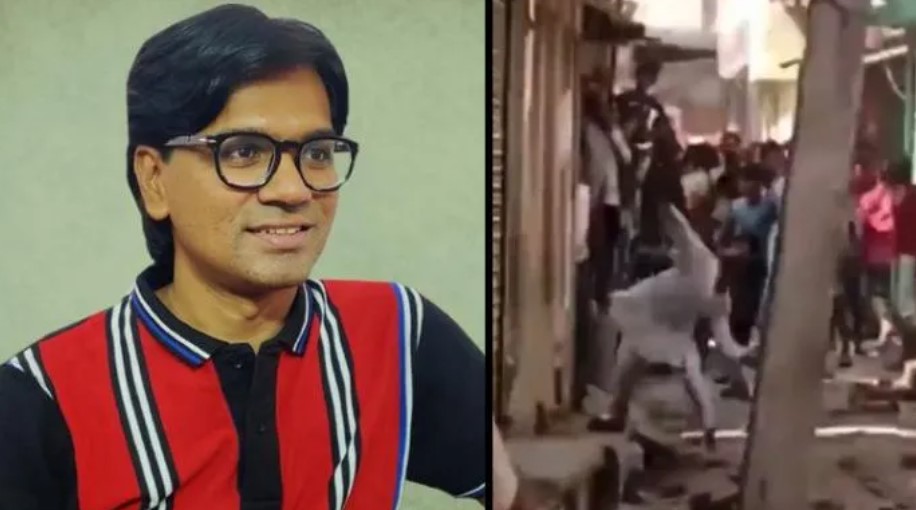
Case Summary
In Bareilly, Uttar Pradesh, a group of Kanwariyas, who were en route to Budaun to perform 'jalabhishek' at the Vankandinath temple, were attacked by Islamists near Shahnoori mosque in the Jogi Nawada area. The incident occurred around 3 pm and resulted in over 12 Kanwariyas sustaining injuries from the stone pelting. The attack was reportedly led by ex-corporator Usman Ali and his supporters, who threw stones at the Kanwariyas from their houses. This incident is not an isolated one, as Bareilly has witnessed similar instances of Islamist aggression against Kanwar Yatras in the past. Mohammed Zubair, the co-founder of Alt News, shared a 27-second cropped video suggesting mutual stone-pelting between the two groups. However, a longer version of the video revealed that the Muslim mob initiated the attack on the Kanwariyas. Zubair did not mention that the video of Kanwariyas pelting stones was in retaliation to the unprovoked attack by Muslims. By shrewdly avoiding the context of the video, he thus insinuated that it was somehow a ‘free-for-all’ case of stone pelting. This attempt to obfuscate the truth led to widespread criticism. “Why was the beginning of this video cut off, Zubair? Because it was clearly visible who was throwing the first stone? As soon as stones were pelted at Hindus in response, Zubair cut off that part and started running propaganda,” Twitter (or X) user Ankur Singh wrote.
Why it is Hate Crime ?
This case has been added to the hate tracker under the prime category of 'Hate speech against Hindus'. Further, as per case details, the sub-category under which this case has been placed is- Media Bias. Under this, the tertiary category selected is- Mislabelling/Misrepresentation of perpetrator's religion as Hindu. Hate speech is defined as any speech, gesture, conduct, writing, or display that is prejudicial against a specific individual and/or group of people, which is leading to or may lead to violence, prejudicial action or hate against that individual and/or group. Media plays a specific and overarching reach in perpetuating prejudicial attitudes towards a community owing to unfair, untrue coverage and/or misrepresentation/misinterpretation, selective coverage and/or omission of facts of/pertaining to issues affecting a specific religious group. This type of bias can dehumanise the victim group, making it easier for others to justify harmful actions against them, which aligns with the objectives of hate speech laws aimed at preventing such harm. It is often observed that the media takes a prejudicial stand against the Hindu community driven by their need to shield the aggressor community which happens to be a numeric minority, however, is the one perpetrating violence against Hindus. For example, the media is often quick to contextualise religiously motivated crimes against Hindus, omit or misrepresent facts that point towards religiously motivated hate crimes, justify and/or downplay religiously motivated hate crimes or simply present fake news to stereotype Hindus. Such media bias leads to the denial of persecution and is often used to dehumanise Hindus, leading to justification for violence against them. For example, the media covered several fake allegations of Hindus targeting Muslims and forcing them to chant Jai Shree Ram. Most of these cases were proved false and fabricated after police investigation. These fake news reports were subsequently never retracted or clarified. Such fake news led to the justification of violence and dehumanisation of Hindus based on the argument that since Hindus targeted Muslims and forced them to chant Jai Shree Ram, the dehumanisation of Hindus and violence against them was par for the course and merely a retaliation. Such media bias leads to prejudicial portrayal of Hindus and offers a justification for violence against them and therefore, is considered hate speech under this category. This incident in Bareilly, Uttar Pradesh, where a group of Kanwariyas was attacked by Islamists near Shahnoori mosque, is a clear case of religiously motivated violence. The attack, led by ex-corporator Usman Ali, involved stone pelting that left over 12 Kanwariyas injured. This hostility towards a Hindu religious procession reflects a pattern of aggression, especially given that similar incidents have occurred in Bareilly in the past. Mohammed Zubair, the co-founder of Alt News, shared a cropped video that distorted the truth, suggesting mutual stone-pelting without acknowledging that the Muslim mob initiated the attack. By omitting this crucial context, Zubair's portrayal misrepresented the situation and downplayed the unprovoked assault on the Kanwariyas. This selective presentation is a case of mislabeling and misrepresentation, rooted in animosity towards Hindus and their faith. Such biased framing not only obscures the truth but also contributes to a broader narrative that seeks to minimize or deny the targeting of Hindu communities in religiously charged violence, making this case worthy of being documented here. The case is also being added to the primary category 'attack not resulting in death' under 3 sub-categories. The first sub-category is 'attack on religious procession'. The outward celebration and display of religious symbols in an intrinsic part of Hinduism. Religious processions on various festivals are age-old traditions and a way to manifest faith and form a part of the religious practices of Hindus. On several occasions, such religious processions come under attack by non-Hindu mobs, in a manifestation of their animosity towards Hinduism and their practices. The reasons cited for such violent attacks are many and range from crossing a non-Hindu resident-dominated area to playing loud music, crossing from an area where there is a religious structure of another faith etc. The violent attacks are triggered by the outward display of religiosity by Hindus. The attacks are mainly a manifestation of religious supremacist doctrine which believes that idolatry, essentially the Hindu faith, is one that deserves to be annihilated since the very tenets of Hinduism, its practices and traditions are considered a sin in those doctrines. Since these attacks emanate from intrinsic and doctrinal animosity towards Hindus and Hinduism, it is considered a religiously motivated hate crime under this category. The second sub-category is 'attack on Hindu devotees'. Hindu devotees are a few of the easiest targets of religiously motivated hate crimes because during the festival/procession/puja etc, for non-Hindus it is easy to profile their victims on the basis of religion. Hindu devotees come under attack on several occasions by individual non-Hindus or mobs of non-Hindus owing to their animosity against Hinduism, its symbols and tradition/practices. There are several instances of Hindu devotees being attacked while they worship in temples or temporary religious structures, during religious processions, doing bhajan/kirtan/puja in their own homes, in the residential society etc. These attacks are perpetrated by non-Hindus primarily because of their animosity towards Hindus and their faith. In some cases, the trigger for the violence may be non-religious, however, there are two elements that make these hate crimes. First, the Hindus who come under attack are attacked violently while indulging in religious activity. Whether they are in a place of worship or not is immaterial to the crime. When individuals are attacked while indulging in religious practices, the attack in itself is a hindrance to their freedom to practice religion and therefore constitutes a hate crime. Secondly, religious supremacist doctrines and ideologies deem religious practices of Hindus to be offensive ab initio since they are considered “sinful” by these ideologies, worthy to be annihilated by force or coercion. Driven by these religious supremacist ideologies and doctrines, the attacks against Hindu devotees stem from intrinsic animosity towards Hinduism. In some cases, the trigger for the violence may be non-religious, however, it develops into a religiously motivated crime during the course of the violence. Since these attacks stem from animosity towards Hindus and Hinduism, they are considered religiously motivated hate crimes under this category. The third sub-category is 'attacked for crossing Muslim area'. One of the reasons that Hindus get attacked unprovoked specifically by Islamists is for crossing ‘Muslim areas’. Essentially, Muslim mobs often attack Hindus crossing or present in certain areas which have a majority Muslim population. It has often been cited as one of the reasons to blame Hindus for attacks against themselves, signalling that Hindus displaying religious symbols, taking our religious processions or crossing any area which is dominated by Muslim residents is a provocation in and of itself. These areas are mostly ghettoized areas where mobs mobilize quickly to attack Hindus for a variety of reasons like playing music during a religious procession, crossing a mosque, wearing a tilak or any other religious symbol in a Muslim-dominated area, praying at a local temple in that area etc. There have been cases where the few local Hindus of that area have been attacked on their way to the Temple for prayers as well, simply because the area is considered a Muslim-dominated area. Several times, it is entirely possible that the immediate trigger for the violence against Hindus was non-religious in nature, however, the violence became religiously motivated in nature because the area was Muslim dominated and the residents on the whole harboured animosity towards Hindus, evidenced from the actions of the mob, the slogans, and the nature of the attack. Such crimes are motivated by the religious identity of the victims and are therefore classified as hate crimes under this category.
Victim Details
Total Victim
12
Deceased
0
Gender
- Male 12
- Female 0
- Third Gender 0
- Unknown 0
Caste
- SC/ST 0
- OBC 0
- General 0
- Unknown 12
Age Group
- Minor 0
- Adult 0
- Senior Citizen 0
- Unknown 12


Case Status
Unknown


Perpetrators Details
Perpetrators
Muslim Extremists
Perpetrators Range
Unknown
Perpetrators Gender
male
 Sources




