Hindu students assaulted by Missionary school teacher for wearing Kalava, forced to cut it off
 Bokaro, Jharkhand, India
  17 July, 2023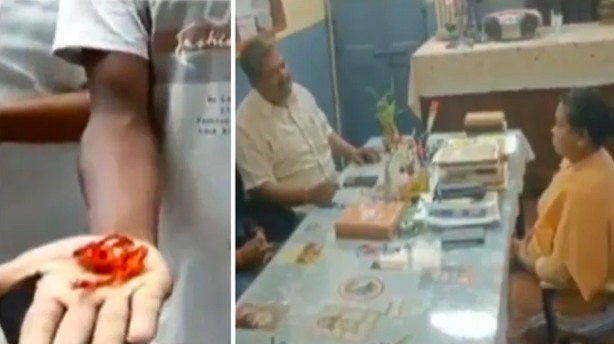
Case Summary
In Bokaro, Jharkhand, a case of religious discrimination against a Hindu student emerged when a teacher beat up a class 9 student for wearing a sacred thread (Kalava) to school. The incident took place at Carmel High School, a government-aided Missionary school, on July 18. Hindu organisations like the Bajrang Dal and Vishwa Hindu Parishad protested the incident on July 19, demanding an inquiry and immediate action against the accused teacher, Amit Lakda. The student, adamant about keeping the Kalava as a matter of faith, was humiliated and forced to cut it in front of the class. He later reported the incident to his parents, who then staged a protest at the school gate. The accused teacher denied the allegations, claiming that the school respects all religions equally. The student's family filed a written complaint with the District Education Officer, Jagarnath Lagra, who pledged to investigate the matter. The school's principal, Sister Joyce Kullu A.C., stated she was unaware of the assault and assured that the School Management Committee would conduct an inquiry before taking action.
Why it is Hate Crime ?
As per case specifics, it has been placed under the sub-category- 'Restriction on expression of Hindu identity', under the prime category- 'Restriction/ban on Hindu practices' of the hate tracker. An example of the state-affected prejudicial and targeted orders against the Hindu community would be a government denying the right of a Hindu or a group of Hindus to hold a religious procession owing to the animosity of non-Hindu groups. Denial of the religious right of the Hindus to assuage the non-Hindu group which harbours animosity to a point where it could lead to violence against Hindus is not only a failure of law and order but is a prejudicial order against Hindus, denying them their fundamental rights to express their religious identity. An example of a hate crime against Hindus by a non-Hindu would be a non-Hindu institution forcing its Hindu employees to abandon religious symbols that a Hindu would wear as an expression of faith owing to inherent prejudice against the faith professed by the victim or a non-Hindu group of people restricting a Hindu group from constructing a place of worship simply because the demography of the area in which the temple is being built is dominated by non-Hindus. Such actions are driven by religious animosity and/or prejudice against Hindus and their faith and would therefore be categorized as a hate crime. The second primary category this case is being added to is 'attack not resulting in death' under the sub-category 'attacked for Hindu identity'. In several cases, Hindus are attacked merely for their Hindu identity without any perceived provocation. A classic example of this category of religiously motivated hate crime is a murder in 2016. 7 ISIS terrorists were convicted for shooting a school principal in Kanpur because they got ‘triggered’ seeing the Kalava on his wrist and tilak that he had put. In this, the Hindu victim had offered no provocation except for his Hindu religious identity. The motivation for the murder was purely religious, driven by religious supremacy. Such cases where Hindus are targeted merely for their religious identity would be documented as a hate crime under this category. In this case, the Christian Missionary school teachers of the school displayed deep disdain for the Hindu faith by forcefully removing the sacred threads (Kalavas) from Hindu students' wrists. In Hinduism, Kalava holds deep religious, cultural, and spiritual significance. It symbolises protection, blessings, unity, and commitment to spiritual and ethical principles. Its use across various rituals and ceremonies underscores its importance in the Hindu way of life and by forcefully cutting off the Kalava, the teacher insulted the Hindu faith and displayed deep disdain towards the religion. This act is an infringement on the religious rights of the Hindus and stems from animosity and prejudice towards the Hindu community, for their religious beliefs. Further, such arbitrary actions are considered prejudicial orders denying the Hindu community its fundamental rights. Such actions stem from animosity and prejudice against Hindu beliefs. This is why this case has been categorised as a religiously motivated hate crime. Another primary category that this case is being added to is 'Predatory Proselytisation' under the sub-category 'Proselytisation by grooming, brainwashing, manipulation or subtle indoctrination'. The case reveals that the Hindu victims were minors, indicating a lack of consent and genuine change of conscience. It is a well-established fact that children are more susceptible to manipulation since they are still developing emotionally, cognitively, and socially. Their brains are not fully mature, making them more vulnerable to influence and less capable of critically evaluating information. Moreover, subtle manipulation tactics can be difficult to detect, especially when employed by trusted authority figures in positions of influence. This makes it challenging for parents to identify and address instances of religious manipulation in schools. In this case, the accused, teachers in a position of trust, demonstrated a clear animosity towards Hinduism by indulging in violence against the minor students for wearing a Kalava - a symbol and manifestation of their professed faith. The teachers essentially covertly tried to push the children towards Christianity by distancing them from their religion and practices. This sort of harassment is rooted in animosity towards the victim’s religious identity and is therefore documented as a religiously motivated hate crime in this Hinduphobia Tracker.
Victim Details
Total Victim
1
Deceased
0
Gender
- Male 1
- Female 0
- Third Gender 0
- Unknown 0
Caste
- SC/ST 0
- OBC 0
- General 0
- Unknown 1
Age Group
- Minor 1
- Adult 0
- Senior Citizen 0
- Unknown 0


Case Status
Complaint filed


Perpetrators Details
Perpetrators
Christian Extremists
Perpetrators Range
One Person
Perpetrators Gender
male
 Sources




