Hindu families targeted for attempted murder as their homes torched by miscreants in Bangladesh amidst rampant persecution of Hindus
 Chittagong District, Bangladesh
  19 December, 2025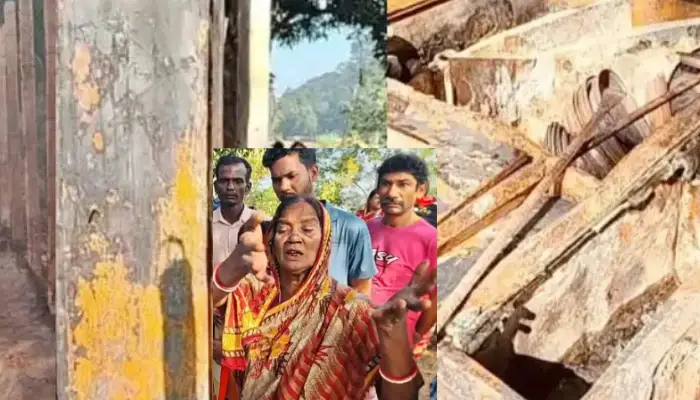
Case Summary
In Raozan Upazila, Chittagong, Bangladesh, two Hindu families, that of Anil Shil and Sukha Shil, were targeted for attempted murder as their houses were set on fire by a few unknown miscreants. According to reports, this occurred at around 3 a.m. on 20 December 2025, at West Banik Para in Ward No. 5 of Raozan Upazila. This occurred when the victims had fallen asleep; the homes of Anil Shil and Sukha Shil were locked from the outside. Clothes soaked in kerosene were placed against the walls and roof. Moments later, both houses were set ablaze by the miscreants, trapping nine Hindu men, women and children inside. Mithun Shil, one of the victims, stated unambiguously that the purpose of the arson was to kill him and his family. There was no feud, no land dispute, and no personal enmity to explain the violence. The attackers ensured escape would be impossible as they locked or barred all exits before setting the house on fire. The trapped families hacked openings through their tin walls and escaped. Mithun Shil stated that his family alone suffered financial losses of at least 10 lakh (1 million) Bangladeshi taka (BDT). A fresh wave of anti-Hindu violence prevailed across Bangladesh following the death of Sharif Osman Bin Hadi. This escalation occurred against the backdrop of ongoing anti-Hindu violence that had persisted since the ouster of the Sheikh Hasina government in August 2024, during which Hindu homes, temples, and religious spaces were repeatedly attacked, and the Hindu community faced intimidation, arson, and mob attacks. In the aftermath of Hadi’s death, Hindu homes were selectively targeted and set ablaze in multiple localities by Muslim mobs, forcing families to flee and rendering many homeless. The violence was not sporadic but patterned, with Muslim mobs targeting Hindu neighbourhoods, properties, and religious symbols with impunity. One of the many victims of this wave of violence was a Hindu man named Dipu Chandra Das, who was brutally lynched by a Muslim mob over false allegations of blasphemy. Such targeting of innocent Hindus over fabricated charges illustrated the vulnerability of the Hindu minority under conditions of rising communal hostility. Posters and written materials calling for the extermination of Hindus were displayed in public spaces, signalling an alarming normalisation of genocidal rhetoric. Combined with acts of physical violence, arson, and vandalism, these developments demonstrated a coordinated campaign designed to terrorise the Hindu community and assert Islamic dominance. Notably, Sharif Osman Bin Hadi was a Muslim political activist and student leader known for his anti-Hindu and anti-India stance. He was actively involved in the political unrest that followed the fall of Sheikh Hasina’s government and was killed in Dhaka in December 2025 during clashes, after which Hindus were blamed and subsequently targeted.
Why it is Hate Crime ?
This case is being added to the tracker under the primary category- Attack not resulting in death. The subcategory selected is- Attacked for Hindu identity. In several cases, Hindus are attacked merely for their Hindu identity without any perceived provocation. A classic example of this category of religiously motivated hate crime is a murder in 2016. 7 ISIS terrorists were convicted for shooting a school principal in Kanpur because they got ‘triggered’ seeing the Kalava on his wrist and tilak that he had put. In this, the Hindu victim had offered no provocation except for his Hindu religious identity. The motivation for the murder was purely religious, driven by religious supremacy. Such cases where Hindus are targeted merely for their religious identity would be documented as a hate crime under this category. In this case, the arson attack on two Hindu families in Raozan Upazila constituted a clear instance of an anti-Hindu hate crime driven by religious animosity. The perpetrators selectively chose these families for extermination while sparing neighbouring households, demonstrating deliberate identification based on Hindu religious identity. The premeditated method, locking doors from outside to trap sleeping victims inside burning houses, revealed intent not just to destroy property but to annihilate Hindu lives systematically. This calculated violence against Hindus alone exposed the attackers' deep-seated hatred for Hinduism, where mere existence as Hindu residents provoked murderous rage. Such discriminatory targeting of the Hindu minority for elimination fits the precise definition of religiously motivated hate crime, rooted in communal prejudice rather than random criminality. The kerosene-soaked clothes used to burn the victims' houses confirmed premeditated intent to burn alive Hindu families, revealing deep-seated religious animosity towards Hinduism and the Hindu community. Such calculated efforts to eradicate Hindu families solely for their faith exemplified religious intolerance and hate crimes. This incident occurred just days after a Hindu man, Dipu Chandra Das, was brutally murdered and his body set ablaze by Muslim radicals over a false allegation of blasphemy against Islam in Bhaluka town, Bangladesh, on 18th December 2025. Such targeted violence in quick succession demonstrated it was not an isolated event but a pattern of selective attacks on Hindus with impunity. In this case, even though the identity of the perpetrators remains unknown, the crime is motivated by religious animosity towards Hindus. Therefore, this incident is being added to the hate crime database of the Hinduphobia Tracker. Disclaimer: Media reports confirmed that nine victims, including men, women, and children, were targeted in this attack. Reports did not specify the exact breakdown of men, women, and children. They identified only three men, Anil Shil, Mithun Shil and Sukha Shil, who are included in the gender and age count; the rest of the victims remain unspecified.
Victim Details
Total Victim
9
Deceased
0
Gender
- Male 3
- Female 0
- Third Gender 0
- Unknown 6
Caste
- SC/ST 0
- OBC 0
- General 0
- Unknown 9
Age Group
- Minor 0
- Adult 3
- Senior Citizen 0
- Unknown 6


Case Status
Unknown


Perpetrators Details
Perpetrators
Unknown
Perpetrators Range
Unknown
Perpetrators Gender
unknown
 Sources




