Hindu temple vandalised and idols desecrated by three Muslim youths following Muslim religious gathering
 Roorkee, Uttarakhand, India
  26 December, 2025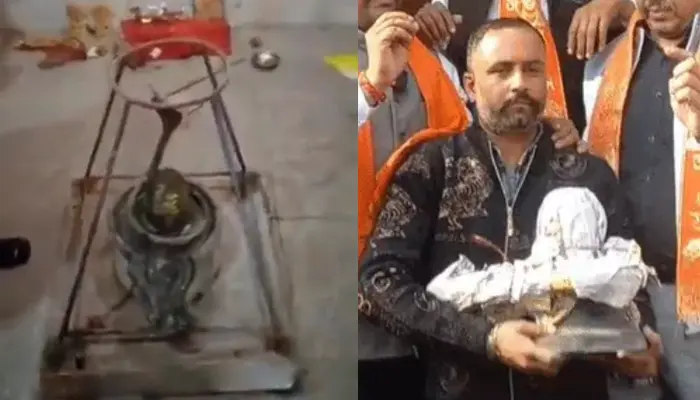
Case Summary
In the Mohitpur village of Roorkee, Uttarakhand, a Hindu temple was vandalised in the aftermath of a large religious gathering by three Muslim youths, resulting in heightened unrest in the locality. According to reports, an Ijtema (religious gathering of Muslims) was held on 26 December 2025 in the Mohitpur village, which was attended by 35,000 Muslims from the surrounding areas. The following morning, at around 6 a.m., three Muslim youths entered the Hindu temple, vandalised it and broke the Shivalinga and the Nandi idols by attacking it with stones. They desecrated the temple's premises and also removed the loudspeaker installed on the premises. Local residents noticed the act, who gathered at the site managed to apprehend one of the perpetrators, identified as a Muslim man named Zuber, while the other two accused fled the scene. The detained youth was handed over to the police by the villagers. As the news of the desecration spread across to the nearby villages, members of the Hindu organisations arrived at the scene and raised slogans, demanding strict legal action against the accused. This escalated tensions in the area, turning the situation highly sensitive and volatile. In response, a heavy police force was deployed in the village to prevent further unrest, and senior officials, including the Circle Officer and Sub-Divisional Magistrate, reached the spot to control the situation. A formal complaint was lodged by a local villager, following which a case was registered, and interrogation of the accused began, while efforts were initiated to trace the two absconding youths. Furthermore, the administration arranged for the installation of a new Shivalinga and Nandi idol to restore the temple, which helped defuse tensions after nearly five hours of protest and commotion. A Kalash Yatra and ritual reinstallation of the idols were scheduled to be held on 29 December 2025. The authorities stated that strict legal action would be taken against the accused in accordance with the law.
Why it is Hate Crime ?
This case has been added to the tracker under the primary category of - Attack on Hindu religious representations; under which the first subcategory is: Attack on temples. In Hinduism, a temple is the abode of the Deity. The Deity in the Temple is consecrated, thereby, making it a real, breathing entity. Hindus believe that not just the Deity but the temple premises itself are sacred to Hindus since Hindus hold the faith that the entire Temple space is an amalgamation of the divine energy of the deity. Given the central significance of Temples in Hindu Dharma, any attack against a Hindu Temple or its peripheral premises is an attack on the faith itself and is born out of animosity towards the faith, of which, the Temple is a central tenet. Any manner of attack against a Temple and/or its premises would therefore be considered a religiously motivated hate crime. The second subcategory is: Desecration of Hindu religious symbol. Icons and symbols or a religious representation of a spiritual ideal are widely revered in Hinduism. Iconography is of vital significance in the Hindu milieu. It helps connect people’s spiritual beliefs with the real world. Iconography within the Hindu faith takes several shapes and forms. Murtis are of most significance to Hindus, to which daily rituals, prayers and offerings are done. Besides the murtis, there are several other symbols which have deep significance in the Hindu faith – the Om and Swastika for example. Since these Hindu religious symbols hold paramount importance in Hinduism, any desecration of symbols, icons, murtis, religious representations and manifestations, is driven by animosity towards the faith itself which manifests itself through these murtis, icons and symbols. Therefore, any desecration of these Hindu religious symbols and representations is considered religiously motivated hate crimes under this category. This incident qualifies as a hate crime because the actions of the accused were directed specifically at Hindu religious symbols and a Hindu place of worship, rather than being random or opportunistic. The three Muslim youths, including Zuber, entered a Hindu temple in Mohitpur village and deliberately vandalised the consecrated Shivalinga and Nandi idol, breaking them with stones and desecrating the temple premises. The removal of the loudspeaker installed in the temple further demonstrated a conscious attempt to interfere with Hindu religious practice and sanctity. In the Hindu faith, temples are not mere physical structures but sanctified spaces believed to embody the living presence of the deity. Thus, acts of violence against such spaces are not isolated incidents of destruction but reflect underlying hostility towards Hindu beliefs and identity. Such an attack is therefore not only material but also symbolic, striking at the Hindu faith itself. Within the Hindu faith, a consecrated murti is not treated as a mere statue; it is regarded as the living embodiment of the deity. Thus, the Shivalinga is not regarded as a symbolic object or statue but as the living embodiment of divine presence, established through ritual consecration. The Shivalinga represents Lord Shiva’s formless, infinite essence and holds profound spiritual significance as a symbol of cosmic creation, preservation, and dissolution. Similarly, Nandi occupies a sacred position as the divine attendant of Lord Shiva. Intentionally damaging these sacred representations goes far beyond vandalism and constitutes a direct assault on the religious beliefs and collective identity of Hindus. The timing and context of the incident further underline its religious motivation. The desecration occurred immediately after a large Muslim religious gathering in the same village, intensifying fear, insecurity, and vulnerability among the local Hindu population. Beyond the physical damage, the psychological impact of such attacks is profound. For devotees, temples are places of solace, peace, and connection with the divine. When such sacred spaces are targeted and their sacred idols are attacked, it disrupts the sense of security and belonging that the Hindu community finds in these institutions. The pain caused by idol desecration is not limited to tangible loss; it wounds the collective psyche of Hindus, leaving many feeling isolated, vulnerable, and marginalised. Such attacks are not simply acts of vandalism; they are calculated assaults on the faith and identity of the Hindu community.


Case Status
Case sub-judice


Perpetrators Details
Perpetrators
Muslim Extremists
Perpetrators Range
From 2 To 5
Perpetrators Gender
male
 Sources




