Minor Hindu children targeted, offered inducements and pressured for religious conversion by Muslim man in Chandauli, Uttar Pradesh
 Chandauli, Uttar Pradesh, India
  24 December, 2025
Case Summary
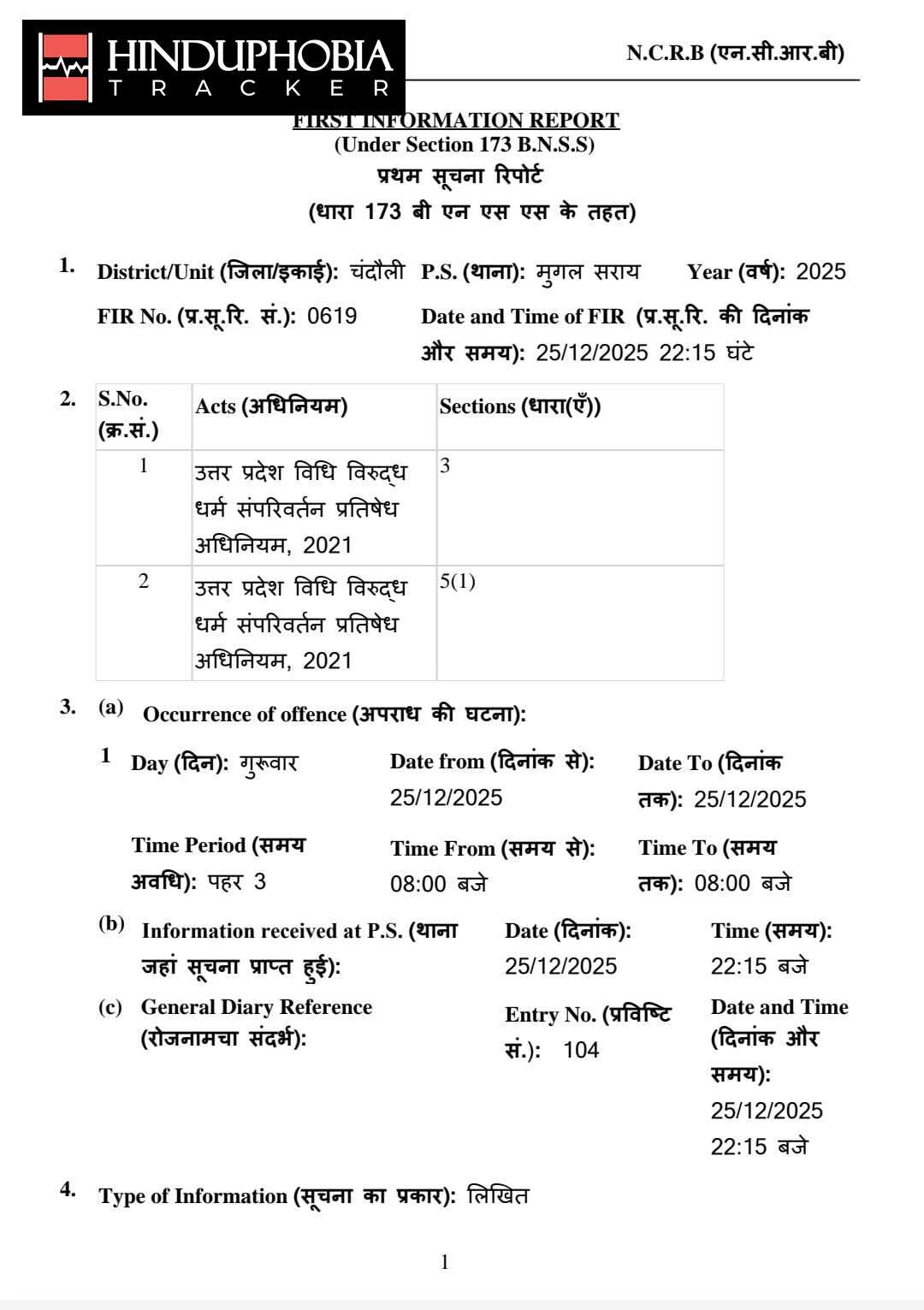
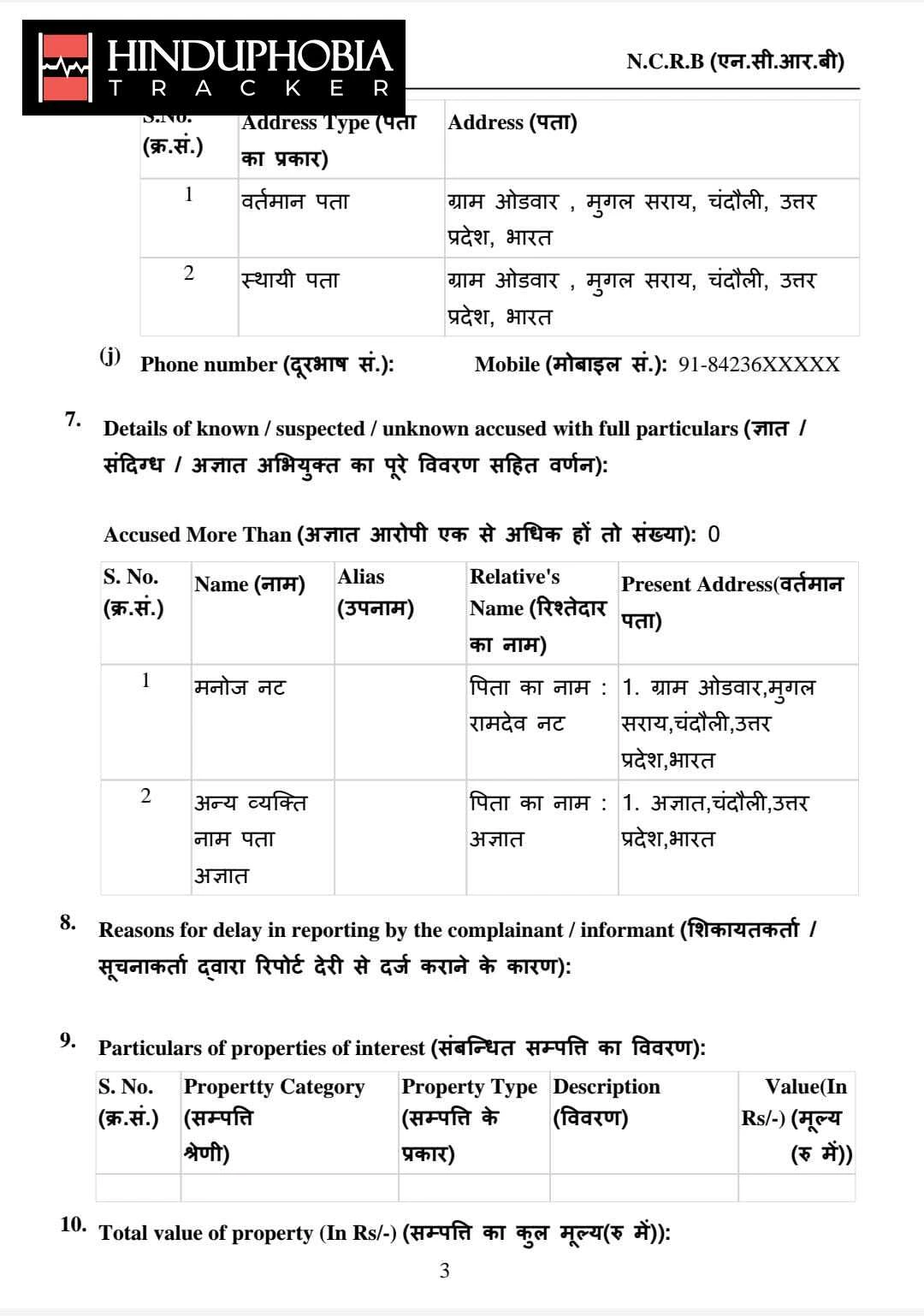
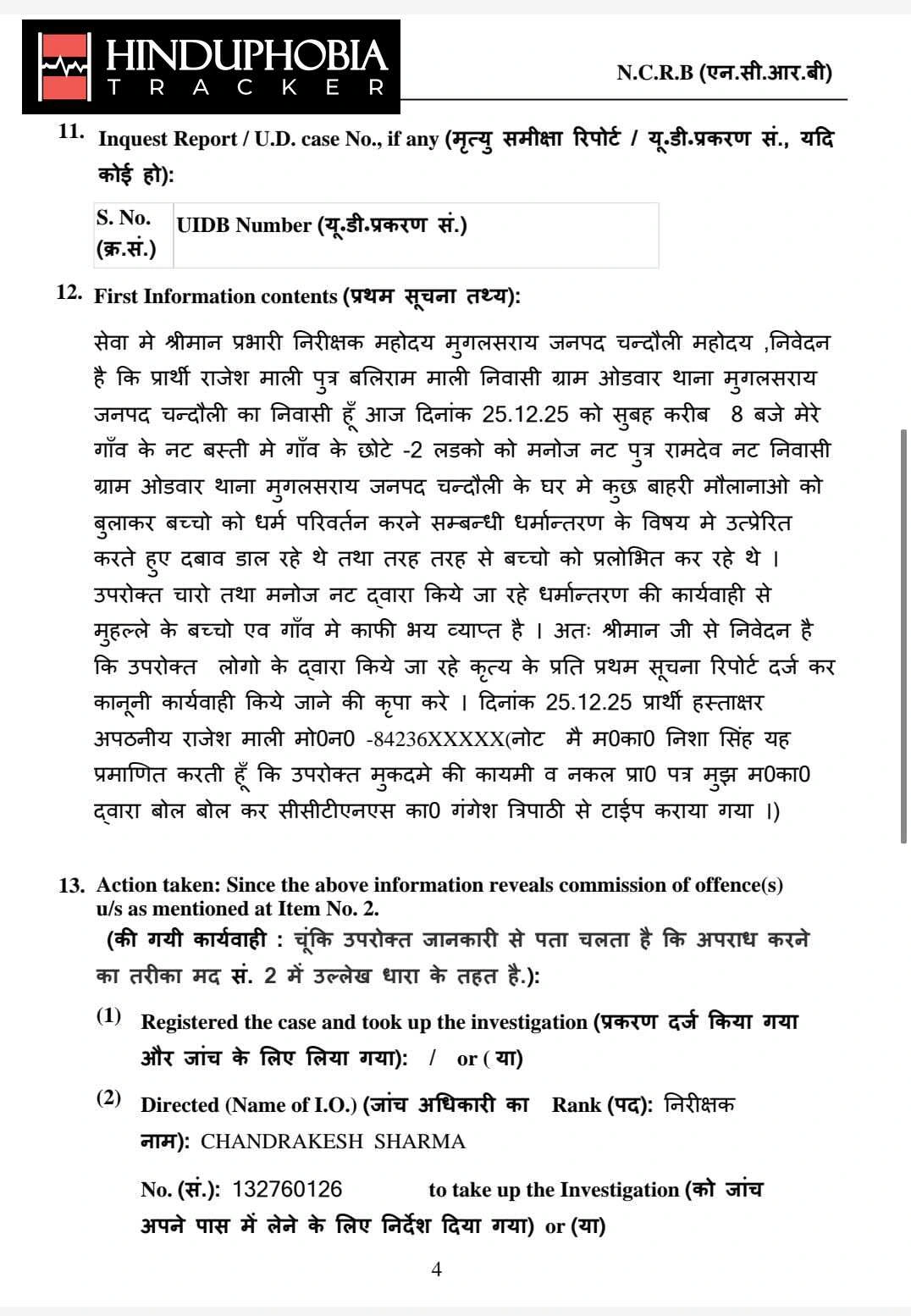
In the Nat Basti village of Chandauli district, Uttar Pradesh, two minor Hindu children were targeted and pressured to convert to Islam by a Muslim man named Manoj Nat, who invited maulanas (Muslim clerics) to facilitate conversion. The Hinduphobia Tracker accessed the FIR filed by Rajesh Mali. According to the complaint, at around 8 a.m. on 25 December 2025, two minor Hindu boys from the Nat Basti of the village were taken to the house of the Muslim accused, Manoj Nat, son of Ramdev Nat. The accused had invited maulanas from outside the area to their house and were pressurising the children to change their faith. They also offered inducements to the children in order to push them towards conversion. As the information spread, these activities created fear among children of the locality and panic across the village. Based on the complaint, the Mughalsarai Kotwali police registered a case and arrested 6 people, including the accused and maulanas, for questioning. The situation led to unrest in the area, prompting an immediate police response. Kotwal Gaganraj Singh confirmed that the case was registered on the basis of the written complaint and that those taken into custody were being interrogated, with further legal action to follow after completion of the investigation. The incident led to commotion in the village, though the police took control of the situation. Kotwal Gaganraj Singh confirmed that a case had been registered, and further action would be taken after the completion of the investigation.
Case Images
Why it is Hate Crime ?
This case has been added to the tracker under the primary category - Predatory Proselytisation. Within it, the sub-category selected is - Proselytisation by grooming, brainwashing, manipulation or subtle indoctrination, with the tertiary category being - Conversion of minor. Religious brainwashing essentially means the often subtle and forcible indoctrination to induce someone to give up their religious beliefs to accept contrasting regimented ideas. Religious grooming or brainwashing also involves propaganda and manipulation. It involves the systematic effort, driven by religious malice and indoctrination, to persuade “non-believers’ to accept allegiance, command, or doctrine to and of a contrasting faith. Cases of such grooming or brainwashing are far more nuanced than direct threats, coercion, inducement and violence. In such cases, it is often seen that there is repeated, subtle and continual manipulation of the victim to induce disaffection towards their own faith and acceptance of the contrasting faith of the perpetrator. While subtle indoctrination is widely acknowledged as predatory, an element which is often understated in such conversions or the attempts of such conversion is the role of loyalty and trust which might develop between the perpetrator and the victim. Fiduciary relationships are often abused to affect such religious conversion. For example, an educator transmitting religious doctrine of a competing faith to a Hindu student. The Hindu student is likely to accept what the teacher is transmitting owing to existence of the fiduciary relationship. The exploitation of the fiduciary relationship to religiously indoctrinate victims would also be included in this category. Since the underlying animosity towards the victim’s faith forms the basis of predatory proselytization, such cases are considered religiously motivated hate crimes. The other sub-category selected is - Harassment, threats, coercion for conversion. Harassment covers a wide range of behaviours of an offensive nature. It is commonly understood as behaviour that demeans, humiliates, and intimidates a person, including threats and coercion. Harassment and threats, in this case, find their root on discriminatory grounds which has the effect of nullifying a person’s rights or infringing upon his freedom to exercise his right specifically owing to the victim’s religious identity. Verbal and physical threats and psychological or physical harassment are often used against Hindu victims because they choose to practice their professed religion. Religious harassment also includes forced and involuntary conversions by harassment, threats or coercion. Coercion includes intimidatory tactics like force-feeding a Hindu victim beef to convert to another religion, forceful circumcision etc. In several cases documented, non-Hindu perpetrators or those who harbour specific animosity towards Hinduism, harass victims simply based on their religious identity. Such cases often also include harassment to ensure the Hindu victim abandons his/her professed religion and adopts the religion of the perpetrator. Such cases where Hindu victims are harassed to convert to the perpetrator’s religion are rooted in animosity towards the victim’s religious identity and are therefore documented as religiously motivated hate crimes. The other sub-category selected here is - Conversion/attempts to convert by inducement. Predatory Proselytisation is not just limited to threat, harassment, force and violence, but it also has contours of stealth. In several cases, the Hindu victim is exploited to convert, with non-Hindus taking advantage of their poverty. In such cases, the Hindu victim who is suffering financially is offered monetary benefits, including lucrative offers for jobs, health treatment, education, etc, to induce the victim into changing his/her religion. In such cases, the religious identity of the victim and the aim to disenfranchise him from his faith form the heart of the crime. Also, taking advantage of and exploiting an individual’s economic vulnerabilities is widely acknowledged as exploitation, forms of which are often penalised by law. Such cases therefore are considered religiously motivated hate crimes since the victim’s religious identity forms the very heart of the crime itself. This case has been added to the tracker because two minor Hindu children were targeted, offered inducements and pressured to convert to Islam by a Muslim man named Manoj Nat, who invited maulanas (Muslim clerics) to facilitate conversion. Firstly, it is important to note here that the victims were minors, which means the element of consent and genuine change of conscience was missing ab initio. Minors, due to their young age and lack of maturity, are particularly vulnerable to manipulation and coercion. They may not have the ability to fully understand the implications of converting to another religion, and the Muslim perpetrator purposely targeted and exploited this vulnerability of the victim. Since this case exemplifies the use of coercion and manipulation to achieve religious conversion, it is a blatant act of religious hate, which is why it has been documented here in the hate tracker. Such actions stem from inherent hostility towards the victim's professed faith since Abrahamic faiths believe that any non-adherent to the faith is subject to being dehumanised till they convert. Therefore, religious conversions, even of minors, are often seen as a badge of honour, totally disregarding the methods used to achieve it. Secondly, the accused actively attempted to compel Hindu minors to renounce their religion and convert to Islam. Pressuring a Hindu individual to discard their religious faith and embrace another was a direct attack on their religious identity and dignity. It was not a matter of personal choice; it was coercion rooted in hostility towards the victim's Hindu identity. Such an attempt reflects religious animosity because the act is not simply about personal differences but about erasing the victim’s Hindu faith, making it a religiously motivated crime. Thirdly, the accused lured the minor Hindu children and offered them inducements in order to push them to convert to Islam. Offering inducements to vulnerable individuals, particularly minors, demonstrates that such acts are not charitable or benevolent in nature but are calculated efforts to exploit Hindus on the basis of religion. By providing inducements in exchange for conversion, the accused was effectively blackmailing those who might have been desperate for assistance or hope. Such practices strip victims of agency and dignity and result in coerced religious conversions. These acts were not isolated or incidental but reflected a deeper pattern of religious hostility directed at Hindu victims. This systematic attempt to erode the religious foundation of individuals and replace it with allegiance to another faith reflects deep religious malice and animus against the Hindu identity. Because the core motivation of the act stems from hostility toward the victim’s religion, it meets the threshold of a hate crime. Hence, categorised as a hate crime in the database. Disclaimer: The media reports stated that around half a dozen individuals were taken into custody, including the named accused Manoj Nat and several maulanas (Muslim clerics) who were invited to facilitate the conversion. Since the police detained six persons in connection with the incident, the perpetrator count has been recorded as 6 for the purpose of this tracker.
Victim Details
Total Victim
2
Deceased
0
Gender
- Male 2
- Female 0
- Third Gender 0
- Unknown 0
Caste
- SC/ST 0
- OBC 0
- General 0
- Unknown 2
Age Group
- Minor 2
- Adult 0
- Senior Citizen 0
- Unknown 0


Case Status
Complaint registered


Perpetrators Details
Perpetrators
Muslim Extremists
Perpetrators Range
From 5 to 10
Perpetrators Gender
male
 Sources




