Anti-Hindu bias: Muslims, Leftists and media spreads false mob-lynching narrative of Muslim cleric over refusing to chant "Ram Ram"
 India
India  20 September, 2025
Case Summary
An anti-Hindu fake news relating to a fabricated mob lynching and assault on a Muslim cleric named Mustaqeem was spread by leftist groups and Muslims, including some sections of the media. It was propagated that Mustaqeem had been beaten and lynched by a group of Hindus for not chanting "Jai Sri Ram" and "Ram Ram," Hindu religious greetings inspired by the name of Lord Ram. A video of Mustaqeem was viral on social media in which he claimed that he was beaten by Hindu youths for not chanting "Ram Ram." This video was amplified by a local Islamic cleric (Mufti) Mohammad Akbar Kazmi, who described the incident as “mob lynching.” He further claimed that the Imam was forced to chant “Jai Shri Ram” and was assaulted by 10-12 people. Following this, Kazmi demanded strict police action in this matter. Even Shahi Jama Masjid Imam Mahmood Raza Kazmi joined the propaganda by claiming that Mustaqeem had been harassed for a month by Hindu boys. He alleged that they taunted him by calling out “Ram-Ram,” and when he did not respond, he was abused, labelled a fanatic, and beaten. The same false narrative was pushed by the Indian National Congress (INC). The official INC Uttar Pradesh X handle claimed that Mustaqeem had been beaten for not chanting "Ram Ram." Their post read: “In Aligarh, a local mosque’s Imam was held hostage by some power-backed goons, brutally beaten for over an hour, and forced to chant 'Ram-Ram.' The double-engine BJP government wants to plunge the entire state into the fire of hatred. The government's hatred against a particular community has grown to such an extent that it has given free rein to antisocial elements with hateful ideologies.” The false propaganda was further spread by Observer Post, a leftist and Islamist news outlet, which stated that Hindus had beaten Mustaqeem after identifying him by his beard and cap, traditional attire for Indian Muslims. The outlet spread the story that he was thrashed for not chanting "Jai Shri Ram." Even mainstream media outlets like ABP News and Dainik Bhaskar also spread the falsehood. ABP reported that Mustaqeem’s beard was pulled out, and he was called a “cow-eater.” They further reinforced the fake story of Hindus lynching him for refusing to chant "Ram Ram" and because of his Muslim identity. Dainik Bhaskar followed the same line, amplifying the fabricated account. However, this false narrative collapsed when the Aligarh police investigated the matter. On their X (formerly Twitter) handle, Aligarh police confirmed that the incident was a minor scuffle with no religious angle involved. The inquiry revealed that Mustaqeem had been riding his bicycle when he tried to remove some children from the road. This led to an argument with Zeeshan, a Muslim youth who was standing nearby. The altercation quickly escalated into a scuffle in which both sustained injuries and were taken to the hospital. The Aligarh police on X tweeted, stating, "A case has come to our notice through social media, in which a person is stating that he was forced to chant some religious slogans and was beaten up. In this regard, it is informed that yesterday, dated 20.09.2025, at Lodha Police Station, under Gram Bulakgarhi, a person named Mustaqeem was going on his bicycle when some children came in the way, and during the process of removing those children, he had an argument with a person named Zeeshan who was standing nearby. This led to a scuffle between the two individuals, resulting in injuries. The police attended the incident on the spot and also conducted a scene inspection. In this connection, it is also informed that both individuals have been sent for treatment; both are stable now, and their medical examinations have been conducted. Upon investigation, the matter appears to be a case of simple assault; no element of any religious angle or forcing to chant religious slogans has emerged in this case. This claim is completely false, and the Aligarh Police refutes it. Legal proceedings are being followed in this matter, statements from both parties have been received, and there is peace at the scene."
Case Images
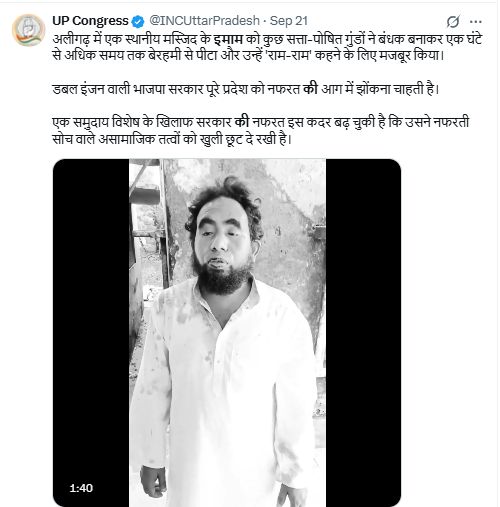
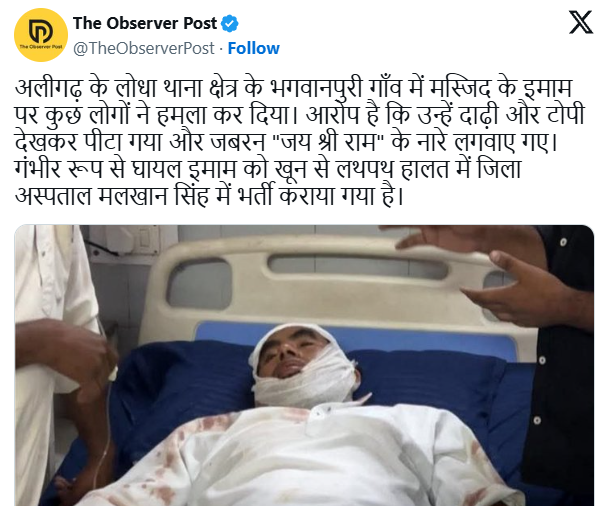
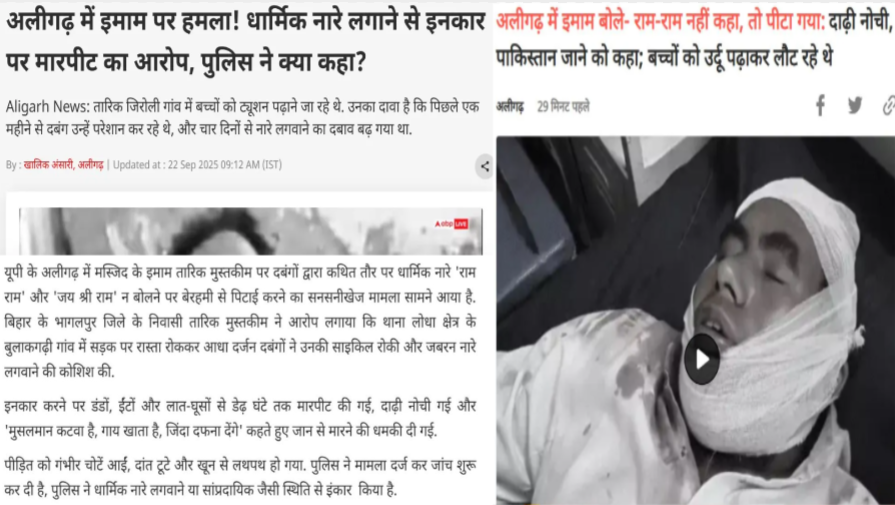
Why it is Hate Crime ?
This case has been added to the tracker under the primary category- Hate Speech against Hindus. Within this, the subcategory selected is- Anti-Hindu subversion and prejudice. The tertiary categories selected are- 'Anti-Hindu fake news or downplaying' and 'Mislabelling/ Misrepresentation of perpetrator's religion as Hindu'. Hate speech is defined as any speech, gesture, conduct, writing, or display that is prejudicial against a specific individual and/or group of people, which is leading to or may lead to violence, prejudicial action or hate against that individual and/or group. Media plays a specific and overarching reach in perpetuating prejudicial attitudes towards a community owing to unfair, untrue coverage and/or misrepresentation/misinterpretation, selective coverage and/or omission of facts of/pertaining to issues affecting a specific religious group. This type of bias can dehumanise the victim group, making it easier for others to justify harmful actions against them, which aligns with the objectives of hate speech laws aimed at preventing such harm. It is often observed that the media takes a prejudicial stand against the Hindu community driven by their need to shield the aggressor community which happens to be a numeric minority, however, is the one perpetrating violence against Hindus. For example, the media is often quick to contextualise religiously motivated crimes against Hindus, omit or misrepresent facts that point towards religiously motivated hate crimes, justify and/or downplay religiously motivated hate crimes or simply present fake news to stereotype Hindus. Such media bias leads to the denial of persecution and is often used to dehumanise Hindus, leading to justification for violence against them. For example, the media covered several fake allegations of Hindus targeting Muslims and forcing them to chant Jai Shree Ram. Most of these cases were proved false and fabricated after police investigation. These fake news reports were subsequently never retracted or clarified. Such fake news led to the justification of violence and dehumanisation of Hindus based on the argument that since Hindus targeted Muslims and forced them to chant Jai Shree Ram, the dehumanisation of Hindus and violence against them was par for the course and merely a retaliation. Such media bias leads to prejudicial portrayal of Hindus and offers a justification for violence against them and therefore, is considered hate speech under this category. In this case, the perpetrators spread the fake news that a Muslim cleric, Mustaqeem, was mob lynched by Hindus for not chanting religious slogans such as “Jai Shri Ram” or “Ram Ram.” This false narrative itself showcased deep-seated animosity towards the Hindu community. Greetings such as “Jai Shri Ram” and “Ram Ram” hold sacred reverence for Hindus, being derived from the name of Lord Ram, one of the most revered deities in Hinduism. These slogans form an integral part of Hindu religious and cultural identity. By spreading a fabricated story where these sacred greetings were misrepresented as tools of intimidation, the perpetrators undermined and devalued Hindu traditions and spiritual expressions. This weaponisation of Hindu religious slogans to create a false victimhood narrative was intended to malign Hindu society and portray it as intolerant, making it an act of religiously motivated hate speech. In this instance, two Muslim clerics, Mohammad Akbar Kazmi and Mahmood Raza Kazmi, played an active role in spreading the propaganda. They propagated the false story that Mustaqeem was beaten by Hindu youths for not chanting “Jai Shri Ram” or “Ram Ram” and even claimed that he was insulted and called a fanatic. Such fabrications exposed deep-seated hostility against Hindus, as the clerics deliberately spread a lie that vilified Hindu religious expressions and transferred the blame upon the Hindu community. This facilitated a distorted image of Hindus, placing them as aggressors and bigots when, in reality, no such religious attack had occurred. The dissemination of such anti-Hindu propaganda carries dangerous real-life consequences, as it feeds stereotypes, generates animosity, and provokes hatred and violence against Hindus purely for their religious identity. What was even more concerning was that the Indian National Congress (INC), a mainstream national political party, amplified this fake narrative through its Uttar Pradesh X handle. Their statement painted Hindus in a negative light and framed the sacred chant of “Jai Shri Ram” as a tool of persecution, portraying Hindus as constant oppressors of Muslims. When a mainstream political party endorses such falsehoods, it further legitimises anti-Hindu propaganda in the public domain and ensures that hatred directed at Hindus gains wider acceptance. This political participation strengthened the propaganda campaign and entrenched animosity against the Hindu community. Similarly, sections of the media, including Observer Post, ABP News, and Dainik Bhaskar, also contributed to spreading this fabricated story. They propagated versions of the incident claiming that Hindus had identified Mustaqeem by his beard and skullcap, called him a “cow-eater,” and beaten him for refusing to chant “Ram Ram.” By reproducing and publishing these falsehoods, the media expanded and legitimised the propaganda, further strengthening the anti-Hindu narrative. Such media complicity did not merely misinform but aggravated the crime by amplifying the hate propaganda against the Hindu community to a much wider audience. Cases like this have direct consequences in real life. The spreading of such propaganda incites hatred, discrimination, hostility, and even violence against the Hindu community. It falsely paints Hindus as habitual persecutors who use their sacred religious slogans as instruments of oppression. This unjustly stigmatises the entire Hindu identity, causing suspicion, resentment and marginalisation of Hindus in society. Finally, it is critical to note that the Aligarh police confirmed that the entire incident was not a religious attack at all. Their investigation established that a scuffle had broken out between Mustaqeem and another Muslim youth named Zeeshan while Mustaqeem was riding his bicycle and attempting to move children from the road. No Hindus were involved, and there was no instance of forceful chanting of religious slogans. This confirmed beyond doubt that the entire fabricated story was designed with malicious intent to target Hindus, misrepresent their faith, and portray them as aggressors. Therefore, it is clear that this episode was not just misinformation but a calculated instance of religiously motivated hate speech against the Hindu community. By fabricating a narrative of Hindu aggression and demeaning sacred Hindu greetings, the perpetrators propagated hate, endangered Hindus in real life, and contributed to the growing climate of Hinduphobia. For this reason, this case is being recorded in the hate crime database of the Hinduphobia Tracker.


Case Status
Unknown


Perpetrators Details
Perpetrators
Others
Perpetrators Range
From 5 to 10
Perpetrators Gender
unknown
 Sources




