Hindu religious procession disrupted and denied passage through Muslim-majority village in Darbhanga
 Darbhanga, Bihar, India
  17 September, 2025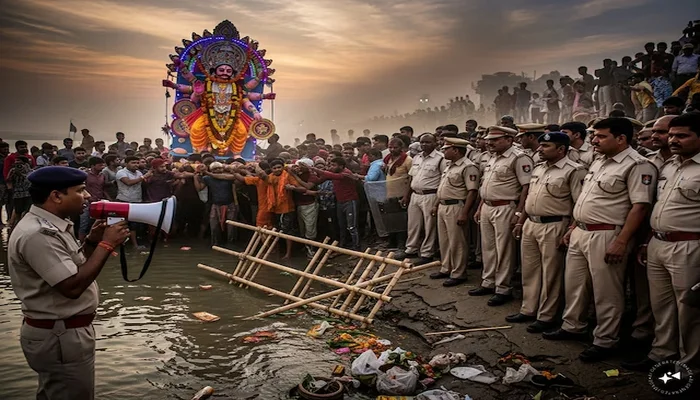
Case Summary
In Kataharia village, Darbhanga district, Bihar, during the immersion of the Baba Vishwakarma idol, the religious procession was disrupted by members of the Muslim community, who refused to allow it to pass through their predominantly Muslim dominated village. According to reports, the immersion procession, held for the first time, was going through its designated route when members of the Muslim community objected to the route passing through their village. They disrupted the religious procession and blocked the road, creating a tense atmosphere in the area. The local administration, including SDM Vikas Kumar and SDPO Shubhendra Kumar Suman, arrived at the site with a significant police presence to manage the situation. Even after prolonged discussions between the villagers and the administration, the Muslim community stayed firm in its stance and did not let the idol pass through the area. Local Hindu youths noted that during Muslim festivals, they extend hospitality by welcoming them and even offering refreshments. Yet, when it came to their own celebration, they were stopped from carrying their idol. The Hindu youths clarified that they had not planned a large procession but only intended to take the statue with two people on a cart, yet permission was denied. This led the district authorities to change the route of the religious procession, resulting in a longer journey for the immersion. Police remained deployed in Kataharia village and the surrounding regions to prevent any further disturbances. The administration’s intervention ensured that the immersion of the idols was completed without further escalation.
Why it is Hate Crime ?
The primary category selected in this case is- Attack not resulting in death. Within this, the first subcategory selected is- Attack on religious procession. The outward celebration and display of religious symbols in an intrinsic part of Hinduism. Religious processions on various festivals are age-old traditions and a way to manifest faith and form a part of the religious practices of Hindus. On several occasions, such religious processions come under attack by non-Hindu mobs, in a manifestation of their animosity towards Hinduism and their practices. The reasons cited for such violent attacks are many and range from crossing a non-Hindu resident-dominated area to playing loud music, crossing from an area where there is a religious structure of another faith etc. The violent attacks are triggered by the outward display of religiosity by Hindus. The attacks are mainly a manifestation of religious supremacist doctrine which believes that idolatry, essentially the Hindu faith, is one that deserves to be annihilated since the very tenets of Hinduism, its practices and traditions are considered a sin in those doctrines. Since these attacks emanate from intrinsic and doctrinal animosity towards Hindus and Hinduism, it is considered a religiously motivated hate crime under this category. The other sub-category selected is- Attacked for crossing 'Muslim area'. One of the reasons that Hindus get attacked unprovoked specifically by Islamists is for crossing ‘Muslim areas’. Essentially, Muslim mobs often attack Hindus crossing or present in certain areas which have a majority Muslim population. It has often been cited as one of the reasons to blame Hindus for attacks against themselves, signalling that Hindus displaying religious symbols, taking our religious processions or crossing any area which is dominated by Muslim residents is a provocation in and of itself. These areas are mostly ghettoized areas where mobs mobilize quickly to attack Hindus for a variety of reasons like playing music during a religious procession, crossing a mosque, wearing a tilak or any other religious symbol in a Muslim-dominated area, praying at a local temple in that area etc. There have been cases where the few local Hindus of that area have been attacked on their way to the Temple for prayers as well, simply because the area is considered a Muslim-dominated area. Several times, it is entirely possible that the immediate trigger for the violence against Hindus was non-religious in nature, however, the violence became religiously motivated in nature because the area was Muslim dominated and the residents on the whole harboured animosity towards Hindus, evidenced from the actions of the mob, the slogans, and the nature of the attack. Such crimes are motivated by the religious identity of the victims and are therefore classified as hate crimes under this category. The other primary category selected here is - Restriction/ban on Hindu practices. Within it, the sub-category selected here is - Restriction on expression of Hindu identity. An example of the state-affected prejudicial and targeted orders against the Hindu community would be a government denying the right of a Hindu or a group of Hindus to hold a religious procession owing to the animosity of non-Hindu groups. Denial of the religious right of the Hindus to assuage the non-Hindu group which harbours animosity to a point where it could lead to violence against Hindus is not only a failure of law and order but is a prejudicial order against Hindus, denying them their fundamental rights to express their religious identity. An example of a hate crime against Hindus by a non-Hindu would be a non-Hindu institution forcing its Hindu employees to abandon religious symbols that a Hindu would wear as an expression of faith owing to inherent prejudice against the faith professed by the victim or a non-Hindu group of people restricting a Hindu group from constructing a place of worship simply because the demography of the area in which the temple is being built is dominated by non-Hindus. Such actions are driven by religious animosity and/or prejudice against Hindus and their faith and would therefore be categorised as a hate crime. This case has been added to the tracker because the Hindu religious procession was disrupted by members of the Muslim community, who refused to allow it to pass through the Muslim-dominated village. The hostility was manifested through the blocking of the route, which reflects an intention to restrict or punish the outward expression of Hindu identity. The disruption was driven by intrinsic and doctrinal animosity toward Hindu religious expression and the presence of a Hindu procession in a Muslim-majority area. In fact, such actions reflect a deeply entrenched mindset that considers Hindu worship and processions in these areas as a provocation, effectively treating public spaces as segregated zones. This normalisation of aggression against Hindus crossing certain neighbourhoods shows religious supremacist tendencies. It is important to mention here that there have been multiple instances where, in areas with a majority Muslim population, Hindus have faced hostility since the tenets of Islam harbour antagonism towards the Hindu faith and the adherents of Hinduism. Such religious and doctrinal animosity manifests in violence against Hindu devotees when religious processions pass areas with a Muslim majority. Since the violence was a product of religious animosity, this case is being categorised as a religiously motivated hate crime. Moreover, in Islamic theology, idol worship (Shirk) is considered a grave sin. The Qur’an condemns it strictly, and Islamic teachings emphasise the rejection of any practices associated with idol worship. While this belief is central to the Islamic faith, it has historically contributed to intolerance and hostility toward idol-worshipping religions, particularly Hinduism. Therefore, obstruction of a Hindu religious procession often reflects more than personal disrespect—it represents doctrinal contempt toward Hindu ritual and symbolism. This also reflects a broader, repeated pattern of aggression against Hindu processions and festivals. Across India, stone-pelting, violence, and desecration of idols often occur during Hindu celebrations, particularly in areas with a history of communal tension. These incidents are rarely spontaneous; they arise from doctrinal animosity towards Hinduism, with idolatry and ritual worship often vilified as sinful or offensive.


Case Status
Complaint not filed


Perpetrators Details
Perpetrators
Muslim Extremists
Perpetrators Range
Unknown
Perpetrators Gender
unknown
 Sources




