Hindu Dalit community faces state‑backed eviction amidst ongoing persecution of Hindus in Bangladesh
 Barisal, Barisal District, Bangladesh
  12 September, 2025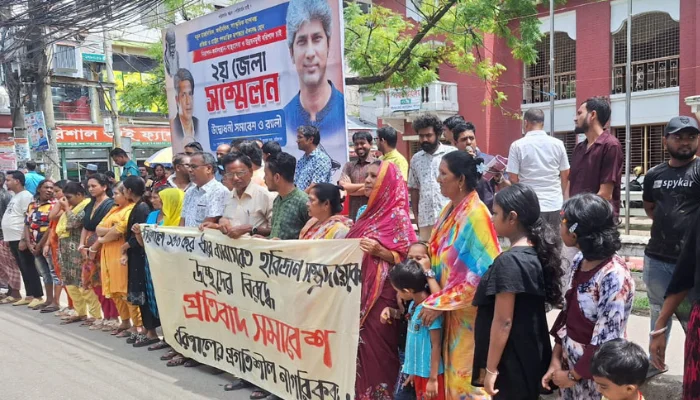
Case Summary
In Barishal district, Bangladesh, Hindus belonging to the Harijan community, a Dalit Hindu community, were targeted in an eviction drive by the Bangladeshi state authorities. According to media reports, this led to a human chain being formed in protest against the eviction drive organised by the Barisal City Corporation. The demonstration took place under the banner of Progressive Citizens at Ashwini Kumar Hall premises at noon on 13th September 2025. Trade union leader AK Azad led the protest, which was addressed by Communist Party of Bangladesh metropolitan secretary Dulal Chandra Majumdar, Barisal University teacher Unmesh Roy, and student coordinators Sujoy Shuvo and Kajal Das, among others. Speakers emphasised that for the past 150 years, members of the Harijan (Dalit Hindu) community had been cleaning the city, yet the corporation was now attempting to uproot them. They warned that if the eviction attempt continued, they would launch a strong agitation. The Hindu victims also spoke of their ordeal. Supriya Rani, a resident of the sweeper colony, said, “We have been living in this colony in Ward No. 9 for seven generations. Twenty‑seven families are crowded into just nine houses. I do not want to leave this colony. The municipal corporation has verbally ordered us to vacate after Durga Puja. Where will we go?” Another community leader, Sanjeev Khokon, added, “Nobody will rent to us anywhere else. We work on very low wages and have no financial ability to resettle. If we are forced out, our families will have nowhere to survive.” This case serves as a stark reminder of the growing Muslim extremism and anti-Hindu sentiments in Bangladesh, which have only increased manifold since the fall of Sheikh Hasina’s Awami League government on August 5, 2024. After her violent ouster, Bangladesh plunged into chaos as Islamist extremists took advantage of the political turmoil to unleash a wave of terror and violence against the Hindu community. The Islamist mobs have attacked Hindu homes, burned them to the ground, and abducted women in a horrific descent into anarchy. Several temples have been destroyed in various parts of the Islamic country in a major crackdown on Hindus. Reports have exposed how Muslim students forced around 60 Hindu teachers, professors, and government officials to resign. Exiled Bangladeshi activist Asad Noor has also revealed that the minority Hindu community is now being coerced into joining ‘Jamaat-e-Islami’. Hindu religious events have been repeatedly targeted. On 6th September, a procession carrying Lord Ganesha’s idol was attacked in Chittagong. Ahead of Durga Puja, multiple incidents of idol vandalism occurred, including attacks in Mymensingh, Pabna, Rajshahi, Kishoreganj, and Dhaka. On 29th November, a violent Muslim mob attacked three temples in Patharghata, Chittagong, immediately after Jumma Namaz. The crackdown on Hindu voices has also escalated. On 30th November, Hindu journalist Munni Saha was arrested in Dhaka. Muslim mob attacks have increased in Bangladesh, for example, on 22nd May 2025, a Muslim mob carried out arson attacks selectively on Hindu homes in Dahar Mashihati village in Abhaynagar upazila in Jessore district of Bangladesh. Even ISKCON leader Chinmoy Krishna Das Prabhu and his aides have been targeted, and attempts have been made to ban ISKCON and suppress Hindu protests through sedition charges. These arbitrary actions point to a systematic pattern of persecution under Muhammad Yunus’s interim government.
Why it is Hate Crime ?
This case has been added to the tracker under the primary category- Attack not resulting in death. The subcategory selected is- Attacked for Hindu identity. In several cases, Hindus are attacked merely for their Hindu identity without any perceived provocation. A classic example of this category of religiously motivated hate crime is a murder in 2016. 7 ISIS terrorists were convicted for shooting a school principal in Kanpur because they got ‘triggered’ seeing the Kalava on his wrist and tilak that he had put. In this, the Hindu victim had offered no provocation except for his Hindu religious identity. The motivation for the murder was purely religious, driven by religious supremacy. Such cases where Hindus are targeted merely for their religious identity would be documented as a hate crime under this category. The eviction drive in Barishal district is a clear case of a hate crime against Hindus. The Bangladeshi state authorities selectively targeted Hindu colonies, specifically the Dalit Hindu Harijan community, and not any other group. This demonstrated that the action was rooted in religious identity, as Hindus were singled out for attack due to their faith. Such targeting by the state made it unmistakably clear that Hindus were being treated not as equal citizens, but as a community marked for exclusion and discrimination. The very act of eviction based solely on religious belonging reflected institutional bias and deep animosity against Hindus. The deliberate targeting of the Hindu Dalit community revealed the state‑driven nature of anti‑Hindu hostility in Bangladesh. Hindus are persecuted not for legal or administrative reasons, but because of their religion and identity. This instance is part of a wider pattern of structural discrimination: Hindus in Bangladesh have long faced violent attacks, desecration of their temples, dispossession of their land, sexual violence against their women, and intimidation at the social and political level. Each of these incidents demonstrated that Hindus were attacked because they were Hindus, and this eviction drive was no different. It was an example of state‑backed persecution and a religiously motivated attempt to uproot an already marginalised minority community. By targeting Hindus for eviction, the Bangladeshi authorities showcased the contempt with which they viewed the Hindu community. These actions were not administrative but discriminatory and hostile, representing an attack on Hindus for their faith. They stripped Hindu families of their security, dignity, and heritage, despite their seven‑generation presence in the colony. Such cases revealed the depth of hatred embedded in state policies and in extremist backing. This eviction attempt was therefore not a bureaucratic matter, but a targeted hate crime against Hindus. Therefore, it is being documented in the hate crime database of the Hinduphobia Tracker.


Case Status
Unknown


Perpetrators Details
Perpetrators
State and Establishment
Perpetrators Range
Unknown
Perpetrators Gender
unknown
 Sources




