Hindu man's house attacked, 'Sar Tan Se Juda' flyer pasted for objecting offensive posters during Eid-e-Milad procession
 Vikhroli, Maharashtra, India
  8 September, 2025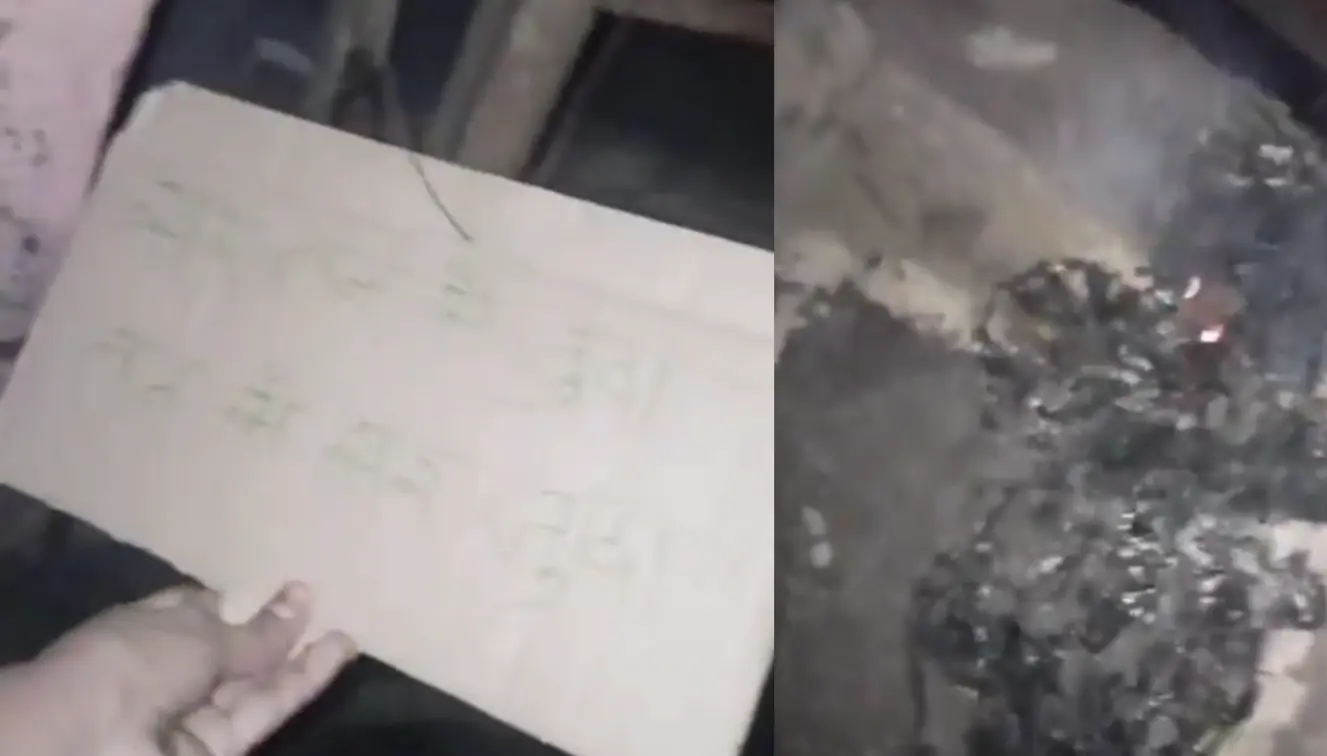
Case Summary
The house of a Hindu man was attacked in the Vikhroli Parksite area of Mumbai, Maharashtra, when unidentified persons attempted to set fire to his residence and pasted a threatening poster. The incident occurred in the early hours of 9 September 2025 at Upadhyay Housing Society in Varsha Nagar, where the victim, Neeraj Upadhyay, lives with his family. The attackers burnt the curtain hanging at the gate of his house and left a poster hanging on the staircase carrying the Islamist beheading slogan "Sar Tan Se Juda". The act created an atmosphere of fear and panic within the family. Police confirmed that the incident took place between three and four in the morning. The attack followed a dispute a day earlier during the Eid-e-Milad procession at Sambhaji Chowk. Objectionable posters had been put up during the procession, and Neeraj Upadhyay objected to them, demanding their removal. An argument broke out with four to five individuals, which was subdued by police officers present at the scene. A few hours after the confrontation, his home was targeted. Police registered a criminal case against unidentified individuals and were examining CCTV footage. Officials stated that attempts to create such communal tension would not be tolerated.
Why it is Hate Crime ?
The primary category in this case is: Attack not resulting in death. The subcategory under this is: Attacked for opposing radicals or trying to save victim. In several cases, Hindus are attacked for opposing religiously motivated crimes being committed against a fellow Hindu or simply for voicing an opinion opposing radical elements, who either have in the past or continue to persecute Hindus. In such cases, the initial attack against the victim, against which the Hindu was trying to defend the victim, would also need to be classified as a religiously motivated hate crime. Since the initial crime itself was religiously motivated and the subsequent crime of attempting to save the victim or speaking against the radical elements ends up inviting a violent attack, it would also be classified as a religiously motivated hate crime under this category. Another primary category in this case is: Hate speech against Hindus. The subcategory under this is: Violent threats. Violent threats, explicit, implicit or implied, is the most dangerous form of hate speech since it goes beyond discriminatory and prejudicial language to express the intent of causing harm to an individual or a group of people based on their religious identity and faith. There could be several different kinds of threats that are issued to Hindus based on religious animosity. An explicit threat would mean the direct threat of violence towards an individual Hindu, a group of Hindus or Hindus at large. Physical violence, death threats, threats of destruction of property belonging to Hindus and threats of genocide would mean explicit threats against Hindus for their religious identity. Implicit threats may not be a direct threat but implied through the use of symbols of actions – for example – in the Nupur Sharma case, other than explicit threats, there were also implicit threats when Islamists took to the streets to burn and beat her effigies. It implies that they want to do the same to Nupur Sharma – thereby is considered an implicit threat. Violent threats can be delivered in person, through letters, phone calls, graffiti, or increasingly through social media and other online platforms. It would be important to understand that a threat – explicit or implicit, online or offline – to an individual who happens to be a Hindu does not qualify as a religiously motivated threat. Such a threat, while vile and dangerous, could be owing to non-religious reasons and/or personal animosity. To qualify as a religiously motivated threat, it would need to exhibit an indication that the individual is being targeted for religious reasons and/or owing to his/her religious identity as a Hindu. This case has been added to the tracker because it demonstrates two distinct yet interconnected forms of religiously motivated aggression directed against Hindus. The assault upon Neeraj Upadhyay’s home was not an arbitrary act of vandalism but a calculated attempt to intimidate him for opposing radical behaviour during a public procession. The sequence of events illustrates how a Hindu individual, by merely objecting to objectionable displays in a religious march, became the target of violence. The perpetrators escalated the matter from a verbal dispute in a public space to an attack on his private residence, thereby crossing into a sphere meant to embody personal safety and security. The method of attack is telling. An effort was made to set fire to the curtain outside the residence, signalling intent to cause physical harm and material destruction. Alongside this, the attackers left a poster bearing the slogan "Sar Tan Se Juda". This slogan is not an ambiguous phrase but a violent call for beheading that has, in recent years, become a rallying cry for Muslim groups against Hindus and others who are deemed to have offended Islamic sensibilities. The choice to paste such a poster at the very threshold of a Hindu family’s home is an act of deliberate psychological warfare. It conveys that the individual is marked, that his life is considered forfeit, and that his family is equally unsafe. “Gustakh-e-Rasool Ki Ek Hi Saza, Sar Tan Se Juda, Sar Tan Se Juda”, which translates to “There is only one punishment for being disrespectful to Rasool (Prophet Muhammad), their head separated from their torso, their head separated from the torso”, is an Islamist clarion call, that has become a staple feature of violent protests that have so far claimed the lives of at least 6 Hindus, including Kanhaiya Lal in Udaipur and Umesh Kolhe in Amravati, after Muslim fundamentalists, egged on by the dog-whistling of Alt News co-founder Mohammed Zubair against former BJP spokesperson Nupur Sharma, resorted to violence for what they perceived as ‘blasphemy’ against Prophet Muhammad. The slogan itself carries an established history in India of being invoked before or after mob attacks, beheadings, and riots. Its appearance is therefore not a symbolic protest but a direct threat of violence, with deep resonance in the collective memory of Hindus who have witnessed or read of killings preceded by this chant. By using it here, the perpetrators transformed a localised dispute into a broader message of religious intimidation: opposition to Islamist excesses will be met with violence, even within the supposed sanctuary of one’s home. This act qualifies under the category of "Attack not resulting in death" because an attempt was made to harm both property and life, even though no fatalities occurred. It also falls under "Hate speech against Hindus: Violent threats," because the poster with the beheading slogan is an explicit declaration of intent to murder. It is crucial to recognise that this was not merely a threat against Neeraj Upadhyay as an individual but a warning extended to the Hindu community at large. The attackers sought to establish that raising a voice against religious radicalism would invite reprisal, thus discouraging resistance to future acts of intimidation. For these reasons, the case is classified as a religiously motivated hate crime. The targeting of a Hindu man for objecting to Islamist conduct during a procession, the attempt to ignite his residence, and the explicit beheading threat together represent a form of coercion designed to suppress dissent and perpetuate fear. The incident belongs within the documented pattern of Hindus being threatened, attacked, or even killed under the invocation of "Sar Tan Se Juda," and serves as a reminder of the persistent and escalating dangers posed by such slogans and the ideology they advance.
Victim Details
Total Victim
1
Deceased
0
Gender
- Male 1
- Female 0
- Third Gender 0
- Unknown 0
Caste
- SC/ST 0
- OBC 0
- General 0
- Unknown 1
Age Group
- Minor 0
- Adult 1
- Senior Citizen 0
- Unknown 0


Case Status
Complaint registered


Perpetrators Details
Perpetrators
Muslim Extremists
Perpetrators Range
Unknown
Perpetrators Gender
unknown
 Sources




