Insult to Hindu religious sentiments: Posters of Hindu deities desecrated by Muslim men in Aligarh
 Aligarh, Uttar Pradesh, India
  29 August, 2025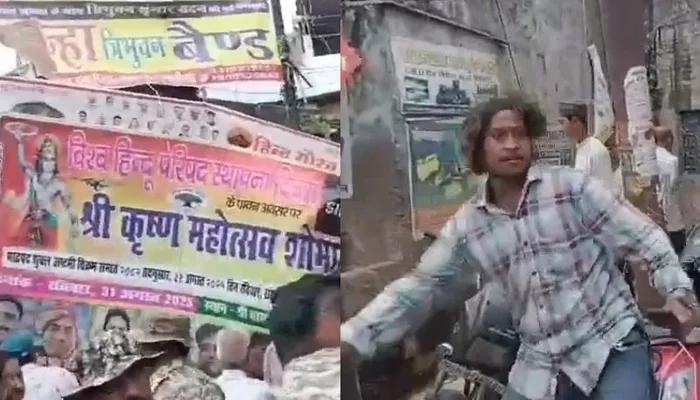
Case Summary
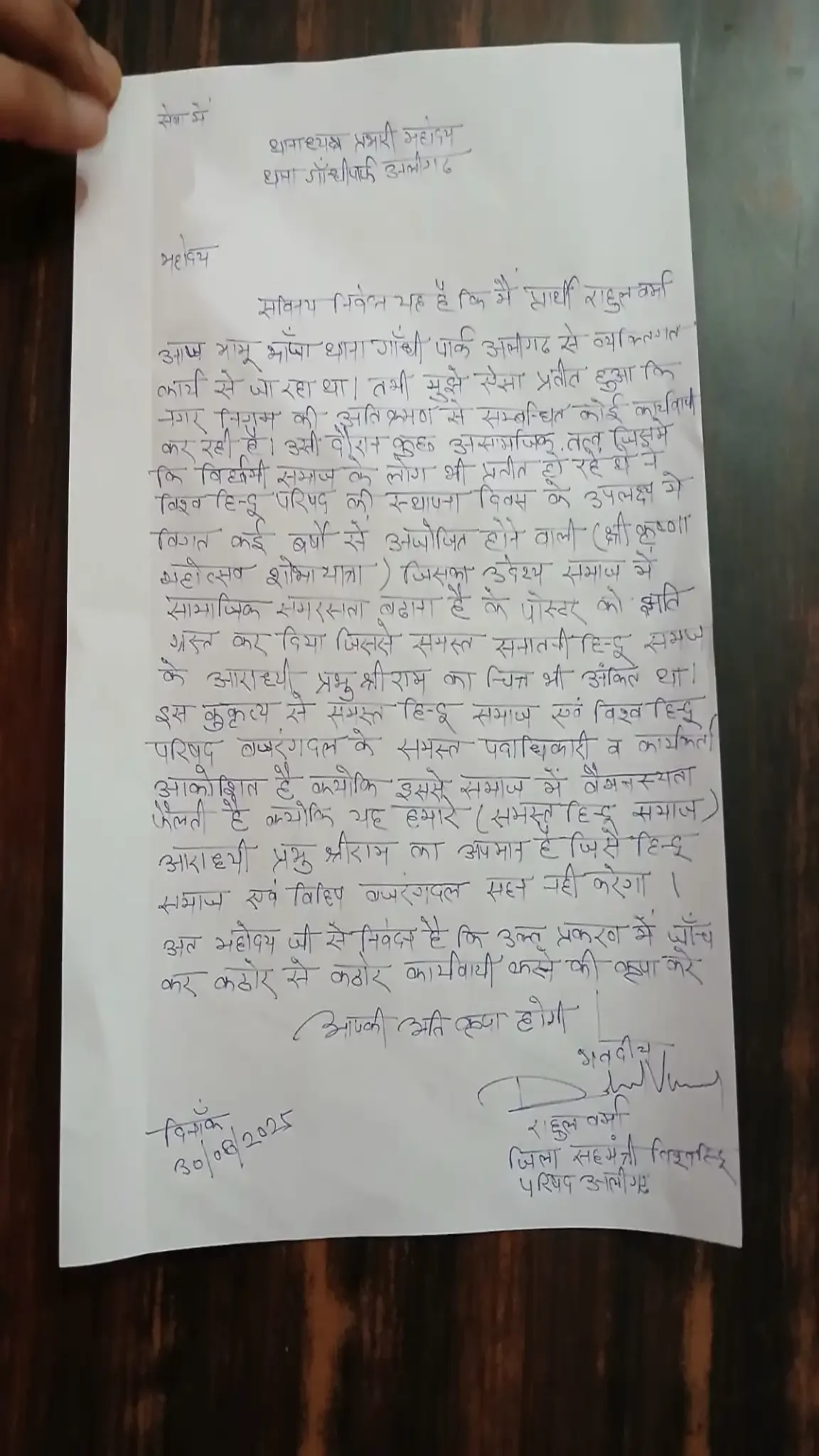
In Aligarh, Uttar Pradesh, tension erupted in the area after posters of Hindu deities were torn by members of the Muslim community. According to reports, the Municipal Corporation of Aligarh was carrying out an operation to remove illegal encroachments in the Mamu Bhanja Bazaar area, a Muslim-dominated area. During the anti-encroachment drive, posters of Hindu deities were torn down by members of the Muslim community as a protest against the removal of enroachment. The Muslim community began gathering in large numbers and creating a ruckus on the road. Amid the agitation, Muslim youths specifically targeted posters of the Shri Krishna Janmashtami Shobha Yatra, which depicted Lord Ram and Lord Krishna. Despite being placed high above the ground, the posters were forcibly brought down and torn. The incident provoked widespread anger within the Hindu community, particularly among members of the Vishwa Hindu Parishad (VHP) and Bajrang Dal, who regarded it as an insult to Hinduism and its revered deities. District Co-Secretary of the VHP, Rahul Verma, filed a written complaint at police station against those responsible. He reported that the posters had been put up across the city ahead of the VHP’s foundation day procession scheduled for 31 August and that their desecration in a Muslim-dominated area was a deliberate provocation. As of the date of this report, the police confirmed that the complaint had been received and assured that appropriate action would be taken against those involved.
Case Images
Why it is Hate Crime ?
This case has been added to the tracker under the primary category of - Attack on Hindu religious representations. Within it, the sub-category selected is - Desecration of Hindu religious symbols. Icons and symbols or a religious representation of a spiritual ideal are widely revered in Hinduism. Iconography is of vital significance in the Hindu milieu. It helps connect people’s spiritual beliefs with the real world. Iconography within the Hindu faith takes several shapes and forms. Murtis are of most significance to Hindus, to which daily rituals, prayers and offerings are done. Besides the murtis, there are several other symbols which have deep significance in the Hindu faith – the Om and Swastika for example. Since these Hindu religious symbols hold paramount importance in Hinduism, any desecration of symbols, icons, murtis, religious representations and manifestations, is driven by animosity towards the faith itself which manifests itself through these murtis, icons and symbols. Therefore, any desecration of these Hindu religious symbols and representations is considered religiously motivated hate crimes under this category. This case has been added to the tracker because posters of Hindu deities were torn and desecrated by the Muslim community. The immediate pretext for this desecration was the anti-encroachment drive that was being conducted by the Aligarh Municipal Corporation. In this case, the Hindu community did nothing that could be considered a provocation, yet Hindu religious sentiments were insulted through the targeted destruction of their sacred representations. In Hinduism, idols, pictures, and even posters of deities are not just artistic representations but are deeply revered manifestations of the divine. Their desecration, especially in a deliberate and targeted manner, is a direct affront to the religious sentiments of Hindus and an act of profound disrespect. Such acts of violence against Hindu religious symbols are not only a violation of faith but also an attack on the religious sentiments of the Hindu community, which derives spiritual, cultural, and social meaning from such symbols. The act of tearing down posters of Lord Ram and Lord Krishna was not random but reflected a deeper religious hostility. In Islamic theology, idol worship, referred to as shirk, is regarded as the gravest sin. The Qur’an strictly condemns it, and Islamic teachings emphasise the complete rejection of any practice associated with idol worship. Muslims are taught from a young age that idolatry is an unforgivable sin. While this belief is central to the Islamic faith, it has also led, historically and in contemporary times, to intolerance and hostility towards idol-worshipping religions, especially Hinduism. Therefore, when Muslims tore down posters of Hindu deities, it was not simply a spontaneous protest against the municipal corporation. It was a manifestation of deep-seated theological contempt against Hindu practices, stemming from the Islamic doctrinal view that idol worship is impure and offensive. It is also important to note that this incident occurred just before the day when the Vishwa Hindu Parishad (VHP) organised a procession to mark its foundation day. As a Hindu organisation dedicated to the preservation of Hindu identity and working for the Hindu cause, the VHP is often viewed with hostility by those who harbour animosity towards Hinduism. By desecrating the posters, the Muslim community not only insulted Hindu deities but also sought to disrupt the activities of a Hindu organisation and assert dominance in a Muslim-dominated area. Such actions were aimed at disrupting a Hindu religious procession and were rooted in animosity towards the public expression of Hindu identity in a Muslim-dominated area.


Case Status
Complaint filed


Perpetrators Details
Perpetrators
Muslim Extremists
Perpetrators Range
Unknown
Perpetrators Gender
unknown
 Sources




