Hindu migrant worker assaulted by Muslim men over saffron scarf; Hindu manager beaten for defending him and permitting the attire
 Bengaluru, Karnataka, India
  23 August, 2025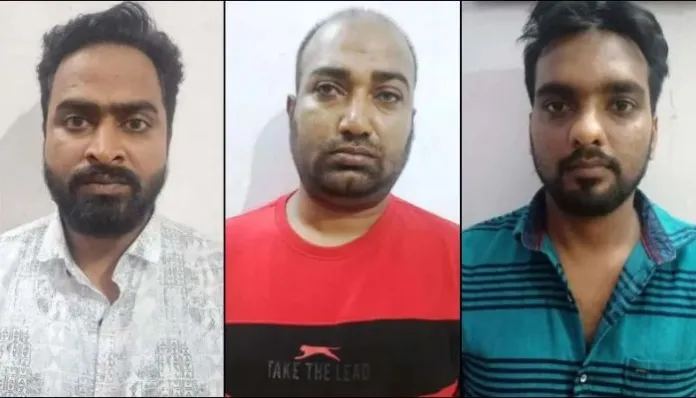
Case Summary
A migrant worker named Surendra Kumar from Bihar was attacked in Bengaluru, Karnataka, on the night of 24 August 2025, for wearing a saffron scarf on his head. The incident took place at around 9:30 pm in Kalasipalya, outside a transport company called Royal Travellers, where Surendra was employed as a labourer. Three Muslim men confronted him, mocked him for wearing the saffron scarf, ordered him to remove it, and then pushed him to the ground and beat him. When Harikrishna, the manager of the company who has been serving there for fifteen years, rushed to intervene, the attackers turned on him as well. They beat him, tore his shirt, and abused him, demanding to know why he allowed his workers to wear saffron. Harikrishna later filed a police complaint detailing the assault. Initially, the police treated the case lightly, recording it as a non-cognizable offence that did not allow immediate arrests. However, once a video of the attack spread across social media and Hindu groups protested, the police took firmer action. Three men were arrested: mechanic M. Tabrez (30), radium cutter Imran Khan (35), and real estate agent A. Aziz Khan (37). They were booked under provisions of the Bharatiya Nyaya Sanhita for voluntarily causing hurt, insulting religious sentiments, and provoking breach of peace. Police stated that further investigation was ongoing and assured that strict action would follow against those responsible.
Why it is Hate Crime ?
The primary category in this case is: Attack not resulting in death. The secondary category under this is: Attacked for Hindu identity. In several cases, Hindus are attacked merely for their Hindu identity without any perceived provocation. A classic example of this category of religiously motivated hate crime is a murder in 2016. 7 ISIS terrorists were convicted for shooting a school principal in Kanpur because they got ‘triggered’ seeing the Kalava on his wrist and tilak that he had put. In this, the Hindu victim had offered no provocation except for his Hindu religious identity. The motivation for the murder was purely religious, driven by religious supremacy. Such cases where Hindus are targeted merely for their religious identity would be documented as a hate crime under this category. The second sub-category relevant here is- Attacked for opposing radicals or trying to save victim. In several cases, Hindus are attacked for opposing religiously motivated crimes being committed against a fellow Hindu or simply for voicing an opinion opposing radical elements, who either have in the past or continue to persecute Hindus. In such cases, the initial attack against the victim, against which the Hindu was trying to defend the victim, would also need to be classified as a religiously motivated hate crime. Since the initial crime itself was religiously motivated and the subsequent crime of attempting to save the victim or speaking against the radical elements ends up inviting a violent attack, it would also be classified as a religiously motivated hate crime under this category. The assault on Surendra Kumar in Bengaluru is a religiously motivated hate crime rather than a simple dispute or altercation. The immediate provocation cited by the perpetrators was not a quarrel over personal conduct or an economic rivalry, but the presence of a saffron scarf on the victim’s head. Saffron has long carried symbolic weight as an expressive marker of Hindu identity, encompassing both religious devotion and cultural assertion. To single out an individual on account of this visible emblem is to target him for his religious identity rather than his actions. The fact that the attackers mocked the scarf, demanded its removal, and escalated to physical violence demonstrates hostility directed specifically towards the religious signifier. In this light, the attack cannot be detached from the broader phenomenon of Hinduphobia, where the very expression of Hindu identity becomes grounds for humiliation and assault. When Harikrishna, the manager of the company, rushed to intervene, the Muslim perpetrators turned on him as well. They beat him, tore his shirt, and abused him, demanding to know why he allowed his workers to wear saffron. The attackers shifted their aggression toward Harikrishna solely because he opposed their assault. They not only beat him but also abused him for allowing his workers to display saffron identity, which shows that his intervention and stance against their intimidation directly triggered their attack on him. This was not a random extension of violence but a deliberate targeting of someone who tried to stop the radical behaviour and stand up against religious bullying. The incident gains further clarity when examined in conjunction with other documented cases of similar character. The Hinduphobia Tracker has previously recorded episodes where Hindus faced violence solely for outward signs of faith, including the case in Malad, Maharashtra, where Hindu youths were assaulted by Muslims for chanting 'Jai Shri Ram' and wearing saffron attire. In both cases, the victims did nothing to provoke confrontation beyond manifesting a religious marker associated with Hindu practice. The motivation for the violence was thus not circumstantial but rooted in an animus towards the religion itself. This establishes a continuity in pattern, where symbolic Hindu identifiers are interpreted by hostile actors as challenges to their own religious or ideological supremacy. The Bengaluru case, therefore, illustrates the mechanics of a hate crime: it targeted a vulnerable worker not for any quarrel, but for his open identification as a Hindu through a saffron scarf. The secondary assault on Harikrishna, the manager, reinforces the religious undertone, as he was interrogated for permitting such visible markers within his workplace. When individuals or communities are attacked merely for symbols, colours, or attire associated with their religious identity, it constitutes a direct assault on freedom of belief and expression. In recognising such crimes as hate-driven rather than incidental, one acknowledges the deliberate targeting of Hindus for who they are, not for what they do.
Victim Details
Total Victim
2
Deceased
0
Gender
- Male 2
- Female 0
- Third Gender 0
- Unknown 0
Caste
- SC/ST 0
- OBC 0
- General 0
- Unknown 2
Age Group
- Minor 0
- Adult 2
- Senior Citizen 0
- Unknown 0


Case Status
Arrested


Perpetrators Details
Perpetrators
Muslim Extremists
Perpetrators Range
From 2 To 5
Perpetrators Gender
male
 Sources




