Hindu man attacked after minor scuffle in Muslim-dominated area of Meerut; several Jatav men injured in communal clash
 Meerut, Uttar Pradesh, India
  21 August, 2025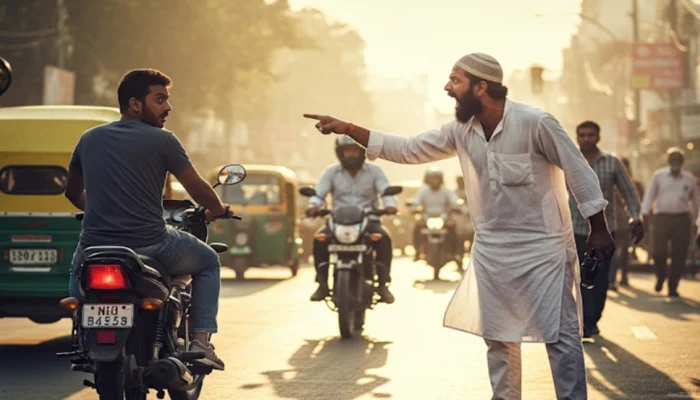
Case Summary
In Lu-Buxar village of Meerut, Uttar Pradesh, a Hindu man was brutally attacked by a Muslim man named Sariq over a minor scuffle, which escalated into a violent communal clash. The incident began when Sariq, a resident of the village, was driving his father’s pickup van at high speed. When villagers objected to his rash driving, an argument broke out, resulting in minor pushing and shoving, and the glass of the vehicle was broken. The matter was pacified at the time. However, in the evening, when the Hindu man, who was involved in a scuffle with Sariq earlier, was passing through a Muslim dominated area, he was stopped by Sariq. Sariq abused him and physically assaulted him, due to which communal tensions rose in the area. The Jatav community quickly gathered and reached the spot. The Muslim community also gathered, and a fight broke out between the two groups. Both sides began attacking each other with sticks and sharp weapons, and the violence continued late into the night. The chaos continued till midnight, and several people from the Jatav community were injured. Those injured included Shivanshu Gautam, Anuj, Lalin, Mohit, Gaurav, Adesh and Pawan. Following the incident, the police reached the spot, rushed the injured to the Community Health Centre, and took control of the situation. An FIR was registered on the basis of facial recognition, and four accused were arrested.
Why it is Hate Crime ?
This case has been added to the tracker under the primary category of - Attack not resulting in death. Within it, the sub-category selected is - Attacked for crossing 'Muslim area'. One of the reasons that Hindus get attacked unprovoked specifically by Islamists is for crossing ‘Muslim areas’. Essentially, Muslim mobs often attack Hindus crossing or present in certain areas which have a majority Muslim population. It has often been cited as one of the reasons to blame Hindus for attacks against themselves, signalling that Hindus displaying religious symbols, taking our religious processions or crossing any area which is dominated by Muslim residents is a provocation in and of itself. These areas are mostly ghettoized areas where mobs mobilize quickly to attack Hindus for a variety of reasons like playing music during a religious procession, crossing a mosque, wearing a tilak or any other religious symbol in a Muslim-dominated area, praying at a local temple in that area etc. There have been cases where the few local Hindus of that area have been attacked on their way to the Temple for prayers as well, simply because the area is considered a Muslim-dominated area. Several times, it is entirely possible that the immediate trigger for the violence against Hindus was non-religious in nature, however, the violence became religiously motivated in nature because the area was Muslim dominated and the residents on the whole harboured animosity towards Hindus, evidenced from the actions of the mob, the slogans, and the nature of the attack. Such crimes are motivated by the religious identity of the victims and are therefore classified as hate crimes under this category. The second sub-category selected here is - Attacked for Hindu identity, In several cases, Hindus are attacked merely for their Hindu identity without any perceived provocation. A classic example of this category of religiously motivated hate crime is a murder in 2016. 7 ISIS terrorists were convicted for shooting a school principal in Kanpur because they got ‘triggered’ seeing the Kalava on his wrist and tilak that he had put. In this, the Hindu victim had offered no provocation except for his Hindu religious identity. The motivation for the murder was purely religious, driven by religious supremacy. Such cases where Hindus are targeted merely for their religious identity would be documented as a hate crime under this category. The third sub-category selected here is - Communal clash/attack. Communal clash is a form of collective violence that involves clashes between groups belonging to different religious identities. For a communal clash between Hindus and non-Hindus to qualify as a religiously motivated hate crime, the trigger of the violence itself would have to be anti-Hindu in essence. For example, if there is a Hindu religious procession that comes under attack from a non-Hindu mob and after the initial attack, Hindus retaliate in self-defence, leading to a communal clash between the two religious communities. While at a later stage, both communities are involved in the clash/violence, the initial trigger of the violence was by the non-Hindu mob against the Hindus and therefore, it could safely be termed as an anti-Hindu violence. Further, the trigger would also have to be religiously motivated. In the cited example, the attack by the non-Hindu mob was against religious processions and therefore, can be concluded to be religiously motivated. In some cases, the trigger may be non-religious, however, it develops into religious violence against Hindus at a later stage. In such cases too, the foundational animosity towards Hindus becomes the motivating factor of the crime and therefore, it would be classified as a religiously motivated hate crime against Hindus under this category. This case has been added to the tracker because a Hindu man was brutally attacked by the Muslim accused over a minor scuffle. The attack occurred when the Hindu victim was crossing a Muslim-dominated area, which transformed the incident from a personal dispute into a communal hate crime. Although the immediate trigger appeared to be a minor argument over rash driving, the disproportionate level of violence inflicted upon the Hindu man demonstrates that the attack had clear communal undertones. Even though the earlier scuffle in this case had already been sorted and pacified, the fact that Sariq chose to attack the Hindu man again when he crossed through the Muslim area shows that the real trigger was not the earlier argument itself but the religious identity of the victim. It was about how a Hindu man could challenge the actions of the Muslim community. The fact that the assault occurred when the Hindu victim entered the Muslim area demonstrated how such spaces are often treated as exclusive zones where Hindus are considered outsiders and can be targeted with impunity. This reflects an Islamist supremacist mindset, where Muslims view opposition or confrontation by Hindus as intolerable and something that must be crushed through violence, which the accused did in this case. Such violence also serves as a statement to others that no one should oppose Muslims, else they would be met with the same fate. The confrontation in the Muslim area represents clear targeting and premeditated intent, as the accused’s actions likely would have no consequence or opposition in such areas. In many such cases across India, violence against Hindus has been concentrated around mosques, dargahs, or localities dominated by Muslims. These spaces are often constructed as communal strongholds where religious identity dictates social control, leading to the exclusion and targeting of Hindus. This behaviour is not simply reactive hostility but an organised form of communal entitlement, where sometimes even the very presence of Hindus in Muslim-majority areas is interpreted as a provocation, let alone a minor argument. Even when an initial dispute appears unrelated to religion, the disproportionate violence inflicted upon the victim reveals a deeper layer of religious animosity towards the Hindu identity. Since this case meets the parameters of a religiously motivated crime, it is being added to the hate crime database.
Victim Details
Total Victim
7
Deceased
0
Gender
- Male 7
- Female 0
- Third Gender 0
- Unknown 0
Caste
- SC/ST 7
- OBC 0
- General 0
- Unknown 0
Age Group
- Minor 0
- Adult 0
- Senior Citizen 0
- Unknown 7


Case Status
Case sub-judice


Perpetrators Details
Perpetrators
Muslim Extremists
Perpetrators Range
Unknown
Perpetrators Gender
unknown
 Sources




