Hindu temple attacked and Shivling desecrated by Muslim miscreants in Uttar Pradesh
 Bareilly, Uttar Pradesh, India
  19 August, 2025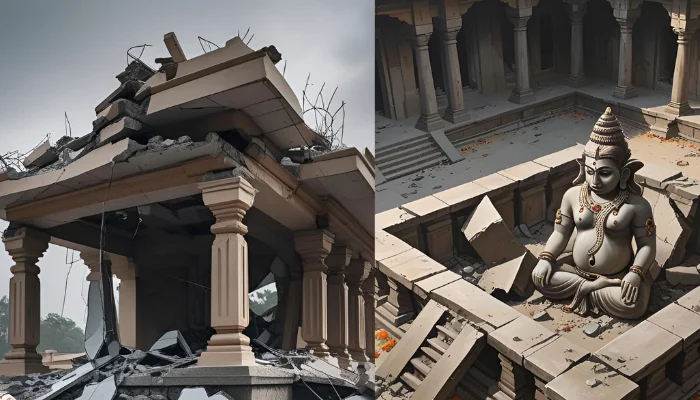
Case Summary
In Fazilpur village, Bareilly, Uttar Pradesh, a Hindu temple dedicated to Lord Shiva was attacked by members of the Muslim community. The perpetrators also broke the sacred Shivling inside the temple. According to reports, the dispute occurred when Hindu villagers constructed a security wall around the temple site without obtaining administrative approval. Enraged by the construction, members of the Muslim community entered the temple premises, desecrated the Shivling, and attempted to demolish the temple wall. The situation quickly escalated in the area as members of both communities confronted one another. On receiving information, the police immediately rushed to the location, detained eight individuals, and took them into custody. After some time, SDM Udit Pawar, Tehsildar Dushyant Pratap Singh and the revenue team arrived and began an investigation. To maintain peace in the area, the administration offered to install another Shivling in place of the previous one. A woman also submitted a memorandum to the SDM demanding action against those responsible. Following this, the administration ordered the installation of CCTV cameras at the site and issued firm warnings that any future attempts at desecration or unlawful construction would not be tolerated. The officials emphasised that no further construction would take place without official permission and referred the matter to the Tehsildar for further investigation. Media reports stated that the dispute had been going on since 2017, and there were tensions between the two communities. During the Urs procession (Islamic religious procession) in 2017, people from both communities also came face to face. During that time, the administration prohibited construction from taking place at the religious site. Despite that order, construction later resumed, eventually sparking the current conflict.
Why it is Hate Crime ?
This case has been added to the tracker under the primary category of - Attack on Hindu religious representations. Within it, the sub-category selected is - Attack on temples. In Hinduism, a temple is the abode of the Deity. The Deity in the Temple is consecrated, thereby, making it a real, breathing entity. Hindus believe that not just the Deity but the temple premises itself are sacred to Hindus since Hindus hold the faith that the entire Temple space is an amalgamation of the divine energy of the deity. Given the central significance of Temples in Hindu Dharma, any attack against a Hindu Temple or its peripheral premises is an attack on the faith itself and is born out of animosity towards the faith, of which, the Temple is a central tenet. Any manner of attack against a Temple and/or its premises would therefore be considered a religiously motivated hate crime. The other sub-category selected is - Desecration of Hindu religious symbol. Icons and symbols or a religious representation of a spiritual ideal are widely revered in Hinduism. Iconography is of vital significance in the Hindu milieu. It helps connect people’s spiritual beliefs with the real world. Iconography within the Hindu faith takes several shapes and forms. Murtis are of most significance to Hindus, to which daily rituals, prayers and offerings are done. Besides the murtis, there are several other symbols which have deep significance in the Hindu faith – the Om and Swastika for example. Since these Hindu religious symbols hold paramount importance in Hinduism, any desecration of symbols, icons, murtis, religious representations and manifestations, is driven by animosity towards the faith itself which manifests itself through these murtis, icons and symbols. Therefore, any desecration of these Hindu religious symbols and representations is considered religiously motivated hate crimes under this category. This case has been added to the tracker because the Muslim community desecrated the Hindu temple and broke the sacred Shivling. They also attempted to damage the temple wall. A temple is an institution that holds immense spiritual importance in the Hindu faith. For Hindus, temples are not mere physical structures; they are sanctified spaces that embody the divine presence of Hindu deities. Acts of violence against such spaces are not isolated incidents of destruction but reflect underlying hostility towards Hindu beliefs and identity. Such an attack is therefore not only material but also symbolic, striking at the Hindu faith itself. The Muslim community also broke the consecrated idol, the Shivling, present inside the temple. The intention was obvious: to damage the temple idols and hurt Hindu religious sentiments. In Hinduism, idols of Hindu deities are not just artistic representations but are deeply revered manifestations of the divine. Their desecration is a direct affront to the religious sentiments of Hindus and an act of profound disrespect. Such acts of violence against Hindu temples and their idols are not just an attack on temple property; they are an act of violence against the religious sentiments of the Hindu community that derives spiritual, cultural, and social meaning from that temple space. Furthermore, even if the Muslim community had issues with the construction of the security wall, they should have taken the appropriate legal or administrative channels to resolve the dispute. Instead, they chose to forcibly enter the temple premises and specifically target the Shivling, demonstrating that the motivation was not merely territorial or related to the construction, but one rooted in religious animosity. The fact that the sacred Shivling and the Hindu temple were the target, in a dispute that could have remained about the construction of the wall, makes the religious motivation clear. Such actions are rooted in religious animosity towards Hindus and their sacred sites; therefore, this case is being added to the hate crime database.


Case Status
Arrested


Perpetrators Details
Perpetrators
Muslim Extremists
Perpetrators Range
From 5 to 10
Perpetrators Gender
unknown
 Sources




