Anti-Hindu Fake News: 'The Wire' attempts to downplay the genocide of Hindus by labelling the Partition of India as a 'class struggle'
 Delhi, India
  14 August, 2025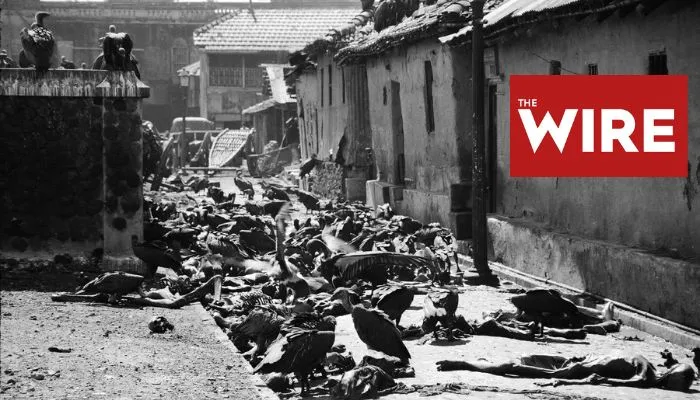
Case Summary
A deliberate attempt to whitewash and downplay the genocide of Hindus by Muslim extremists was undertaken by The Wire, a leftist Islamist news portal. On 15th August 2025, it published an article written by a Bangladeshi writer, Ahmede Hussain, which tried to reframe the Partition of India and the creation of Pakistan. The Wire’s article stated that the demand for Pakistan was not rooted in religious separatism but was supposedly a “class struggle” of peasants and oppressed groups against zamindars and colonial exploitation. The Wire also asserted that Islam in Bengal functioned as an instrument of equality, suggesting that Partition should be understood not as a communal project, but rather a pursuit of social justice. The article presented the Pakistan Movement in East Bengal as a peasant uprising, claiming Islam served merely as a symbol of unity in the fight against class oppression. This narrative deliberately downplayed the overtly religious character of the demand for Pakistan. In reality, Muhammad Ali Jinnah’s “Two-Nation Theory” was not a call for class revolution; it was an unequivocal declaration that Hindus and Muslims could not coexist as a single nation. The Muslim League did not rally the poor under socialist ideals, but beneath the green banner of Islam. Its speeches, resolutions, and mobilisation were saturated with Islamic rhetoric and not with appeals for economic redistribution. Such biased articles served only to whitewash the brutality and genocide suffered by Hindus at the hands of Muslim extremists. This form of historical revisionism also glossed over events like Direct Action Day and the Noakhali genocide, diminishing the real suffering and violence experienced by Hindu communities at the hands of the bloodthirsty Muslim extremists. In a similar manner, the left and Muslim lobby of 'intellectuals' and 'journalists', previously on multiple occasions, had also attempted to whitewash and justify the Moplah genocide of Hindus by Muslim extremists as a 'class struggle'.
Why it is Hate Crime ?
This case has been added to the tracker under the primary category- Hate Speech against Hindus. Within this, the subcategory selected is- Denial or mocking of genocide/large-scale persecution of Hindus. Denial or mocking of genocide/large-scale persecution/ethnic cleansing refers to the act of denying or minimizing the fact of the ethnic cleansing and/or genocide and/or religious persecution of Hindus. This often involves denying the scale, mechanisms, religious intent, or even the occurrence of the ethnic cleansing and/or genocide and/or religious persecution of Hindus. Hate speech of this kind involves the dissemination of falsehoods that deny or distort established historical facts or mock the suffering of Hindus by saying that they deserved the persecution, motivated by Hinduphobia. Denying such atrocities is not only about the denial of facts or rewriting/revising history, but it also delegitimises the religiously motivated persecution of Hindus, the religious hate/motivation/animosity that led to the persecution, and dehumanises Hindus as a religious group. Such denial of ethnic cleansing and/or genocide and/or religious persecution of Hindus not only denies the suffering but also paves the way for future/present atrocities and hate speech, inciting prejudice and violence against Hindus. It also provides a justification for violence by delinking religious animosity from religiously motivated crimes committed against Hindus. Since such denial and/or mocking of genocide/ethnic cleansing/atrocities motivated by religious animosity leads to present and future ramifications of creating more hate speech, violence, dehumanisation and delegitimisation, it would be considered hate speech under this category. The other subcategory selected is- Anti-Hindu subversion and prejudice. Within this, the tertiary category selected is- Anti-Hindu fake news or downplaying. Hate speech is defined as any speech, gesture, conduct, writing, or display that is prejudicial against a specific individual and/or group of people, which is leading to or may lead to violence, prejudicial action or hate against that individual and/or group. Media plays a specific and overarching reach in perpetuating prejudicial attitudes towards a community owing to unfair, untrue coverage and/or misrepresentation/misinterpretation, selective coverage and/or omission of facts of/pertaining to issues affecting a specific religious group. This type of bias can dehumanise the victim group, making it easier for others to justify harmful actions against them, which aligns with the objectives of hate speech laws aimed at preventing such harm. It is often observed that the media takes a prejudicial stand against the Hindu community driven by their need to shield the aggressor community which happens to be a numeric minority, however, is the one perpetrating violence against Hindus. For example, the media is often quick to contextualise religiously motivated crimes against Hindus, omit or misrepresent facts that point towards religiously motivated hate crimes, justify and/or downplay religiously motivated hate crimes or simply present fake news to stereotype Hindus. Such media bias leads to the denial of persecution and is often used to dehumanise Hindus, leading to justification for violence against them. For example, the media covered several fake allegations of Hindus targeting Muslims and forcing them to chant Jai Shree Ram. Most of these cases were proved false and fabricated after police investigation. These fake news reports were subsequently never retracted or clarified. Such fake news led to the justification of violence and dehumanisation of Hindus based on the argument that since Hindus targeted Muslims and forced them to chant Jai Shree Ram, the dehumanisation of Hindus and violence against them was par for the course and merely a retaliation. Such media bias leads to prejudicial portrayal of Hindus and offers a justification for violence against them and therefore, is considered hate speech under this category. The Wire’s article exemplified anti-Hindu rhetoric through its deliberate misrepresentation of the historical record, systematic erasure of Hindu suffering, and justification of the atrocities committed against Hindus under the false disguise of 'social justice'. Firstly, The Wire asserted that the creation of Pakistan was simply the result of “class struggle” rather than Islamic separatism and anti-Hindu bigotry. However, this narrative was contradicted by the explicit declarations and documented intentions of leaders like Muhammad Ali Jinnah and Sir Syed Ahmed Khan, whose “Two-Nation Theory” maintained that Hindus and Muslims were two distinct nations unable to coexist. The foundation of the Pakistan Movement was built on Islamic religious identity, not on the grievances of peasants or supposed class oppression. Downplaying this fact is not only historically inaccurate but serves to falsify the very basis upon which one of the bloodiest chapters in history took place, where Hindus were butchered by Muslim extremists. Secondly, the article whitewashes several instances of horrific anti-Hindu violence, such as the Direct Action Day massacre in Calcutta and the Noakhali genocide, as mere caste or class struggles. The Direct Action Day, called for by Jinnah in 1946, was not a peasant uprising but a mass mobilisation of Muslims under the banner of Islam, which resulted in targeted slaughter, sadistic brutality, and mass displacement of Hindus. The violence was overtly communal; Hindu temples were desecrated, religious symbols were defiled, Hindu women were raped and murdered, and thousands were rendered homeless. Labelling such crimes as “class struggle” conceals the reality that these were acts of genocide driven by religious hatred and the desire to eliminate Hindus as a civilisational presence. The Noakhali genocide followed the same trajectory: the systematic killing, rape, forced conversion, and mass displacement of Hindus, all carried out with explicit religious intent. The attempts by The Wire to rationalise these events as struggles of peasants against zamindars not only distort history but also amount to a cynical act of whitewashing the genocide of Hindus. Such linguistic manipulation shifts attention from the actual victims and absolves the Muslim perpetrators of communal hatred. The creation of Pakistan itself was a product of persistent religious animosity towards Hindus, reinforced by the global doctrine of Ummah—a belief within Islam that Muslims constitute a nation unto themselves, superseding the civilisational and territorial boundaries of India. This belief fuelled calls for a separate state, not out of any genuine movement for economic equality but from the desire for religious dominance and the marginalisation of Hindus. Such actions were glaring demonstrations of acts motivated by deep-seated religious animosity towards the Hindu community and their faith, making it a religiously motivated crime. Furthermore, The Wire and similar leftist and 'Islamist' intellectuals have long justified genocidal violence against Hindus by reframing events such as the Moplah massacre of 1921 in Kerala. This was no agrarian revolt or class struggle; it was an Islamist campaign to establish an Islamic caliphate in Malabar. The Moplah genocide involved the mass killing, forced conversion, and displacement of thousands of Hindus, many of whom were not landlords or wealthy oppressors but poor peasants, artisans, and Dalits. The consistent effort to label these as class uprisings is an ideological attempt to excuse religious bigotry and violence, betraying the memory, lives and dignity of Hindu victims. The recurring theme in these narratives is the weaponisation of Marxist vocabulary, “class”, “social justice”, “oppression”, to obscure the religious motivation behind anti-Hindu atrocities. Islam was not a mere vehicle for equality, as The Wire asserted, but the explicit rallying point for communal mobilisation. Religious appeals saturated the speeches, resolutions, and campaigns of the Muslim League and other Islamist groups, not the vocabulary of economic redistribution. Ultimately, The Wire’s article did not offer analytical nuance but participated in a well-documented pattern of historical revisionism intended to erase Hindu suffering, justify Islamic violence, and recast Muslim perpetrators as revolutionaries. By doing so, it perpetuated anti-Hindu prejudice and contributed to the ongoing marginalisation and dehumanisation of Hindus, both in historical memory and contemporary discourse. Given that this is an instance of denial and whitewashing of the genocide of Hindus, this case is being added to the hate crime database.


Case Status
Unknown


Perpetrators Details
Perpetrators
Others
Perpetrators Range
One Person
Perpetrators Gender
male
 Sources




