Dalit Hindu couple harassed and lured with inducements to convert; Christian missionaries insulted Hindu deities
 Pune, Maharashtra, India
  30 April, 2025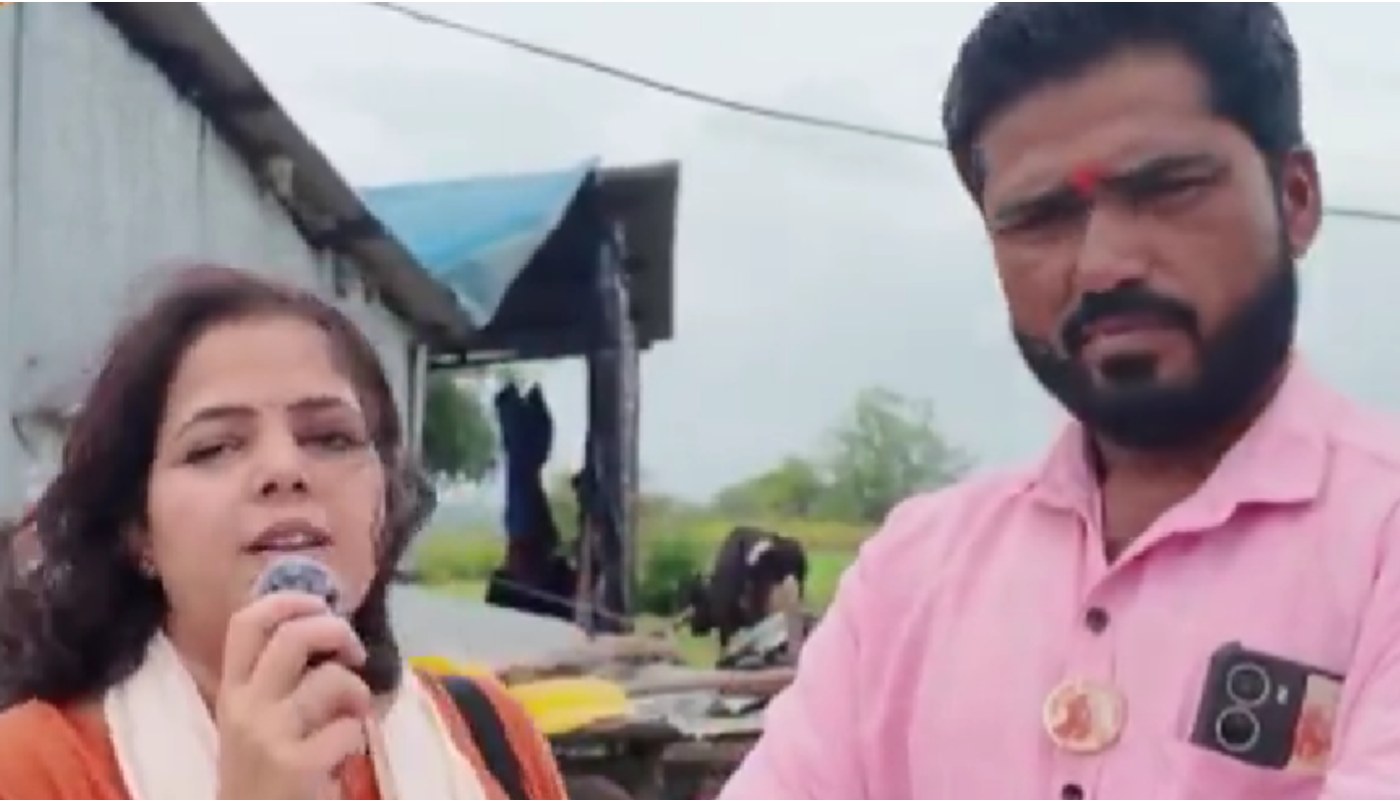
Case Summary
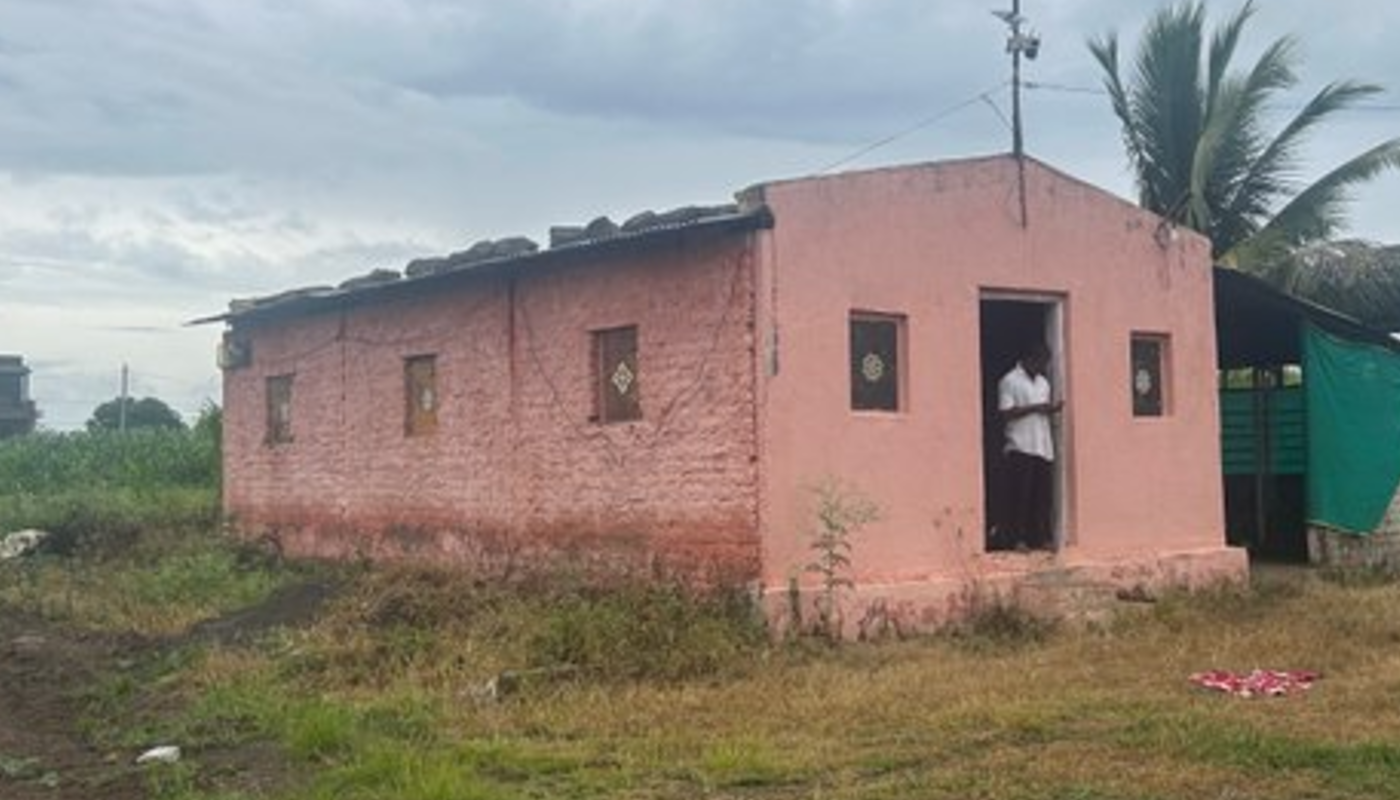
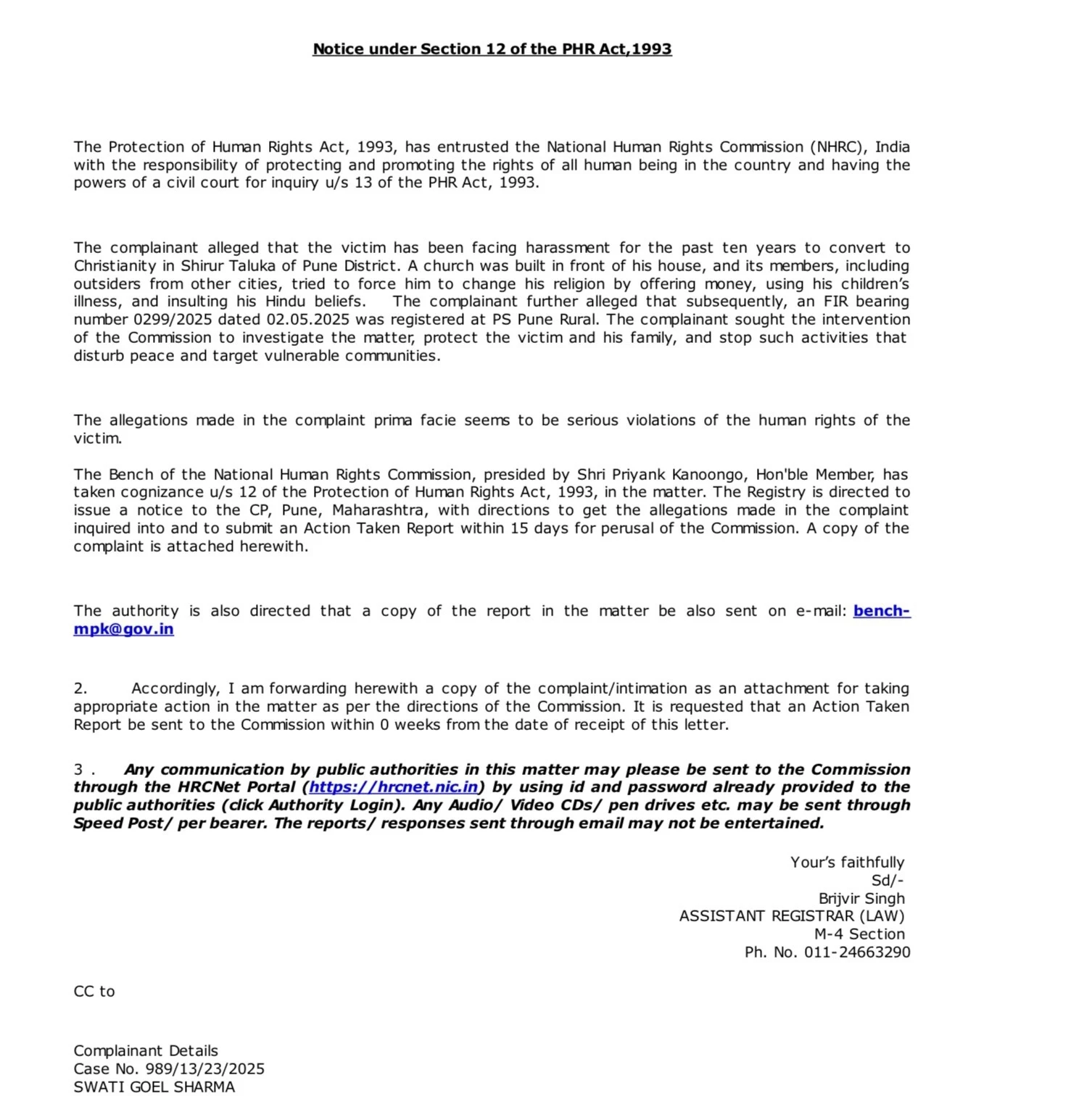
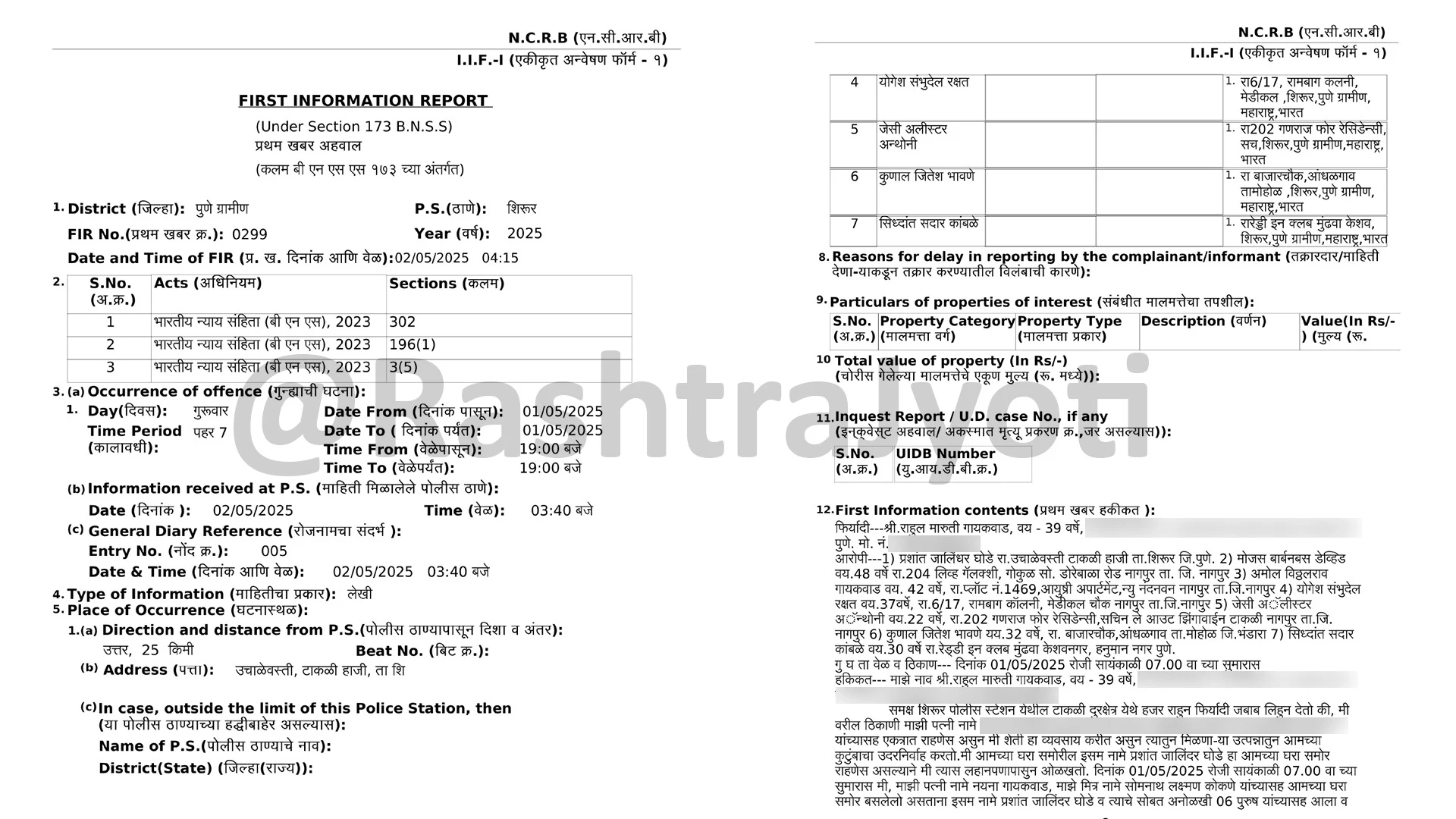
A Hindu man from a Scheduled Caste community in a village in Pune district, Maharashtra, was forced to convert to Christianity. He resisted sustained efforts at religious conversion that targeted him and his family. Missionaries offered inducements and denigrated Hindu deities in the conversion process. The pressure came from a group of Christian missionaries operating through an illegally constructed and unregistered church in the village, under the guise of a prayer hall. Rahul Maruti Gaikwad, a 39-year-old daily wager from the Matang community in Uchalevasti, Taklihaji village of Shirur taluka, filed a police complaint on May 1, 2025, against seven men who attempted to coerce him and his wife into converting to Christianity. Among them was Prashant Jalindar Ghode, his long-time neighbour, who had become a covert Christian convert and local missionary figure. Ghode, along with six accomplices from other parts of Maharashtra, approached Rahul and his wife at their home. One of them, identifying himself as Moses David, began preaching about Christianity and questioned Rahul about his faith. When Rahul made it clear that he followed Hinduism and had no interest in converting, the group brought out a Bible and began insulting Hindu deities worshipped by the family, including Goddess Kalubai and Swami Narendra Maharaj. They claimed that Jesus alone could heal illnesses and solve financial troubles. One of them, Amol Gaikwad, claimed miraculous healing of his eyesight after attending church in Nagpur. They mocked Rahul’s religious practices and ridiculed his gods for being ineffective, specifically targeting the family’s hardships and the illnesses of his children. When the pressure escalated, Rahul used a friend’s phone to call the police emergency number. Officers arrived and took both parties to the Takali police outpost. Based on Rahul’s complaint, Shirur Police registered FIR No. 299/2025 under several sections of the Bharatiya Nyaya Sanhita, 2023. These included Section 302 (deliberate wounding of religious sentiments), Section 196(1) (promoting communal hatred), and Section 3(5) (collective criminal liability). All seven men named in the FIR were arrested but later released on bail. Seven men were named as accused, namely Prashant Ghode, Moses David from Nagpur, Amol Gaikwad from Nagpur, Yogesh Sambhudel Rakshat from Nagpur, Jesse Allister Anthony from Nagpur, Kunal Jitesh Bhavane from Bhandara, and Siddhant Sadar Kamble from Pune. The confrontation was not an isolated incident. It was the culmination of almost a decade of activity at the illegal church facing Rahul’s house. The structure, bearing a Christian cross and image of Jesus, was built by Prashant Ghode without any government clearance and had been functioning for seven years. Multiple villagers confirmed that it had become a hub for conversion attempts targeting Hindu families from the SC Matang and NT Dhangar communities, using inducements, false claims of miracles, and psychological pressure. During Hindu festivals like Gudi Padwa and Ram Navami, as well as during funerals, the prayer hall would routinely blare sermons asserting the supremacy of Jesus through loudspeakers. On May 1, 2025, hours before the FIR, villagers had requested the centre to stop the broadcasts during mourning for an elderly woman’s death. Their appeal was ignored. Following the incident and the registration of the FIR, national-level intervention came after a complaint was filed in June with the National Human Rights Commission (NHRC) by journalist Swati Goel Sharma. NHRC member Priyank Kanoongo took cognisance of the matter and directed the Pune district authorities to act. Subsequently, the prayer hall was ordered shut down. Villagers confirmed that the hall had ceased operations, and it was revealed that the Pune police commissioner had personally intervened after the NHRC notice. Rahul continued to face threats but remained undeterred. “I may be poor, but I will not give up my Dharma,” he said. “What they did in the name of ‘prayer’ was nothing but conversion and spreading hatred. Now the truth is being exposed," he remarked, speaking to a journalist.
Case Images
Why it is Hate Crime ?
The primary category in this case is: Predatory proselytisation. The first subcategory under this is: Conversion/ attempts to convert by inducement. Predatory Proselytisation is not just limited to threat, harassment, force and violence, but it also has contours of stealth. In several cases, the Hindu victim is exploited to convert, with non-Hindus taking advantage of their poverty. In such cases, the Hindu victim who is suffering financially is offered monetary benefits, including lucrative offers for jobs, health treatment, education, etc, to induce the victim into changing his/her religion. In such cases, the religious identity of the victim and the aim to disenfranchise him from his faith form the heart of the crime. Also, taking advantage of and exploiting an individual’s economic vulnerabilities is widely acknowledged as exploitation, forms of which are often penalised by law. Such cases therefore are considered religiously motivated hate crimes since the victim’s religious identity forms the very heart of the crime itself. The second subcategory under this is: Attempting to convert/converting by denigrating Hinduism. In several cases, Hindus are converted or an attempt is made to convert Hindus by denigrating their faith, Hinduism. In such cases, the Hindus associate with the non-Hindu perpetrators often by choice and then, the attempt to convert them by insulting their faith, showing the faith down etc begins. An example of this would be a non-Hindu gathering where the Hindus are attending the gathering of their own free will. However, once they attend the gathering, there is an explicit attempt to convert them by abusing their faith and hailing the faith of the perpetrator. The denigration of the Hindu faith is often based on misrepresentation of the Hindu faith, its doctrine and scriptures and insult to espoused traditions if not blatant lies about Hindu beliefs and ways. Such conversions or attempts at conversions are driven by animosity towards the Hindu faith and are therefore documented as religiously motivated hate crimes. The third subcategory under this is: Harassment, threats, coercion for conversion. Harassment covers a wide range of behaviours of an offensive nature. It is commonly understood as behaviour that demeans, humiliates, and intimidates a person, including threats and coercion. Harassment and threats, in this case, find their root on discriminatory grounds which has the effect of nullifying a person’s rights or infringing upon his freedom to exercise his right specifically owing to the victim’s religious identity. Verbal and physical threats and psychological or physical harassment are often used against Hindu victims because they choose to practice their professed religion. Religious harassment also includes forced and involuntary conversions by harassment, threats or coercion. Coercion includes intimidatory tactics like force-feeding a Hindu victim beef to convert to another religion, forceful circumcision etc. In several cases documented, non-Hindu perpetrators or those who harbour specific animosity towards Hinduism, harass victims simply based on their religious identity. Such cases often also include harassment to ensure the Hindu victim abandons his/her professed religion and adopts the religion of the perpetrator. Such cases where Hindu victims are harassed to convert to the perpetrator’s religion are rooted in animosity towards the victim’s religious identity and are therefore documented as religiously motivated hate crimes. The fourth subcategory under this is: Proselytisation by grooming, brainwashing, manipulation or subtle indoctrination. The tertiary category under this is: Pattern of targeting Hindus. Religious brainwashing essentially means the often subtle and forcible indoctrination to induce someone to give up their religious beliefs to accept contrasting regimented ideas. Religious grooming or brainwashing also involves propaganda and manipulation. It involves the systematic effort, driven by religious malice and indoctrination, to persuade “non-believers’ to accept allegiance, command, or doctrine to and of a contrasting faith. Cases of such grooming or brainwashing are far more nuanced than direct threats, coercion, inducement and violence. In such cases, it is often seen that there is repeated, subtle and continual manipulation of the victim to induce disaffection towards their own faith and acceptance of the contrasting faith of the perpetrator. While subtle indoctrination is widely acknowledged as predatory, an element which is often understated in such conversions or the attempts of such conversion is the role of loyalty and trust which might develop between the perpetrator and the victim. Fiduciary relationships are often abused to affect such religious conversion. For example, an educator transmitting religious doctrine of a competing faith to a Hindu student. The Hindu student is likely to accept what the teacher is transmitting owing to existence of the fiduciary relationship. The exploitation of the fiduciary relationship to religiously indoctrinate victims would also be included in this category. Since the underlying animosity towards the victim’s faith forms the basis of predatory proselytization, such cases are considered religiously motivated hate crimes. In the Pune case involving Rahul Maruti Gaikwad, the sequence of events reflects a deeply troubling example of predatory proselytisation, a religious hate crime driven by hostility toward Hindu beliefs. The targeting of Rahul and his family by a group of Christian missionaries shows a clear intent to manipulate, insult, and pressure a Hindu man into abandoning his ancestral faith. This crime involved all three layers commonly seen in such hate-motivated conversion attempts: inducement, denigration, and harassment. The first step was inducement. The missionaries offered promises of healing and financial relief, exploiting the economic vulnerability of Rahul, a father of three from the Matang community. They claimed that worshipping Jesus would cure illnesses and improve the family’s situation. Such attempts to lure a struggling family with promises of miracles and material benefits weaponise poverty for religious gain. The underlying message was that Hinduism had failed him, and Christianity was the solution. The next stage involved deliberate denigration of Hinduism. When Rahul refused to engage with their religious material, the group insulted Hindu gods and mocked his faith. They belittled the worship of Goddess Kalubai and spiritual leader Swami Narendra Maharaj, questioning whether these deities had ever helped his family. These were not harmless opinions; they were calculated attacks on deeply personal beliefs. The ridicule was intended to create self-doubt, shame, and a sense of inferiority, paving the way for psychological manipulation. Finally, the missionaries resorted to harassment. Despite Rahul’s repeated rejections, they continued pressuring him and his wife to convert. Their presence at his home was deliberate, confrontational, and intimidating. Rahul had to call the police to protect himself and his family. The harassment extended even after the FIR, with threats continuing over the phone, indicating sustained pressure from religious networks. The case of Rahul Gaikwad reflects a sustained pattern of religiously motivated targeting. For over seven years, the nearby church played a decisive role in conditioning his beliefs and conduct, gradually distancing him from his Hindu identity. This was not incidental exposure but a calculated use of religious institutions to shape a Hindu man’s worldview. Through long-term grooming, the perpetrators leveraged emotional and social influence, manipulating him into rejecting his own dharma. Such exploitation of trust under the veil of education or care constitutes religious hate, rooted not in compassion but in deliberate hostility toward Hinduism. This case is an example of a targeted, ideologically motivated attempt to strip a Hindu man of his faith by exploiting his circumstances, insulting his beliefs, and coercing him into religious submission. Disclaimer: While the family's minor children were referenced during the coercion attempt—particularly in relation to their illnesses—it is not evident from available information that the children themselves were directly targeted for conversion. Therefore, for the purpose of documentation, only the adult Hindu couple (husband and wife) has been considered as victims in this case.
Victim Details
Total Victim
2
Deceased
0
Gender
- Male 1
- Female 1
- Third Gender 0
- Unknown 0
Caste
- SC/ST 2
- OBC 0
- General 0
- Unknown 0
Age Group
- Minor 0
- Adult 2
- Senior Citizen 0
- Unknown 0


Case Status
Case sub-judice


Perpetrators Details
Perpetrators
Christian Extremists
Perpetrators Range
From 5 to 10
Perpetrators Gender
male
 Sources




