Hindu passenger becomes victim of anti-Hindu bias; Muslim perpetrator falsely labelled 'Hindu' in Indigo assault case
 India
India  31 July, 2025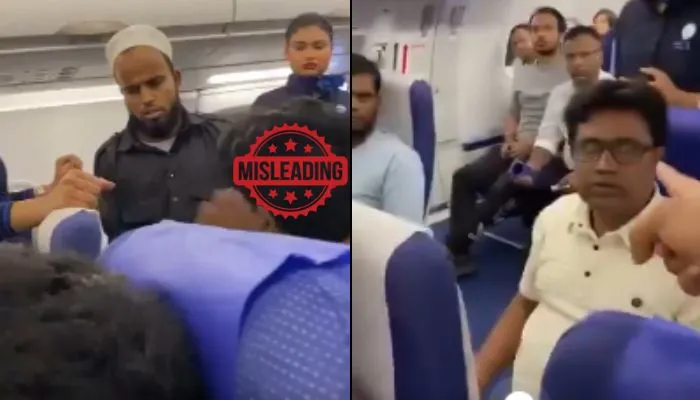
Case Summary
A physical assault incident took place aboard an Indigo Airlines flight from Kolkata to Mumbai. A Muslim passenger, Hossain Ahmed Mazumdar from Cachar district, Assam, was slapped by another Muslim passenger, Hafijul Rahaman. The incident, captured on video, was immediately circulated on social media with false claims that the assaulter was a Hindu, triggering a coordinated disinformation campaign around ‘Muslim victimhood.’ During the boarding and taxiing phase of the flight, Hossain suffered a panic attack, which caused a delay in takeoff. In response to the situation, Hafijul Rahaman, another passenger on the same flight, physically assaulted him. The video shows Hossain visibly distressed and crying after the assault. Another passenger was heard confronting the attacker, stating, “Why did you slap him? You don’t have any right to hit anybody.” The CISF arrested Hafijul Rahaman after he was deboarded in Kolkata. Indigo Airlines issued an official statement the same day, confirming the physical altercation and declaring such behaviour completely unacceptable. The airline clarified that the crew acted in accordance with standard operating procedures, identified the passenger as unruly, and handed him over to the appropriate security agencies upon landing. Indigo reiterated its commitment to ensuring the safety and dignity of all passengers and crew. Despite these facts, several social media accounts, including prominent leftist and Islamist handles, circulated misleading narratives branding the assaulter as Hindu. They exaggerated the religious identity of the victim and deliberately associated the assault with Hindus using terms such as ‘sanghi’. These accounts ignored the actual identity of the perpetrator and weaponised the incident to construct a narrative of systemic Muslim persecution. The falsehood of this narrative was first corrected by journalist Jagriti Chandra of The Hindu, who cited Indigo’s confirmation that both the victim and the assaulter were Muslim. Once the truth was established, the orchestrators of the narrative abandoned the story and shifted focus to other incidents that could be used to manufacture communal victimhood.
Why it is Hate Crime ?
This case has been added to the tracker under the primary category- Hate speech against Hindus. Under this, the sub-category selected is- Anti-Hindu subversion and prejudice and the tertiary category chosen is- Mislabelling/Misrepresentation of perpetrator's religion as Hindu. Hate speech is defined as any speech, gesture, conduct, writing, or display that is prejudicial against a specific individual and/or group of people, which is leading to or may lead to violence, prejudicial action or hate against that individual and/or group. Media plays a specific and overarching reach in perpetuating prejudicial attitudes towards a community owing to unfair, untrue coverage and/or misrepresentation/misinterpretation, selective coverage and/or omission of facts of/pertaining to issues affecting a specific religious group. This type of bias can dehumanise the victim group, making it easier for others to justify harmful actions against them, which aligns with the objectives of hate speech laws aimed at preventing such harm. It is often observed that the media takes a prejudicial stand against the Hindu community driven by their need to shield the aggressor community which happens to be a numeric minority, however, is the one perpetrating violence against Hindus. For example, the media is often quick to contextualise religiously motivated crimes against Hindus, omit or misrepresent facts that point towards religiously motivated hate crimes, justify and/or downplay religiously motivated hate crimes or simply present fake news to stereotype Hindus. Such media bias leads to the denial of persecution and is often used to dehumanise Hindus, leading to justification for violence against them. For example, the media covered several fake allegations of Hindus targeting Muslims and forcing them to chant Jai Shree Ram. Most of these cases were proved false and fabricated after police investigation. These fake news reports were subsequently never retracted or clarified. Such fake news led to the justification of violence and dehumanisation of Hindus based on the argument that since Hindus targeted Muslims and forced them to chant Jai Shree Ram, the dehumanisation of Hindus and violence against them was par for the course and merely a retaliation. Such media bias leads to prejudicial portrayal of Hindus and offers a justification for violence against them and therefore, is considered hate speech under this category. This case involves deliberate dissemination of false information that wrongly attributes violence to a Hindu individual, thereby fuelling distrust and prejudice against the Hindu community at large. By projecting a Muslim-on-Muslim assault as a Hindu-on-Muslim hate crime, the incident was weaponised to reinforce a fabricated narrative of Hindu aggression and intolerance. The widespread mislabelling across social media—by influential handles and ideologically driven commentators—was not a case of error but of motivated bias, selectively constructing a Hindu perpetrator to vilify the community and sustain an ongoing disinformation campaign. This type of misinformation amounts to hate speech because it builds and reinforces a social atmosphere where Hindus are painted as habitual aggressors, regardless of the facts. Such misrepresentation dehumanises Hindus, contributes to a culture of justified hostility against them, and creates an enabling environment for future hate crimes. By perpetuating a false perception of Hindus as violent oppressors through strategically crafted narratives and ignoring the actual identity of the aggressor, the media and allied online voices actively promote anti-Hindu prejudice. This not only erodes public empathy for Hindu victims in actual cases of persecution but also legitimises retaliatory violence or social exclusion directed at Hindus—thus making the act of mislabelling a form of hate speech with the potential to incite real-world harm.


Case Status
Unknown


Perpetrators Details
Perpetrators
Others
Perpetrators Range
Unknown
Perpetrators Gender
both
 Sources




