Hindu student hounded by Muslim mob over allegations of 'blasphemy' in Bangladesh, genocidal calls issued
 Netrokona District, Bangladesh
  27 February, 2025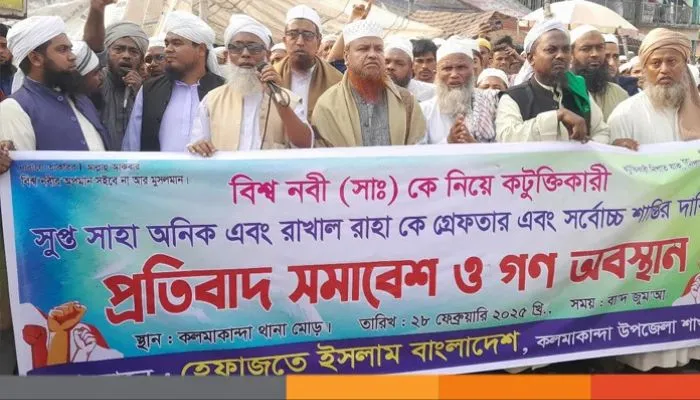
Case Summary
In Kalmakanda upazila of Netrakona district, Bangladesh, a Hindu man was hounded by a Muslim mob over a mere accusation of 'blasphemy'. According to media reports, the victim is identified as Supta Saha Anik, a resident of Mantal village in Kalmakanda upazila. He was a student at the Rajshahi University and a member of the Chhatra League, the banned student wing of the Awami League led by Sheikh Hasina. The Muslim mob, comprising members of the radical groups like ‘Hefazat-e-Islam Bangladesh’ and ‘Tawhidi Janata’, claimed that the victim had made ‘objectionable remarks’ about Islam. After Jumma Namaz (Friday prayers), the mob organised a protest rally. They demanded the immediate arrest of the Hindu man for supposedly insulting Prophet Muhammad and issued a 48-hour ultimatum. Following this, the mob raised genocidal slogans and vowed to make the ‘ultimate sacrifice’ to avenge the supposed insult to Islam. Reports state that the screenshots that surfaced on social media showed that Anik had been involved in a heated exchange with a Muslim man and criticised Islam in response to provocations against Hinduism. Following this, a video circulated on social media, in which the violent Muslim mob could be seen at the residence of Supta Saha Anik. They were intimidating his father. This incident reflects a troubling and recurring pattern across Bangladesh, where blasphemy accusations, often unverified or entirely fabricated, are weaponised to target Hindu minorities. Such cases are frequently followed by orchestrated campaigns of intimidation, social exclusion, and, in some instances, outright violence. The use of blasphemy as a tool for communal targeting not only endangers individual lives but also undermines the safety and rights of entire minority communities. This incident is one of the several incidents of the continued persecution of Hindus in Bangladesh, which has only increased manifold since the fall of Sheikh Hasina’s Awami League government on August 5, 2024. After her violent ouster, Bangladesh has plunged into chaos as Islamist extremists have taken advantage of the political turmoil to unleash a wave of terror and violence against the Hindu community. The Islamist mobs have attacked Hindu homes, burned them to the ground, and abducted women in a horrific descent into anarchy. Several temples have been destroyed in various parts of the Islamic country in a major crackdown on Hindus. Reports have exposed how Muslim students forced around 60 Hindu teachers, professors, and government officials to resign. Exiled Bangladeshi activist Asad Noor has also revealed that the minority Hindu community is now being coerced into joining ‘Jamaat-e-Islami’. Hindu religious events have been repeatedly targeted. On 6th September 2024, a procession carrying Lord Ganesha’s idol was attacked in Chittagong. Ahead of Durga Puja, multiple incidents of idol vandalism occurred, including attacks in Mymensingh, Pabna, Rajshahi, Kishoreganj, and Dhaka. On 29th November 2024, a violent Muslim mob attacked three temples in Patharghata, Chittagong, immediately after Jumma Namaz. The crackdown on Hindu voices has also escalated. On 30th November 2024, Hindu journalist Munni Saha was arrested in Dhaka. Even ISKCON leader Chinmoy Krishna Das Prabhu and his aides have been targeted, and attempts have been made to ban ISKCON and suppress Hindu protests through sedition charges. These arbitrary actions point to a systematic pattern of persecution under Muhammad Yunus’s interim government.
Why it is Hate Crime ?
This case has been added to the tracker under the primary category of: - Attack not resulting in death. Within it, the sub-category selected is: - Attacked over 'Blasphemy'. Blasphemy essentially refers to the desecration of anything which is held sacred/holy to a group of people. However, for religious supremacist groups, the elements of ‘blasphemy’ are ever-changing, shifting and expanding – leading to infringement on the rights of other religious groups, freedom of speech and expression, threats and even physical violence. There are instances where blasphemy is also used as a dog whistle to target Hindus owing to intrinsic animosity towards Hinduism. There are several instances where stating truths as mentioned in the non-Hindu doctrine itself has led to unmitigated violence against Hindus. There have also been instances where non-Hindus have themselves created a ‘blasphemous’ situation, like placing a Quran in a temple, to use it as an excuse to attack Hindus. Essentially, Blasphemy charges are often made up and/or are used to shut down any form of criticism of non-Hindu faiths and as a tool to target Hindus. Any physical violence over Blasphemy charges against Hindus are foundationally based on animosity for Hindus and their faith owing to religious supremacist ideologies, therefore, such attacks would be documented as religious motivated hate crimes under this category. The other primary category selected in this case is- Hate Speech against Hindus. Within this, the subcategory selected is- Call for genocide/violence against Hindus/specific sects of Hindus. Hate speech is defined as any speech, gesture, conduct, writing, or display that is prejudicial against a specific individual and/or group of people, which is leading to or may lead to violence, prejudicial action or hate against that individual and/or group. Often, animosity against Hindus or a specific panth/sampradaya/group of Hindus or a specific ideology they hold manifests itself into hate speech and calls for genocide/violence against that specific section of Hindus. For example, it has often been seen that those who hold animosity against the Hindu faith use specific sects/sampradaya/pant of Hindus as a proxy to express hate against Hindus as a whole. It has been seen that the word ‘Hindutva’ has been used to call for violence against those who say they believe in ‘Hindutva’. It is observed that ‘Hindutva’ is only used as a proxy to call for violence against Hindus as a whole, as seen in the Dismantling Global Hindutva conference where speakers admitted that ‘Hindutva’ cannot be eradicated till ‘Hinduism’ is eradicated. The eradication of an entire faith, in turn, is a genocidal call against the entire community that practices that faith. Further, it is also observed that violence against a specific section of Hindus is made, justifying these calls by weaving exaggerated tales of historical injustices. Often, those who hold animosity towards Hindus and their faith attempt to make their animosity more palatable by justifying their hate for a specific section, claiming that they are against that particular section because of their faith in the broader community and the religion they process. Such calls for violence against specific sections of Hindus, as mentioned, is a proxy for their animosity against the entire community and the faith they profess, and therefore, would be considered hate speech under this category. The removal of Sheikh Hasina from power in Bangladesh on August 5, 2024, escalated the persecution and marginalisation of the Hindu minority in the predominantly Islamic nation, intensifying what can be described as a silent genocide. Since her exile, Muslim radicals have carried out unchecked atrocities against Hindus, including physical violence, the destruction of temples and religious symbols, and the systematic displacement of Hindus from their ancestral lands. Hundreds of attacks on Hindu temples, shops, and businesses have been recorded following Sheikh Hasina's removal as Prime Minister. Many Hindus have been brutally murdered or injured in Muslim mob attacks. Amidst these developments, reports have emerged of Muslims hounding a Hindu man over allegations of 'blasphemy' against Islam and the Prophet Mohammad. In this case, it is highly possible that most Muslim protestors likely have no idea what the Hindu man actually said, but that hardly matters. They rally behind the crowd, driven more by deep-rooted bias against Hindus. Demands for the harshest punishments, including death, echo through the streets without any evidence being examined. Instead of letting the police investigate and due process take its course, it is the street justice of the Muslim mob that prevails. The accusations themselves appear to be merely a pretext to incite communal violence and assert Islamic dominance over a vulnerable Hindu minority. This pattern of targeting Hindus under the guise of “hurting religious sentiments” is disturbingly common in Bangladesh More often than not, especially during these waves of targeted violence, Islamist groups just need an excuse to attack non-Muslims, particularly Hindus. And that excuse is frequently "blasphemy." It has become a common and convenient trigger, fabricated or exaggerated, to justify a Muslim mob action against Hindus. The criteria for what constitutes blasphemy keep shifting, and in many cases, there's no actual offence, just a pretext born out of deep-seated animosity toward Hindus and their beliefs. The flexibility and vagueness of what constitutes blasphemy allow Muslim extremists to weaponise it at will, making Hindus and other minorities easy targets. In this case, the genocidal calls made by Muslim mobs over an alleged insult to Islam are a clear example of a hate crime targeting a Hindu individual because of his religious identity. These violent calls go beyond the individual victim, sending a chilling message of collective hostility towards the wider Hindu community. Such actions are deeply rooted in religious animosity against Hindus and their spiritual identity. Hate crimes are defined as criminal acts motivated by bias or prejudice against a particular group, in this instance, the Hindu minority. The collective targeting of the victim by organised Islamist groups in Bangladesh, accompanied by mass protests referencing the alleged “blasphemy,” unmistakably demonstrates that this was driven by religious hatred. This incident not only endangered the Hindu victim's life but also served to intimidate and threaten the entire Hindu community, making it a profound example of religious intolerance. Such incidents are not isolated but occur within a broader context of systematic discrimination and violence against Hindus in Bangladesh. The use of blasphemy allegations to incite mob violence and demand extreme punishments disproportionately affects religious minorities, particularly Hindus, and serves to intimidate and suppress them and their faith. This case, therefore, is not an isolated episode but part of a deeply entrenched pattern of religiously motivated hate and persecution of the Hindu community in Bangladesh. Therefore, this case is being added to the hate crime database.
Victim Details
Total Victim
1
Deceased
0
Gender
- Male 1
- Female 0
- Third Gender 0
- Unknown 0
Caste
- SC/ST 0
- OBC 0
- General 0
- Unknown 1
Age Group
- Minor 0
- Adult 0
- Senior Citizen 0
- Unknown 1


Case Status
Unknown


Perpetrators Details
Perpetrators
Muslim Extremists
Perpetrators Range
Unknown
Perpetrators Gender
male
 Sources




