Hindu girl abducted, forcibly converted, and married to Muslim man in Pakistan; accused also kidnaps victim's minor brother
 Mirpur Khas, Sindh, Pakistan
  18 July, 2025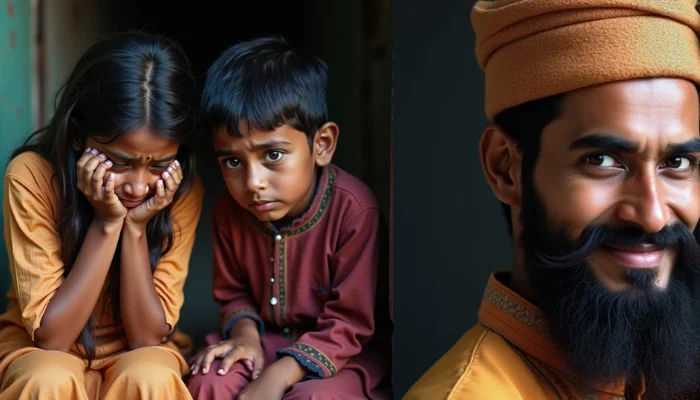
Case Summary
In Kunri city, located in Mirpur Khas district of Sindh, Pakistan, a Hindu girl was abducted, forcibly converted to Islam, and married off to a Muslim man. Her minor brother was also abducted along with her. The Hindu girl was identified as Sunita Maharaj, daughter of Taro Maharaj from Kunri. She was forcibly taken, converted to Islam, and married to a man named Niaz Muhammad, son of Muhammad Aarib from Kunri. Sunita’s minor Hindu brother was also abducted alongside her by the perpetrators. After the marriage, Sunita’s name was changed to Haajran. Initially, the victim filed a petition seeking protection for herself and her husband. According to court records, Haajran stated that she had voluntarily converted to Islam and married of her own free will. She requested legal protection, citing concerns for her safety following the religious conversion and marriage. Following this, the Chairman of Pakistan Darawer Ittehad, Faqir Shiva Kachhi, stated that a First Information Report (FIR) had been registered at the Women Police Station in Umerkot regarding the abduction of Sunita Maharaj and her minor brother, Lakesh Kumar. Subsequently, the Senior Superintendent of Police (SSP) Umerkot took action and ensured the recovery of the abducted siblings. The matter later reached the court in Umerkot, and on 1st November 2025, Sunita met her family and stated that she had been subjected to severe torture at the hands of the Muslim accused. Hindu community activist Shiva Kachhi said that Sunita was able to meet her family after the Sindh court’s order. Kachhi, who represented the girl’s parents in the case, confirmed that Sunita had revealed she was not only beaten in an attempt to break her mentally but was also repeatedly harassed by the elderly man’s family. Kachhi also stated that after her abduction, she was forcibly converted to Islam and married to the older Muslim accused. The local Hindu community leaders and human rights activists stated that Sunita was among the few fortunate Hindu girls who had received justice from the court. Umerkot lawyer Chander Kohli said that this case was not an isolated incident. The systematic abduction, forced conversion, and marriage of Hindu girls had become a crisis that continually terrorised the Hindu community in Sindh. He stated that Sunita had been found in Umerkot after her parents and activists filed a case, but the court had subsequently sent her to a safe house. She had told the court that she had been abducted and forced into conversion and marriage. Lawyer Chander Kohli further stated that the biggest problem was that, in most such cases, the accused produced forged documents to show that their marriages were legal and consensual. These girls mostly came from poor families who lacked the resources or knowledge to pursue legal action. This was why many Hindu leaders had begun to emphasise the importance of education for the Hindu community. This case highlights the persistent persecution faced by the Hindu minorities in Pakistan, marked by systemic discrimination, violence, and forced conversions. Hindu women, particularly young girls, are often abducted, forcibly converted to Islam, and married off to Muslim men with little to no legal recourse. Temples are frequently vandalised or destroyed, and Hindu communities are subjected to social and economic marginalisation. Blasphemy laws are disproportionately used against Hindus, leading to false accusations and severe punishments. Many Hindu families are forced to flee their homes due to religious intolerance, living in constant fear of attacks. This sustained persecution highlights the dire conditions for Hindus in Pakistan, where their religious identity makes them targets of oppression.
Why it is Hate Crime ?
This case is being added to the tracker under the primary category- Predatory Proselytisation. Within this, the subcategory selected is- Harassment, threats, coercion for conversion. Harassment covers a wide range of behaviours of an offensive nature. It is commonly understood as behaviour that demeans, humiliates, and intimidates a person, including threats and coercion. Harassment and threats, in this case, find their root on discriminatory grounds which has the effect of nullifying a person’s rights or infringing upon his freedom to exercise his right specifically owing to the victim’s religious identity. Verbal and physical threats and psychological or physical harassment are often used against Hindu victims because they choose to practice their professed religion. Religious harassment also includes forced and involuntary conversions by harassment, threats or coercion. Coercion includes intimidatory tactics like force-feeding a Hindu victim beef to convert to another religion, forceful circumcision etc. In several cases documented, non-Hindu perpetrators or those who harbour specific animosity towards Hinduism, harass victims simply based on their religious identity. Such cases often also include harassment to ensure the Hindu victim abandons his/her professed religion and adopts the religion of the perpetrator. Such cases where Hindu victims are harassed to convert to the perpetrator’s religion, are rooted in animosity towards the victim’s religious identity and are therefore documented as religiously motivated hate crimes. Another primary category selected in this case is- Attack not resulting in death. The subcategory selected is- Attacked for Hindu identity. In several cases, Hindus are attacked merely for their Hindu identity without any perceived provocation. A classic example of this category of religiously motivated hate crime is a murder in 2016. 7 ISIS terrorists were convicted for shooting a school principal in Kanpur because they got ‘triggered’ seeing the Kalava on his wrist and tilak that he had put. In this, the Hindu victim had offered no provocation except for his Hindu religious identity. The motivation for the murder was purely religious, driven by religious supremacy. Such cases where Hindus are targeted merely for their religious identity would be documented as a hate crime under this category. In this case, the abduction, forced conversion, and marriage of the Hindu victim reflected a recurring pattern of targeted crimes against the Hindu community in Pakistan. Hindu girls had long remained vulnerable to such acts of persecution, where they were abducted for their religious identity, coerced into converting to Islam, and married off to Muslim men. This persistent cycle demonstrated the deep-rooted religious animosity that existed towards the Hindu community. The deliberate targeting of individuals based on their faith, under the guise of religious conversion and marriage, exposed the systematic discrimination and lack of protection faced by minorities, especially Hindus, in Pakistan. Such acts did not merely involve physical coercion; they represented a complete attempt to erase the victim’s religious and personal identity. Forced conversions and marriages were an assault on the fundamental rights of the victims, denying them their autonomy, agency, and freedom of belief. These crimes clearly showcased religiously motivated hatred and the entrenched prejudice that the Hindu minority had endured since Pakistan’s inception. In this case, the victim was stripped of her Hindu faith, converted to Islam, and married to the Muslim accused, which illustrated the deep-seated hatred directed towards her and her religion. Following her abduction and forced marriage, the victim revealed that she had been subjected to brutal torture and repeated physical assault by the Muslim man and his family. This cruel treatment further demonstrated the depth of religious hostility underlying the crime. The violence she endured after being forced into marriage reflected both an assertion of dominance and a deliberate effort to dehumanise her because of her religious background. Initially, she was coerced into declaring that her conversion and marriage were of her own free will—a statement extracted under threat and intimidation. Such coercion highlighted how intimidation was systematically employed as a weapon to silence the victim and legitimise the perpetrators’ actions. Her suffering exemplified how Hindu girls were exploited, manipulated, and violated solely because of their religious identity, making the incident a religiously motivated crime. Amidst all this, the victim’s minor brother was also abducted alongside her, which deepened the gravity and anti-Hindu nature of the crime. The fact that not only the Hindu girl but also her younger brother was targeted underscored the deliberate religious bias driving such acts. By abducting both siblings, the perpetrators reinforced their intent to intimidate and humiliate the Hindu community as a whole. The abduction of a child solely for belonging to a particular faith reflected deep-seated religious animosity and systematic discrimination. This act went beyond an isolated attack—it symbolised a direct assault on an entire community’s sense of security, identity, and dignity. Given that this case fulfilled all criteria of a religiously motivated crime, it was added to the hate crime database of the Hinduphobia Tracker. Disclaimer: The Hinduphobia Tracker records the date of an incident based on when the crime occurs rather than when it is reported by the media. In this case, media sources did not specify the exact date when the victim’s ordeal began. Therefore, for documentation purposes, the date when it was first reported in the media—19th July 2025—was used as the indicative date of the incident in this case.
Victim Details
Total Victim
2
Deceased
0
Gender
- Male 1
- Female 1
- Third Gender 0
- Unknown 0
Caste
- SC/ST 0
- OBC 0
- General 0
- Unknown 2
Age Group
- Minor 1
- Adult 1
- Senior Citizen 0
- Unknown 0


Case Status
Case sub-judice


Perpetrators Details
Perpetrators
Muslim Extremists
Perpetrators Range
One Person
Perpetrators Gender
male
 Sources




