Minor Hindu girl lured away by Muslim men under pretext of marriage; accused part of Muslim gang involved in forced conversions and sexual exploitation of minor Hindu girls
 Kushinagar, Uttar Pradesh, India
  18 July, 2025
Case Summary
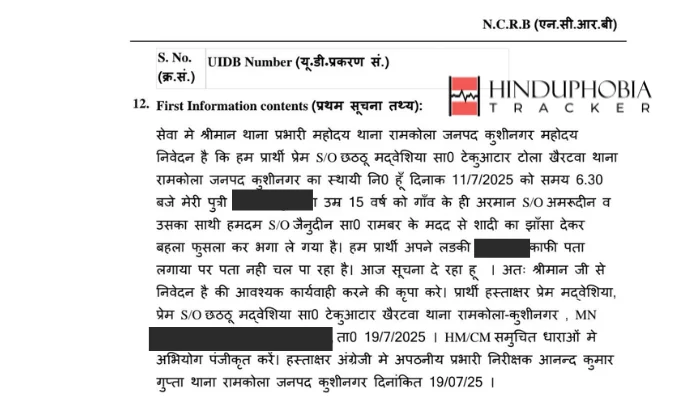
In the Kushinagar district of Uttar Pradesh, a minor Hindu girl was lured away by a Muslim man and his accomplice. The accused were members of a Muslim conversion gang involved in forcible conversions and the sexual exploitation of minor Hindu girls. Police investigations in this case revealed that the Muslim accused were part of a conversion gang which selectively targeted minor Hindu girls and forced them to convert to Islam. According to media reports, the incident came to light when the victim’s father, Prem Madheshiya, a resident of Tekuatar Tola Khairtwa, lodged a police complaint at the Ramkola police station stating that his 15-year-old daughter had been lured away by Arman Ali, with the help of his accomplice, Hamdam Ansari, under the pretext of marriage. Following the complaint, an investigation was launched, and the accused, Arman, along with three other members of the gang, were arrested. The investigation revealed that this gang, active in the Ramkola area, used to entrap minor Hindu girls by luring them into relationships, prepare their fake Aadhaar cards, convert them to Islam, and sexually exploit them. The police also uncovered another case involving this same gang, in which three minor Hindu girls were lured away, converted to Islam, and had forged documents prepared. In this case, the victim girls had been recovered by the police from Mumbai. The four arrested Muslim perpetrators were identified as Arman Ali, son of Arbuddin Ali (23), Arbaaz, son of Samiullah (20), Ikramul Haque, son of Mainuddin (28), and Jairunnisha, wife of Zainuddin Ansari (42). Items recovered from the possession of the arrested Muslims included three fake Aadhaar cards, seven fake SIM cards, one four-wheeler (UP57BS7295), and three Android mobile phones. In this entire case, the team formed under the leadership of Inspector-in-Charge Rajprakash Singh, and under the direction of Superintendent of Police Santosh Kumar Mishra, comprising sub-inspectors, female sub-inspectors, and constables, took swift action and successfully unravelled the case. The arrested accused were booked under sections 111(2)(B), 137(2), 87, 64(1), 61(2), 351(3), 418(2) of the BNS, section 3/4 of the POCSO Act, and section 3/5(1) of the Uttar Pradesh Prohibition of Unlawful Conversion of Religion Act.
Case Images
Why it is Hate Crime ?
This case has been added to the case under the primary category- Crimes against women in relationships and other sexual crimes. Within this, the subcategory selected is- Brainwashed and/or Groomed. Within this, the tertiary category selected is- 'Pattern of targeting Hindu minors', 'Conversion of minor', 'Rape and sexual assault/harassment', and 'Family claims grooming'. In our database, we have not added incidents where women have converted to another religion of their free will and no allegations of forced/involuntary conversion have been made. However, there are certain cases of conversion where the consent itself is a result of the brainwashing or grooming of a minor by the non-Hindu perpetrator trying to victimise a woman for her Hindu religious identity. The phenomenon of grooming points to non-Hindu perpetrators identifying their Hindu victims’ vulnerabilities and exploiting them over months and sometimes years, to extract the supposed ‘consent’ in order to convert their religion. In most cases of grooming, the victims are minors or the grooming started when the victim was a minor. In other cases of grooming, the non-Hindu perpetrator brainwashes and grooms a minor victim to extract their trust and then proceeds to rape them repeatedly with the intent of converting them to their faith. It is pertinent to understand here that when the victim is a minor, the ‘consent’ to convert or enter into a romantic relationship with an adult itself is redundant – addressed by POCSO. While every case of conversion of a minor and incidents of establishing a physical relationship with a minor by an adult is a crime, for the purpose of this database, a case would be considered a hate crime only if there is a distinct religious angle to the grooming. For example, in the UK, if a Hindu minor is targeted by Pakistani grooming gangs, it would be considered a hate crime because the victims are specifically targeted owing to their non-Muslim religious identity with the perpetrators being Muslim. In other cases, if a Hindu minor is brainwashed into entering a physical relationship with the non-Hindu adult perpetrator and the family alleges grooming/brainwashing of the minor to convert her religion, it would form a part of this database. If the victim is a Hindu adult, the case would form a part of this database only if the victim herself says that she was brainwashed/groomed to convert her religion. However, if the victim is deceased (murdered or otherwise), the case would form a part of this database if her family/friends provided testimony that the victim was brainwashed/groomed to convert her religion. Since these crimes have a distinct religious angle where the victim is being targeted owing to her Hindu religious identity, these cases are considered a hate crime. In this case, it is important to highlight that the victim girl, daughter of Prem Madheshiya, and the other three Hindu victims were minors. This means the element of consent and genuine change of conscience was missing ab initio. Minors, due to their young age and lack of maturity, are particularly vulnerable to manipulation and coercion. They may not have the ability to fully understand the implications of converting to another religion or engaging in a romantic relationship, or getting married to an adult. The Muslim perpetrators purposely targeted and exploited this vulnerability of the victims. Since this case exemplifies the use of coercion and manipulation to achieve religious conversion, it is a blatant act of religiously motivated hate crime. The Muslim perpetrators' actions were not random. The police investigation revealed that the Muslim gang’s modus operandi was to identify and entrap minor Hindu girls, luring them into relationships with false promises of marriage or emotional manipulation. This pattern of selecting victims based on their Hindu faith is a clear indicator of hate crime. The victim girls were not targeted for financial gain alone nor for reasons of mere opportunity, but specifically because they were Hindus. This selectivity demonstrates a communal bias, the very essence of religious animosity, where criminal acts are systematically directed at individuals belonging to a particular community. Such actions are a result of deep-rooted religious animosity towards Hindus and their faith, making it a religiously motivated hate crime. Furthermore, the Muslim gang was not content with simple abduction; it pursued a deliberate campaign of forced religious conversion. Once the Hindu victims were in their control, they were forcibly converted to Islam, a traumatic process that entails the erasure of their original identity, family ties, and cultural roots. Forced religious conversion is a gross violation of human rights and the religious autonomy of the Hindu victims, making it a crime motivated by religious hostility towards Hinduism and its adherents. The gravity of the crime escalates further with the revelation that, after the forced conversions, the girls were sexually exploited. This systematic exploitation is a culmination of the process of dehumanisation: after having their identities taken away, the girls’ bodies too were abused. This is not merely a criminal activity here; it is weaponised as a tool of humiliation and subjugation, sending a message of terror and intimidation to the wider Hindu community. Such actions are not isolated instances; rather, they are well-coordinated efforts to target the Hindu community and destroy their religious identity and dignity. Instances like these clearly demonstrate the religious animosity acting as a motivating factor behind the crime. Such acts are committed by Muslims out of doctrinal animosity towards the Hindu faith that treats non-Muslims, especially Hindus, as inferior and sees their women and minor girls as targets to convert or control. This mindset turns what may seem like a crime of kidnapping and sexual exploitation into something far more dangerous: a hate crime against the Hindu community. It uses a Hindu girl's faith as a weapon, aiming to harm not just individuals but the dignity and strength of Hindu society itself. Since the exploitation of Hindu girls in this case stems from deep-rooted ideological hatred and targets them on the basis of their religious identity, it clearly qualifies as a hate crime and thus warrants inclusion in the tracker. Disclaimer: It is important to clarify that the report does not specify the exact date when the victim's ordeal began, but it mentions that the victim's father filed a complaint on 19th July, 2025. Since this is the earliest date mentioned, we are considering this as when the victim's ordeal began and using this as the incident date. While media coverage of the incident emerged later, the Hinduphobia Tracker records the incident based on when the victim’s ordeal began, not when it was reported.
Victim Details
Total Victim
4
Deceased
0
Gender
- Male 0
- Female 4
- Third Gender 0
- Unknown 0
Caste
- SC/ST 0
- OBC 1
- General 0
- Unknown 3
Age Group
- Minor 4
- Adult 0
- Senior Citizen 0
- Unknown 0


Case Status
Case sub-judice


Perpetrators Details
Perpetrators
Muslim Extremists
Perpetrators Range
From 2 To 5
Perpetrators Gender
both
 Sources




