Hindus targeted for conversion through prayer meetings and inducements by Christian missionaries in Bhilai, Chhattisgarh
 Bhilai, Chhattisgarh, India
  19 July, 2025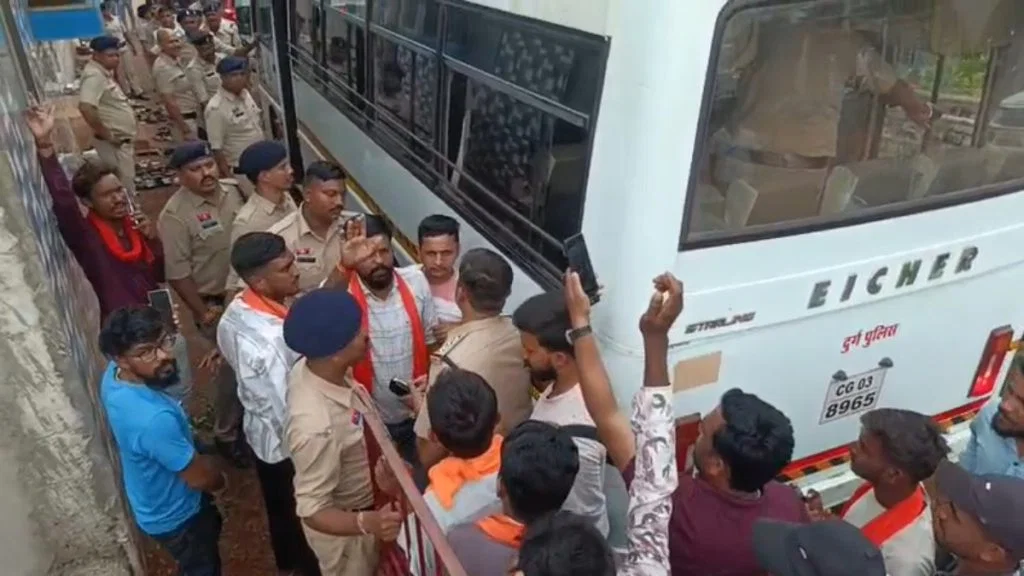
Case Summary
In Bhilai, Chhattisgarh, a Christian prayer meeting was held to convert Hindus using monetary inducements and targeted preaching. Hindu organisations protested outside the church, chanted Hanuman Chalisa, and filed a complaint against the pastors for conversion activities. In the Kailash Nagar area of Bhilai, Chhattisgarh, local Hindu organisations objected to a Christian prayer meeting where religious conversion was taking place. The event had attracted a large crowd, including children and economically vulnerable individuals from Hindu communities. It was reported that the meeting was targeting members of communities such as the Sahu, Kurmi, Devangan, and Patel. Upon receiving this alert, Jamul police reached the site and intervened. Around 100 to 150 individuals present at the church were escorted by the police to the station for questioning and were later sent back to their homes. Hindu activists staged a peaceful sit-in protest outside the church, chanting Hanuman Chalisa and filing a complaint against the church authorities. They also reported that the missionaries were converting children and offering monetary incentives. Police detained the pastors and began questioning them about the nature and objective of the gathering. At the time of writing this report, the matter was under investigation.
Why it is Hate Crime ?
In this case, the primary category is: Predatory proselytisation. Under this, the secondary category is: - Proselytisation by grooming, brainwashing, manipulation or subtle indoctrination. The tertiary categories selected are - Conversion of minor and Pattern of targeting Hindus. Religious brainwashing essentially means the often subtle and forcible indoctrination to induce someone to give up their religious beliefs to accept contrasting regimented ideas. Religious grooming or brainwashing also involves propaganda and manipulation. It involves the systematic effort, driven by religious malice and indoctrination, to persuade “non-believers’ to accept allegiance, command, or doctrine to and of a contrasting faith. Cases of such grooming or brainwashing are far more nuanced than direct threats, coercion, inducement and violence. In such cases, it is often seen that there is repeated, subtle and continual manipulation of the victim to induce disaffection towards their own faith and acceptance of the contrasting faith of the perpetrator. While subtle indoctrination is widely acknowledged as predatory, an element which is often understated in such conversions or the attempts of such conversion is the role of loyalty and trust which might develop between the perpetrator and the victim. Fiduciary relationships are often abused to affect such religious conversion. For example, an educator transmitting religious doctrine of a competing faith to a Hindu student. The Hindu student is likely to accept what the teacher is transmitting owing to existence of the fiduciary relationship. The exploitation of the fiduciary relationship to religiously indoctrinate victims would also be included in this category. Since the underlying animosity towards the victim’s faith forms the basis of predatory proselytization, such cases are considered religiously motivated hate crimes. The other sub-category selected is - Conversion/attempts to convert by inducement. Predatory Proselytisation is not just limited to threat, harassment, force and violence, but it also has contours of stealth. In several cases, the Hindu victim is exploited to convert, with non-Hindus taking advantage of their poverty. In such cases, the Hindu victim who is suffering financially is offered monetary benefits, including lucrative offers for jobs, health treatment, education, etc, to induce the victim into changing his/her religion. In such cases, the religious identity of the victim and the aim to disenfranchise him from his faith form the heart of the crime. Also, taking advantage of and exploiting an individual’s economic vulnerabilities is widely acknowledged as exploitation, forms of which are often penalised by law. Such cases therefore are considered religiously motivated hate crimes since the victim’s religious identity forms the very heart of the crime itself. The incident in Bhilai represents a clear case of religiously motivated grooming and indoctrination targeting economically and socially vulnerable Hindus, particularly from OBC communities such as the Sahu, Kurmi, Devangan, and Patel groups. The covert nature of the event, its scale, and its deliberate targeting of vulnerable Hindu populations point towards a systematic attempt to weaken attachment to the Hindu faith and instil allegiance to a contrasting religion. It is important to note here that some of the victims present in the meeting were minors and thus incapable of providing informed consent to such conversion activities. It is a well-established fact that children are more susceptible to manipulation since they are still developing emotionally, cognitively, and socially. Their brains are not fully mature, making them more vulnerable. This case demonstrates a calculated strategy of targeting those who are less able to resist or understand the long-term implications of conversion, making it a significant case of religious-motivated hate crime. In this case, monetary incentives were offered to lure Hindus into converting. The act of targeting a specific religious community—Hindus—with the intent of dismantling their faith identity through financial enticement reflects a clear disrespect and hostility towards their religious beliefs. Such exploitation of distress and poverty—often affecting marginalised Hindu communities—is a classic strategy of conversion. These inducements directly aim to undermine Hindu belief systems and coerce individuals to abandon their inherited religion in exchange for promised material or emotional gains. The crime lies not just in the act of converting, but in the predatory exploitation of the victim’s vulnerability, which is rooted in a discriminatory view that sees Hindu faith as dispensable or inferior. This case in Bhilai is part of a broader pattern observed across Chhattisgarh, where Christian missionaries have repeatedly targeted economically vulnerable Hindu communities under the guise of prayer meetings and spiritual gatherings. These events often serve as fronts for systematic religious conversion efforts, particularly aimed at Dalits, Adivasis, and OBC Hindus. Hinduphobia Tracker has documented numerous such incidents across Chhattisgarh, revealing a consistent strategy of exploiting poverty, trust, and social marginalisation to erode Hindu religious identity through subtle indoctrination and manipulation. References to some of these documented reports have been provided for further context. In this case, the religious identity of the victim—Hindu—was central to this targeting. Hence, it is a hate crime driven by religious bias. Hence, this case is included in the hate crime database.


Case Status
Arrested


Perpetrators Details
Perpetrators
Christian Extremists
Perpetrators Range
Unknown
Perpetrators Gender
unknown
 Sources




