Dalit Hindu villagers, including women and children, targeted for conversion through ‘healing’ deception and inducements in Barabanki, Uttar Pradesh
 Bara Banki, Uttar Pradesh, India
  19 July, 2025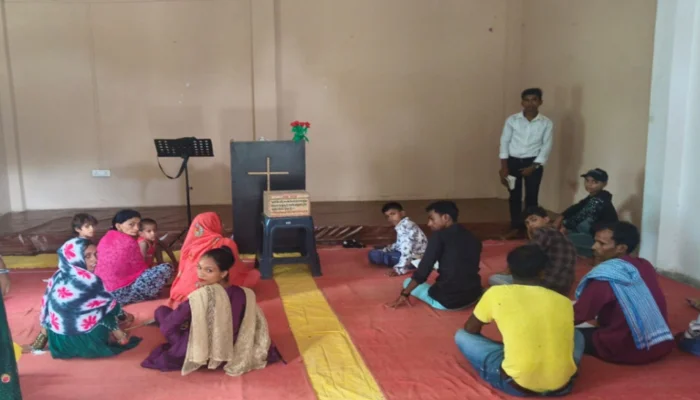
Case Summary
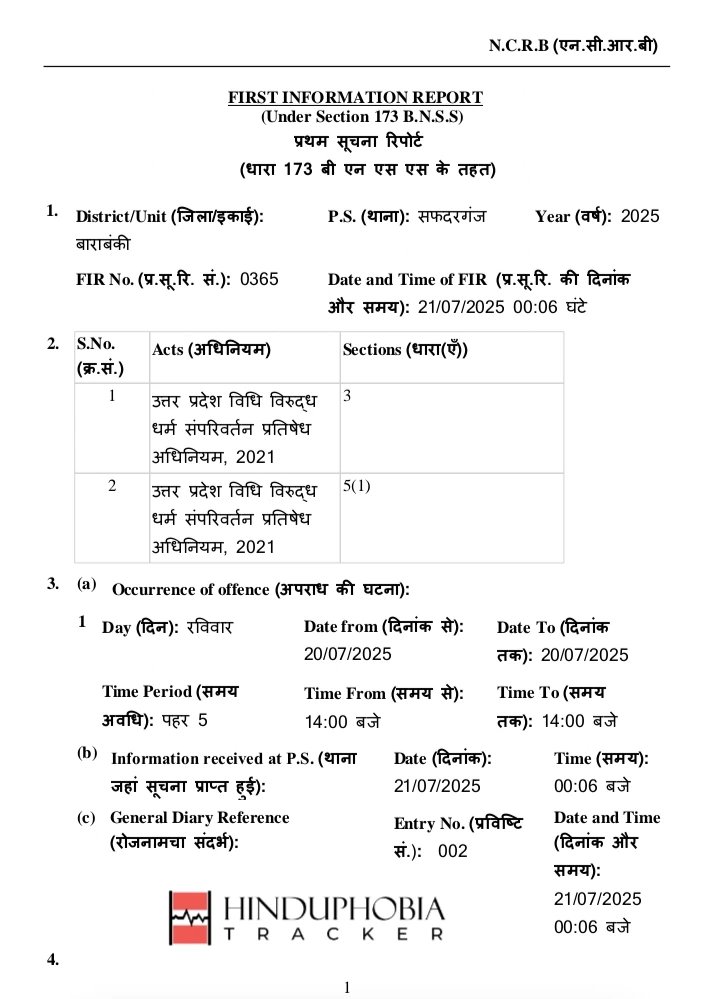
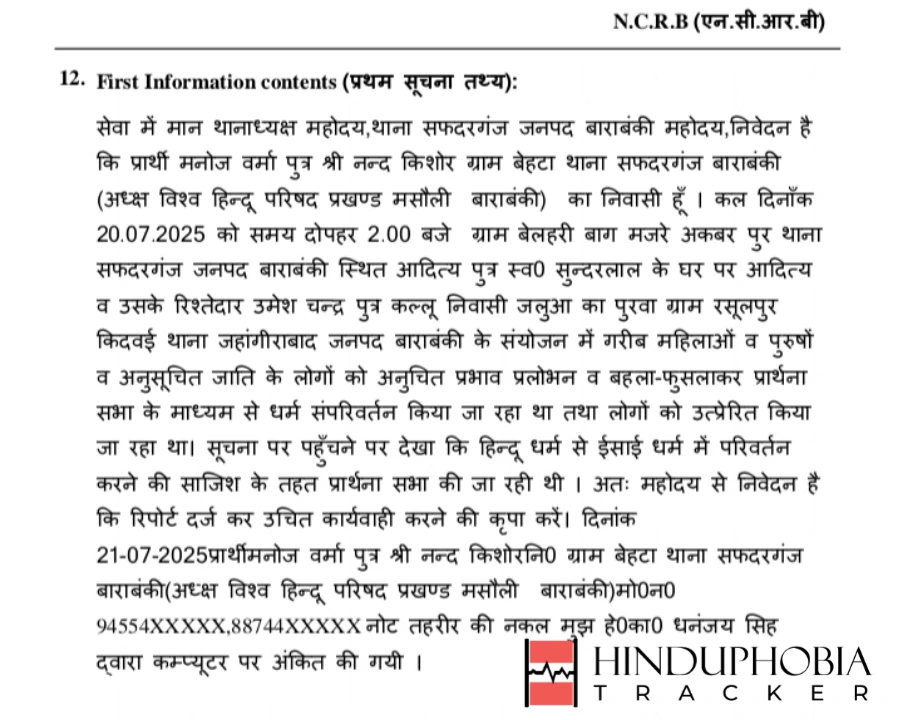
In Belhari Bagh locality of Akbarpur village, Barabanki, multiple Dalit Hindu villagers, including women and children, were targeted for conversion by a Christian missionary by giving them false promises of curing illness and offering inducements. Hinduphobia Tracker obtained a copy of the FIR. It is filed by Manoj Verma, a VHP functionary. According to the FIR, Aditya and his relative Umesh Chandra were converting poor Dalit Hindus, including women and minors, through brainwashing and inducements. According to reports, prayer meetings were conducted every Sunday for nearly two years by a Christian missionary named Umesh, resident of Jahangirabad. The prayer meeting primarily included people from the Scheduled Caste (Dalit) community, who were being brought in under the pretext of curing illness. They were also offered inducements for conversion. A Gandhinagar resident named Mukesh Kumar also confirmed that he had come there with his sister-in-law and two children to get relief from illness. Police raided the premises where they found around 24 individuals from the Dalit Hindu community, including men, women, and children. Police found a Christian symbol at the site and seized religious books, donation boxes, lockets, and three vehicles. Locals informed the police that the hall where the prayer meetings were taking place had initially been constructed after seeking land for building a room, but it was later converted into a church. According to one local resident, most attendees were Dalits who were being lured in with the promise of healing from diseases and other inducements. As of the date of writing this report, a case was registered by the police, and the investigation was ongoing.
Case Images
Why it is Hate Crime ?
This case has been added to the tracker under the primary category- Predatory Proselytisation. Within this, the subcategory selected is- Proselytisation by grooming, brainwashing, manipulation or subtle indoctrination. The tertiary category selected is- Pattern of targeting Hindus and Conversion of minor. Religious brainwashing essentially means the often subtle and forcible indoctrination to induce someone to give up their religious beliefs to accept contrasting regimented ideas. Religious grooming or brainwashing also involves propaganda and manipulation. It involves the systematic effort, driven by religious malice and indoctrination, to persuade “non-believers’ to accept allegiance, command, or doctrine to and of a contrasting faith. Cases of such grooming or brainwashing are far more nuanced than direct threats, coercion, inducement and violence. In such cases, it is often seen that there is repeated, subtle and continual manipulation of the victim to induce disaffection towards their own faith and acceptance of the contrasting faith of the perpetrator. While subtle indoctrination is widely acknowledged as predatory, an element which is often understated in such conversions or the attempts of such conversion is the role of loyalty and trust which might develop between the perpetrator and the victim. Fiduciary relationships are often abused to affect such religious conversion. For example, an educator transmitting religious doctrine of a competing faith to a Hindu student. The Hindu student is likely to accept what the teacher is transmitting owing to existence of the fiduciary relationship. The exploitation of the fiduciary relationship to religiously indoctrinate victims would also be included in this category. Since the underlying animosity towards the victim’s faith forms the basis of predatory proselytization, such cases are considered religiously motivated hate crimes. The other sub-category selected is - Conversion/ attempts to convert by inducement. Predatory Proselytisation is not just limited to threat, harassment, force and violence, but it also has contours of stealth. In several cases, the Hindu victim is exploited to convert, with non-Hindus taking advantage of their poverty. In such cases, the Hindu victim who is suffering financially is offered monetary benefits, including lucrative offers for jobs, health treatment, education, etc, to induce the victim into changing his/her religion. In such cases, the religious identity of the victim and the aim to disenfranchise him from his faith form the heart of the crime. Also, taking advantage of and exploiting an individual’s economic vulnerabilities is widely acknowledged as exploitation, forms of which are often penalised by law. Such cases therefore are considered religiously motivated hate crimes since the victim’s religious identity forms the very heart of the crime itself. This case from Akbarpur village represents a clear instance of religiously motivated hate crime as the perpetrator was targeting vulnerable Dalit Hindu families and attempting to convert them through inducement, including the prayer for curing illness. In such cases, the perpetrators do not rely on overt force or threats but exploit economic and social vulnerabilities, making use of trust, familiarity, or need as tools for religious conversion. Offering incentives or making false promises, especially when directed at vulnerable individuals in need, shows that these incentives are not acts of kindness or charity. Instead, they are calculated moves to exploit vulnerable Hindus because of their religion. By providing inducements or promising healing in exchange for conversion, the accused were effectively blackmailing those who might have been desperate for assistance or hope. Such instances are seen in many cases where members of Christian missionary groups target socially and economically vulnerable Hindus to further their agenda of religious conversions. This form of coercion strips people of their agency and dignity and results in coerced conversions. These are not random or isolated incidents, but rather cases deeply rooted in religious animosity towards Hindu victims. This form of inducement, while not overtly violent, was insidious and exploitative, targeting the very foundations of the victims’ belief systems. The strategy used was not just to promise to cure illness but to make the victims internalise the perceived spiritual superiority of Christianity over their faith. Which is why such practices often take place in a church rather than a hospital. By exploiting their desperation and disillusionment, missionaries effectively introduced disaffection toward Sanatan Dharma while building emotional dependency on Christian symbols and figures. The Christian faith, by its very theological foundations, places a strong emphasis on proselytisation. In pursuit of conversion objectives, Christian evangelists often employ unethical means, ranging from psychological pressure and misinformation to inducements such as money or jobs. These tactics are designed not as acts of charity but as tools to engineer religious change under the guise of social upliftment, particularly among vulnerable and underprivileged communities. It is important to note here that some of the victims present in the meeting were minors and thus incapable of providing informed consent to such conversion activities. It is a well-established fact that children are more susceptible to manipulation since they are still developing emotionally, cognitively, and socially. Their brains are not fully mature, making them more vulnerable. This case demonstrates a calculated strategy of targeting those who are less able to resist or understand the long-term implications of conversion, making it a significant case of religious-motivated hate crime. This incident reflects a pattern of religiously motivated targeting of vulnerable Dalit Hindu families through sustained and repeated prayer meetings held over nearly two years. These meetings, masked as healing sessions, were used to systematically groom and manipulate participants—particularly women and children—into converting. The use of false promises, inducements, and the abuse of trust highlight a calculated effort to erode the victims’ religious identity, making it a clear case of a hate crime rooted in religious malice.
Victim Details
Total Victim
24
Deceased
0
Gender
- Male 0
- Female 9
- Third Gender 0
- Unknown 15
Caste
- SC/ST 24
- OBC 0
- General 0
- Unknown 0
Age Group
- Minor 7
- Adult 0
- Senior Citizen 0
- Unknown 17


Case Status
Complaint filed


Perpetrators Details
Perpetrators
Christian Extremists
Perpetrators Range
From 2 To 5
Perpetrators Gender
male
 Sources




