Hindu families lured with money and ‘healing’ meetings for conversion in Bihar
 Dhaka, Bihar, India
  19 July, 2025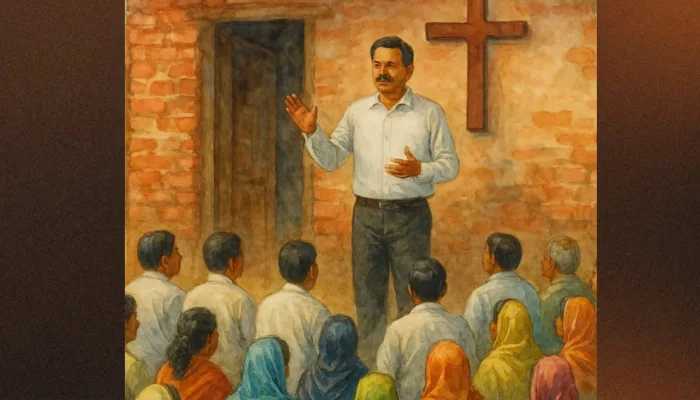
Case Summary
In the Dhaka area of the East Champaran district in Bihar, Hindu families were lured to convert to Christianity. The families were manipulated under the guise of attending a 'healing' meeting. They were also offered monetary incentives to adopt Christianity. According to media reports, a healing meeting was held at night at the Vishnupur Chowk in Dhaka block, where nuns and Christian pastors propagated Christianity using a projector. Innocent Hindu families from the village were being manipulated to convert to Christianity. The Christian perpetrators also travelled from village to village, luring Hindus to convert by enticing them with money. Following this, the Hindu villagers informed the Bajrang Dal, a Hindu organisation, about the situation. Even the Vishva Hindu Parishad's, a Hindu organisation, President Satyendra Kumar Singh, arrived at the scene with his group of Hindu activists. Subsequently, the police were informed about the incident, and they reached the spot. With the support of villagers and the police, the projector was shut down. Forty Christian women and thirty men were present at the scene. Advocate Ashok Srivastava, head of the Bihar-Jharkhand legal cell of the Vishwa Hindu Parishad, called on the district administration to monitor church activities within the district and to take strict action against religious conversion. He warned that if the administration failed to take concrete steps, the Bajrang Dal would stage protests against the churches.
Why it is Hate Crime ?
This case has been added to the tracker under the primary category- Predatory Proselytisation. Within this, the subcategory selected is- Conversion/ attempts to convert by inducements. Predatory Proselytisation is not just limited to threat, harassment, force and violence, but it also has contours of stealth. In several cases, the Hindu victim is exploited to convert, with non-Hindus taking advantage of their poverty. In such cases, the Hindu victim who is suffering financially is offered monetary benefits, including lucrative offers for jobs, health treatment, education, etc, to induce the victim into changing his/her religion. In such cases, the religious identity of the victim and the aim to disenfranchise him from his faith form the heart of the crime. Also, taking advantage of and exploiting an individual’s economic vulnerabilities is widely acknowledged as exploitation, forms of which are often penalised by law. Such cases therefore are considered religiously motivated hate crimes since the victim’s religious identity forms the very heart of the crime itself. The other subcategory selected is- Proselytisation by grooming, brainwashing, manipulation, or subtle indoctrination. The tertiary category selected is- Pattern of targeting Hindus. Religious brainwashing essentially means the often subtle and forcible indoctrination to induce someone to give up their religious beliefs to accept contrasting regimented ideas. Religious grooming or brainwashing also involves propaganda and manipulation. It involves the systematic effort, driven by religious malice and indoctrination, to persuade “non-believers’ to accept allegiance, command, or doctrine to and of a contrasting faith. Cases of such grooming or brainwashing are far more nuanced than direct threats, coercion, inducement and violence. In such cases, it is often seen that there is repeated, subtle and continual manipulation of the victim to induce disaffection towards their own faith and acceptance of the contrasting faith of the perpetrator. While subtle indoctrination is widely acknowledged as predatory, an element which is often understated in such conversions or the attempts of such conversion is the role of loyalty and trust which might develop between the perpetrator and the victim. Fiduciary relationships are often abused to affect such religious conversion. For example, an educator transmitting religious doctrine of a competing faith to a Hindu student. The Hindu student is likely to accept what the teacher is transmitting owing to existence of the fiduciary relationship. The exploitation of the fiduciary relationship to religiously indoctrinate victims would also be included in this category. Since the underlying animosity towards the victim’s faith forms the basis of predatory proselytization, such cases are considered religiously motivated hate crimes. In this case, the Hindu victims were induced to convert to Christianity under the false pretext of 'healing' meetings. They were also offered monetary incentives to adopt Christianity. The nature of the conversion efforts and the wider impact on the Hindu community all indicate a targeted attack against Hindus due to their religious identity. When Christian missionary groups focus their efforts on converting people of a particular religion, in this case, Hindus, then it demonstrates a fundamental disregard for that faith. It is an attempt to undermine the values, traditions, and identity of the Hindu community. In this context, the Christian missionaries specifically targeted Hindus for conversion, which suggests a lack of respect for Hinduism and its followers. Such actions are carried out to strip Hindus of their faith, making it a clear example of religiously motivated crime. Firstly, the act of offering monetary incentives to encourage conversion shows that these incentives are not acts of kindness or charity. Instead, they are calculated moves to exploit vulnerable Hindus because of their religion. By providing inducements to Hindus to change their faith, the Christian perpetrators were effectively blackmailing those who might have been desperate for assistance. Such instances are seen in many cases where members of Christian missionary groups target socially and economically vulnerable Hindus to further their agenda of religious conversions. This form of coercion strips Hindus of their agency and dignity and enforces Christianity on them. These are not random or isolated incidents; rather, they are premeditated efforts to undermine the Hindu faith, persuade Hindus to discard Hinduism, and convert to Christianity. Such acts are deeply rooted in religious animosity towards Hinduism and its adherents, making it a religiously motivated crime. Furthermore, the act of inducing Hindus to convert under the false pretext of 'healing' meetings is a clear act of targeting their religious identity. Such actions undermine the faith and traditions of the Hindu community by exploiting spiritual vulnerabilities and trust. The Christian perpetrators used so-called 'healing' meetings as a tool to manipulate the emotions and spiritual needs of Hindus. By promising miraculous cures or relief from hardships, while linking those outcomes to adopting a new religion, the Christian missionaries essentially exploited the suffering of Hindu individuals. This approach is inherently disrespectful, as it preys on those seeking help and uses their distress to achieve the motive of religious conversions. Such actions are clear demonstrations of crimes motivated by religious animosity towards Hindus and their faith. Report also confirms that the Christian missionary group travelled from village to village to induce people to convert to Christianity. Such acts, especially when they involve manipulation and offering monetary temptations, are a clear example of a religiously motivated crime because they are directed at undermining the religious and cultural identity of Hindus through unlawful means. It also highlights that the conversion attempts were not isolated or random actions; rather, they were well-calculated efforts to target the Hindu community. Such instances of targeting of Hindus from different villages showcase a pattern of the Hindu community being selectively targeted by the Christian missionary members for conversions. By focusing specifically on Hindus, the Christian perpetrators religiously profiled economically vulnerable Hindus and worked systematically to erase their Hindu identity. These instances of targeted proselytisation activities stem from inherent hostility towards the adherents of the Hindu faith since the Abrahamic faiths believe that any non-adherent to their faith is subject to being dehumanised till they convert. This makes it a religiously motivated crime against Hindus. Since this case meets multiple parameters of a religiously motivated attack against Hindus and their faith, it is being added to the hate crime database.


Case Status
Unknown


Perpetrators Details
Perpetrators
Christian Extremists
Perpetrators Range
From 10 to 100
Perpetrators Gender
both
 Sources




