Hindu women sexually assaulted, idols desecrated, temple vandalised, and homes set ablaze by Muslim mob in Nilphamari, Bangladesh
 Nilphamari District, Bangladesh
  19 July, 2025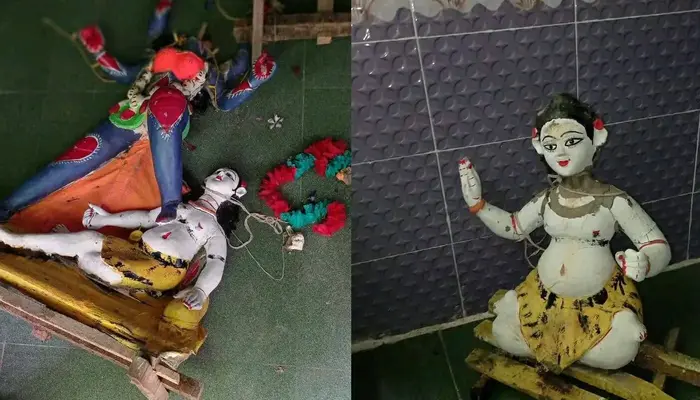
Case Summary
In Dimla Upazila of Nilphamari district in northern Bangladesh, a Muslim mob launched a violent arson attack on the Hindu households. The mob not only set the house ablaze but also vandalised and desecrated a nearby temple, targeting the idols of Hindu deities. Muslims also mercilessly beat and tortured Hindu women. Hindu women were sexually assaulted. A video from the scene, which has since circulated widely on social media platforms, captured a Hindu woman detailing the horror. “Our houses have been set on fire. They have broken down our homes. They have destroyed our temple,” she said. Another voice in the video, belonging to a man, pointed to the involvement of Chhatra Dal, the student wing of the Bangladesh Nationalist Party (BNP), in orchestrating the attack. He said, “It is the handiwork of members of Chhatra Dal.” Despite distress calls made to law enforcement, police did not arrive at the scene during the attack. Visuals of destroyed idols of Hindu deities were shared on social media. This incident is a stark reminder of the prolonged persecution of Hindus in the Islamic nation of Bangladesh, which has only increased manifold ever since the fall of Sheikh Hasina’s Awami League government on August 5, 2024. After her violent ouster, Bangladesh plunged into chaos as Islamist extremists have taken advantage of the political turmoil to unleash a wave of terror and violence against the Hindu community. The Islamist mobs have attacked Hindu homes, burned them to the ground, and abducted women in a horrific descent into anarchy. Several temples have been destroyed in various parts of the Islamic country in a major crackdown on Hindus. Reports have exposed how Muslim students forced around 60 Hindu teachers, professors, and government officials to resign. Exiled Bangladeshi activist Asad Noor has also revealed that the minority Hindu community is now being coerced into joining ‘Jamaat-e-Islami’. Hindu religious events have been repeatedly targeted. On 6th September, a procession carrying Lord Ganesha’s idol was attacked in Chittagong. Ahead of Durga Puja, multiple incidents of idol vandalism occurred, including attacks in Mymensingh, Pabna, Rajshahi, Kishoreganj, and Dhaka. On 29th November, a violent Muslim mob attacked three temples in Patharghata, Chittagong, immediately after Jumma Namaz. The crackdown on Hindu voices has also escalated. On 30th November, Hindu journalist Munni Saha was arrested in Dhaka. Muslim mob attacks have increased in Bangladesh, for example, on 22nd May 2025, a Muslim mob carried out arson attacks selectively on Hindu homes in Dahar Mashihati village in Abhaynagar upazila in Jessore district of Bangladesh. Even ISKCON leader Chinmoy Krishna Das Prabhu and his aides have been targeted, and attempts have been made to ban ISKCON and suppress Hindu protests through sedition charges. These arbitrary actions point to a systematic pattern of persecution under Muhammad Yunus’s interim government.
Why it is Hate Crime ?
This case has been added to the tracker under the primary category of: - Attack on Hindu religious representations. Within this, the subcategory selected is - Desecration of Hindu religious symbols. Icons and symbols or a religious representation of a spiritual ideal are widely revered in Hinduism. Iconography is of vital significance in the Hindu milieu. It helps connect people’s spiritual beliefs with the real world. Iconography within the Hindu faith takes several shapes and forms. Murtis are of most significance to Hindus, to which daily rituals, prayers and offerings are done. Besides the murtis, there are several other symbols which have deep significance in the Hindu faith – the Om and Swastika for example. Since these Hindu religious symbols hold paramount importance in Hinduism, any desecration of symbols, icons, murtis, religious representations and manifestations, is driven by animosity towards the faith itself which manifests itself through these murtis, icons and symbols. Therefore, any desecration of these Hindu religious symbols and representations is considered religiously motivated hate crimes under this category. The other sub-category selected is - Attack on Temples. In Hinduism, a temple is the abode of the Deity. The Deity in the Temple is consecrated, thereby, making it a real, breathing entity. Hindus believe that not just the Deity but the temple premises itself are sacred to Hindus since Hindus hold the faith that the entire Temple space is an amalgamation of the divine energy of the deity. Given the central significance of Temples in Hindu Dharma, any attack against a Hindu Temple or its peripheral premises is an attack on the faith itself and is born out of animosity towards the faith, of which, the Temple is a central tenet. Any manner of attack against a Temple and/or its premises would therefore be considered a religiously motivated hate crime. The other primary category selected is - Attack not resulting in death. Within it, the sub-category selected is - Attacked for Hindu identity. In several cases, Hindus are attacked merely for their Hindu identity without any perceived provocation. A classic example of this category of religiously motivated hate crime is a murder in 2016. 7 ISIS terrorists were convicted for shooting a school principal in Kanpur because they got ‘triggered’ seeing the Kalava on his wrist and tilak that he had put. In this, the Hindu victim had offered no provocation except for his Hindu religious identity. The motivation for the murder was purely religious, driven by religious supremacy. Such cases where Hindus are targeted merely for their religious identity would be documented as a hate crime under this category. The other sub-category selected is - Communal clash/attack. Communal clash is a form of collective violence that involves clashes between groups belonging to different religious identities. For a communal clash between Hindus and non-Hindus to qualify as a religiously motivated hate crime, the trigger of the violence itself would have to be anti-Hindu in essence. For example, if there is a Hindu religious procession that comes under attack from a non-Hindu mob and after the initial attack, Hindus retaliate in self-defence, leading to a communal clash between the two religious communities. While at a later stage, both communities are involved in the clash/violence, the initial trigger of the violence was by the non-Hindu mob against the Hindus and therefore, it could safely be termed as an anti-Hindu violence. Further, the trigger would also have to be religiously motivated. In the cited example, the attack by the non-Hindu mob was against religious processions and therefore, can be concluded to be religiously motivated. In some cases, the trigger may be non-religious, however, it develops into religious violence against Hindus at a later stage. In such cases too, the foundational animosity towards Hindus becomes the motivating factor of the crime and therefore, it would be classified as a religiously motivated hate crime against Hindus under this category. In this case, the Muslim mob targeted and destroyed murtis in the Hindu temple. In Hinduism, murtis are not mere artistic representations—they are sacred embodiments of divinity to whom devotees offer daily prayers and rituals. The act of desecrating these sacred icons demonstrates direct contempt for the Hindu religion. By smashing murtis, the perpetrators intended to insult and violate the spiritual and religious sentiments of Hindus. This was not a random act of vandalism—it was a conscious targeting of what is considered most sacred in Hinduism, making it a textbook case of hate crime. The mob also desecrated the temple itself. A Hindu temple is not just a structure of worship; it is an abode of the Deity, consecrated through intricate rituals and believed to be charged with divine energy. An attack on a temple is, therefore, an attack on a living manifestation of divinity. Such an act is driven by animosity toward Hindu Dharma and its central tenets. The Hindu household that was set ablaze was not accused of any offence or wrongdoing. The mob chose its target solely based on religious identity. The attack was designed to instil fear and exert dominance over a religious minority. No provocation was offered, and the victims were not involved in any conflict. The sole motivation behind the violence was their identity as Hindus. This aligns with patterns observed in other attacks on Hindus in Bangladesh, where religious identity alone becomes the cause for assault. Muslim mob ot only set fire to Hindu homes and desecrated a temple but also subjected Hindu women to brutal physical violence and sexual assault—acts aimed at humiliating and terrorising them as representatives of the Hindu community. The assault on their bodies and dignity was not random but anchored in religious hatred, reflecting a deliberate attempt to punish and intimidate them for being Hindu. The attack involved organised violence by a Muslim mob specifically targeting the Hindu community on the basis of their religious identity. It was not the result of a personal dispute or local altercation—it was a collective, planned assault involving arson, temple desecration, and brutal physical and sexual violence against Hindu women. Thus, the religious identity of the victims as Hindus was central to why they were targeted, making this a clear instance of hate crime against Hindus. This is not an isolated case but part of a broader pattern of targeted violence against Hindus in Bangladesh, which has only increased since the violent ouster of Sheikh Hasina on 5th August 2024, with at least 205 attacks on Hindu temples, shops, and businesses reported within just three days of Dhaka’s fall. Reports have exposed how Muslim students forced around 60 Hindu teachers, professors, and government officials to resign. Exiled Bangladeshi activist Asad Noor has also revealed that the minority Hindu community is now being coerced into joining ‘Jamaat-e-Islami’. Hindu religious events have been repeatedly targeted. On 6th September, a procession carrying Lord Ganesha’s idol was attacked in Chittagong. Ahead of Durga Puja, multiple incidents of idol vandalism occurred, including attacks in Mymensingh, Pabna, Rajshahi, Kishoreganj, and Dhaka. On 29th November, a violent Muslim mob attacked three temples in Patharghata, Chittagong, immediately after Jumma Namaz. The crackdown on Hindu voices has also escalated. On 30th November, Hindu journalist Munni Saha was arrested in Dhaka. ISKCON leader Chinmoy Krishna Das Prabhu and his aides have been targeted, while attempts to ban ISKCON and suppress Hindu protests through sedition charges highlight systematic persecution under Muhammad Yunus’s interim government.


Case Status
Unknown


Perpetrators Details
Perpetrators
Muslim Extremists
Perpetrators Range
Unknown
Perpetrators Gender
male
 Sources




