Hindu students brainwashed against their faith: Govt school teacher discourages from participating in Kanwar Yatra; incites them against Hindu traditions
 Bareilly, Uttar Pradesh, India
  14 July, 2025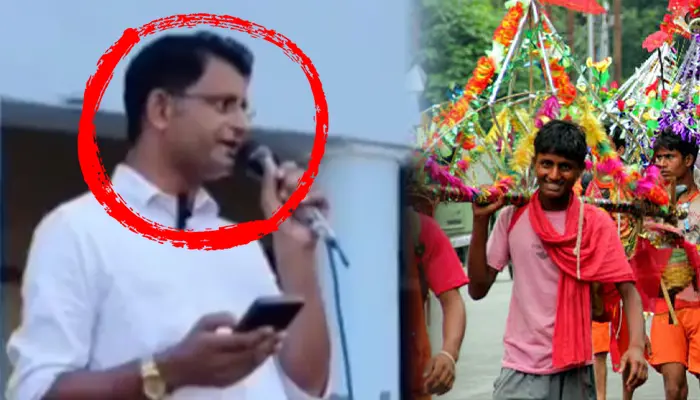
Case Summary
In Bareilly, Uttar Pradesh, a government school teacher named Rajneesh Gangwar composed and recited a poem in which he discouraged minor Hindu children from participating in the Kanwar Yatra and attempted to incite them against their faith and traditions. The Kanwar Yatra is an annual Hindu pilgrimage observed during the holy month of Sharavan by Hindu devotees of Lord Shiva, known as Kanwariyas. They travel to holy sites such as Haridwar, Gaumukh, and Gangotri in Uttarakhand to collect sacred water from the Ganga river, which they then offer to Lord Shiva at local Hindu temples. This tradition is highly revered among Hindus. A video of Rajneesh reciting the poem went viral on social media. In the video, he stated, “Don't go to take Kanwar, light the lamp of knowledge. By serving humanity, you become a true human.” The poem further read, “No one has become a lawyer, DM, or SP by carrying Kanwar. No Baniya has become a Hakim or Vaidya through Kanwar water. Kanwar will not develop wisdom or discretion. There will be no salvation in bhang (marijuana), dhatura, ganja, or sulpha intoxication. Leave behind the addiction to caste and religion, and do good for yourself. Study in schools and libraries, and deepen your knowledge. Serve humanity with good deeds, light the lamp of love. Following the widespread circulation of the video, an FIR was registered against Rajneesh Gangwar. After the complaint, leftist groups on social media platforms like X (formerly Twitter) and Facebook began showing support for Rajneesh, describing his poem as 'logical'. Leftist journalists, including Sakshi Joshi, also stepped forward to defend him. Subsequently, Rajneesh released another video on social media, attempting to justify his actions by stating that his sole intention was to encourage children to pursue education and not to invest excessive time in the Kanwar Yatra.
Why it is Hate Crime ?
This case has been added to the tracker under the primary category- Hate Speech against Hindus. Within this, the subcategory selected is- Anti-Hindu slurs, mocking faith. Anti-Hindu slurs and the deliberate mocking of the Hindu faith owing to religious animosity involve the usage of derogatory terms, stereotypes, or offensive references to religious practices, symbols, or figures. One of the common anti-Hindu slurs used against Hindus is “cow-worshipper” and “cow piss drinker”. The intention of using this term is to demean and mock Hindus as a group and their religious beliefs since Hindus consider the cow holy. Additionally, some symbols and the slurs attached to them have a historical context that exacerbates the insult, hate, stereotyping, dehumanisation and oppression against Hindus. Cow worship has been used for centuries to denigrate Hindus, insult their faith and oppress Hindus specifically as a religious group. There has been overwhelming documentation about how cow slaughter has been used to persecute Hindus with cow meat being thrown in temples and places of worship. There has also been overwhelming documentation where cow meat (beef) has been force-fed to Hindus to either forcefully convert them to Islam or denigrate their faith. Apart from cow worship, the Swastika – which holds deep religious significance for the Hindus – has also been misinterpreted and distorted to use as a slur against Hindus. Similarly, the worship of the Shivling has been used by supremacist ideologies and religions to denigrate Hindus owing to religious animosity. Such slurs and denigration stem out of inherent animosity and hate towards Hindus and their faith, therefore, it is categorised as hate speech targeted at Hindus specifically owing to their religious identity. This poem, narrated by the government school teacher in Bareilly, Uttar Pradesh, was a veiled incitement against the Kanwar Yatra, a sacred and deeply meaningful pilgrimage for the devotees of Lord Shiva and a denigration of deeply revered Hindu traditions and practices. The Kanwar Yatra is not merely a religious journey; it represents devotion, discipline, and spiritual identity for a vast section of the Hindu population. By composing and publicly reciting a poem that mocked and discouraged participation in this holy practice, Rajneesh attacked a core element of Hindu spiritual life and attempted to erode the cultural heritage it embodies. Acts like these stem from deeply rooted prejudice and hostility towards Hinduism and its adherents. This was not just a personal opinion; rather, it was a clear case of religiously motivated hate speech. By saying “Don’t go to take Kanwar, light the lamp of knowledge,” Rajneesh implies that religious devotion is an obstacle to wisdom, thereby presenting Hindu faith as irrational or regressive. This sets up a false dichotomy between spirituality and intellect, subtly suggesting that those who participate in the Kanwar Yatra lack education, discretion, or higher purpose. Such a portrayal not only disrespects the millions of Hindus who undertake this pilgrimage with deep spiritual intent, but also reinforces negative stereotypes about Hindu religious practices being backwards or useless. Statements like “No one has become a lawyer, DM, or SP by carrying Kanwar” mock the religious identity and aspirations of Hindu youth, as if the act of devotion is inherently anti-progress. This not only insults the sacred nature of the pilgrimage but also sends a damaging message to young Hindus that their traditions are barriers to success. Moreover, bhang and dhatura are symbolically associated with Lord Shiva in Hindu tradition. These substances, while symbolic in certain rituals, are not promoted as indulgences but are part of specific theological meanings rooted in ancient practices. Saying that “there is no salvation” in these substances, especially in a poem that mocks the Kanwar Yatra, was not meant to criticise substance abuse; it specifically targeted those ritual elements that are part of Shiva worship, which are not meant for intoxication but are symbolic offerings in puja and associated with Shiva’s rejection of worldly norms. This kind of messaging aligns with a broader pattern of Hinduphobic rhetoric that frames Hindu religious expression as regressive and socially harmful, thereby paving the way for religious alienation, especially among the youth. What makes this incident especially troubling is that Rajneesh delivered this anti-Hindu message to a group of minor Hindu children. At such a tender age, children are impressionable, vulnerable, and highly susceptible to manipulation, especially when the message comes from someone in a position of authority, like a teacher. Rather than nurturing their understanding and identity, Rajneesh misused his role to alienate the Hindu children from their ancestral faith. His poem not only discourages a religious ritual; it subtly invalidates Hindu customs as irrelevant and irrational. This kind of ideological imposition amounts to a quiet, calculated form of indoctrination, one aimed at turning Hindu children away from their own beliefs and traditions. The long-term impact of such actions cannot be underestimated. When children are fed messages that portray their religion as regressive or foolish, it sows seeds of doubt, insecurity, and even contempt, not only towards their faith but towards the broader Hindu community. Furthermore, Rajneesh's portrayal of the Kanwar Yatra as a barrier to success, and linking it to merely to intoxication, sought to convince these children that their religious practice is incompatible with personal growth or ambition. Over time, this leads to a weakening of their cultural connection and also creates a fertile ground for religious conversion, especially when another faith like Islam or Christianity is positioned as more rational or progressive. In doing so, such efforts jeopardise the continuity of the Hindu community’s cultural and spiritual identity. At its core, such messaging arises from a deep animosity towards Hinduism and those who practise it. Another point to highlight is that when this matter escalated, there was a vocal support for Rajneesh from journalists and left-leaning voices on platforms such as X (formerly Twitter) and Facebook. Rather than holding him accountable for targeting a religious tradition, many defended his poem as 'logical' and attempted to paint his actions as a progressive campaign for education. Prominent leftist journalists, including Sakshi Joshi, immediately came to his defence. Such actions are clearly rooted in prejudice and disdain for Hinduism and the Hindu community. The accused, Rajneesh, himself put out a video attempting to justify his actions, presenting them as an effort to promote learning among students. However, the reality is that his words went far beyond an encouragement for education; his message was a direct attack on a sacred Hindu tradition and a subtle attempt to create a sense of doubt against their faith in Hindu children, all under the misleading banner of education, career success and humanity. Such subtle indoctrination of Hindu children is motivated by religious hostility towards the Hindu faith. Since this case meets the parameters of a religiously motivated hate speech against Hindus and their faith, it is being added to the hate crime database.


Case Status
Complaint registered


Perpetrators Details
Perpetrators
Others
Perpetrators Range
One Person
Perpetrators Gender
male
 Sources




