Indian media journalist questions Hindu sobha yatra, ignores Muslim mob's brutal attacks on Hindus during 2023 Nuh violence
 Nuh, Haryana, India
  14 July, 2025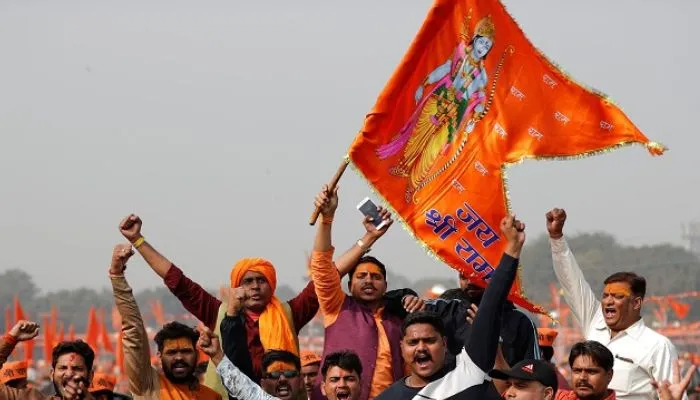
Case Summary
Hindus in Haryana’s Nuh district marked the first Monday of Shravan, 14 July 2025, by setting off on the annual 80‑kilometre Braj Mandal Jalabhishek Yatra, organised by the Vishva Hindu Parishad. This is the same procession that had come under attack by Islamists in Haryana’s Nuh in 2023. The murderous assault had left seven Hindus dead. Among them was a Hindu youth named Abhishek, who was shot, had his throat slit, and his face was pounded with stones. Despite the Hindus being on the receiving end in the 2023 Nuh violence, this year, as a preventive measure, the police banned sharp tridents (Trishul) and baseball bats as potential weapons and kept Hindu leaders like Bittu Bajrangi under watch. Moreover, authorities fielded more than 2,500 police personnel, deployed drones and sniffer dogs, and suspended mobile internet services for the day. Yet, even with these precautions, and knowing that it was the Islamists who had attacked the Hindu procession arranged by the Vishva Hindu Parishad (VHP) and the Bajrang Dal, which led to widespread violence and arson in Nuh and adjoining areas in 2023, Aaj Tak’s studio anchor Neha Batham questioned the wisdom of permitting the Yatra at all. During a live coverage, the journalist questioned, “When such an incident happened in 2023, what was the need for the procession? After all, peace is the top priority.” Her on‑ground colleague Anmol Vali echoed that framing, repeating claims that Hindu participants had triggered last year’s violence while failing to recall that the arson, looting, and killings were executed by organised Muslim gangs who attacked devotees, torched police vehicles, and battered home‑guard volunteers. Despite reports being in the public domain that the Haryana police filed over 60 FIRs and over 400 Muslims were arrested in the 2023 Nuh violence, neither the ground reporter nor the anchor named the Muslim wrongdoers nor the continuing legal proceedings against more than 400 Muslim accused, many now out on bail. They made no mention of the Hindu youth named Abhishek was brutally murdered by the Muslim mob at the Shiv temple premises, nor the female judicial officer whose car was set alight with her three‑year‑old daughter inside, nor of the targeted burning of Hindu‑owned shops in Nuh and adjoining localities. In place of those details, viewers were left with insinuations that the presence of kanwariyas, and, by extension, Hindu public worship, posed the chief threat to communal calm. The ground reporter made a special mention of the police action against Hindu activist Bittu Bajrangi, trying to paint him as the accused in the Nuh violence. He also added that weapons like “Trishul”, “baseball bat”, have been banned from the procession, insinuating that the Hindus were the aggressors during the 2023 violence. Interestingly, during the reporting, on-ground reporter Anmol Vali and Neha avoided mentioning that the 2023 riots were caused by a Muslim mob.
Why it is Hate Crime ?
The primary category in this case is: Hate speech against Hindus. The secondary category under this is: Anti-Hindu subversion and prejudice. The tertiary category under this is: Anti-Hindu Fake News or Downplaying. Hate speech is defined as any speech, gesture, conduct, writing, or display that is prejudicial against a specific individual and/or group of people, which is leading to or may lead to violence, prejudicial action or hate against that individual and/or group. Media plays a specific and overarching reach in perpetuating prejudicial attitudes towards a community owing to unfair, untrue coverage and/or misrepresentation/misinterpretation, selective coverage and/or omission of facts of/pertaining to issues affecting a specific religious group. This type of bias can dehumanise the victim group, making it easier for others to justify harmful actions against them, which aligns with the objectives of hate speech laws aimed at preventing such harm. It is often observed that the media takes a prejudicial stand against the Hindu community driven by their need to shield the aggressor community which happens to be a numeric minority, however, is the one perpetrating violence against Hindus. For example, the media is often quick to contextualise religiously motivated crimes against Hindus, omit or misrepresent facts that point towards religiously motivated hate crimes, justify and/or downplay religiously motivated hate crimes or simply present fake news to stereotype Hindus. Such media bias leads to the denial of persecution and is often used to dehumanise Hindus, leading to justification for violence against them. For example, the media covered several fake allegations of Hindus targeting Muslims and forcing them to chant Jai Shree Ram. Most of these cases were proved false and fabricated after police investigation. These fake news reports were subsequently never retracted or clarified. Such fake news led to the justification of violence and dehumanisation of Hindus based on the argument that since Hindus targeted Muslims and forced them to chant Jai Shree Ram, the dehumanisation of Hindus and violence against them was par for the course and merely a retaliation. Such media bias leads to prejudicial portrayal of Hindus and offers a justification for violence against them and therefore, is considered hate speech under this category. The conduct of Aaj Tak’s anchor and field correspondent meets the threshold of hate speech against Hindus because their reportage systematically re‑framed a documented anti‑Hindu pogrom as a potential Hindu provocation. By suppressing the identity of the previous year’s assailants, organised Muslim mobs, and instead casting suspicion on Hindu devotees merely undertaking a lawful religious procession, the broadcast reversed victim and perpetrator. Such inversion is not a benign error; it entrenches a narrative in which Hindus appear inherently combustible while their attackers are rendered invisible, thereby legitimising prejudice against the Hindu community. This rhetorical distortion exemplifies a persistent pattern within certain segments of Indian media, wherein Hindu religious events are portrayed not as legitimate expressions of cultural and spiritual devotion but as potential flashpoints or provocations. This narrative tendency effectively delegitimises the Hindu community's right to publicly observe its faith, subtly implying that their religious expressions are inherently disruptive or combustible. In the specific context of Nuh district, where Muslims constitute a numerical majority and had, during the 2023 violence, mobilised in large numbers to attack a Hindu procession, the onus of “maintaining peace” has been disproportionately placed upon the Hindu community. This misallocation of moral responsibility not only disregards the asymmetry of violence observed in the past but also acts as a tacit endorsement of that violence by demanding restraint only from the victims. The implication is clear: if the Hindus simply refrain from asserting their religious identity in public, violence may be avoided. Such logic effectively rewards past aggressions and diminishes the Hindu community's civil rights, most notably, the right to assemble, worship, and grieve without preemptive suspicion or restriction. Moreover, the anchor’s emphasis on the ban on the Trishul during the yatra further compounds the problem. By specifically identifying the Trishul, a sacred religious symbol in Hinduism and an emblem of Lord Shiva, as a potential weapon, the coverage implicitly suggested that the Hindu participants had arrived armed and initiated the violence. This is completely untrue, as the assault on the Hindu participants of the yatra at Badkali Chowk, on 31st July, 2023, the day violence broke out in Nuh, was described in detail in the FIR. On July 31, 2023, tensions gripped several parts of Haryana when stones were pelted at the Jalabhishek Shobha yatra in the Muslim-majority region of Mewat. The procession was taken out to mark the auspicious occasion of Shravan Somwar. In several videos of the clashes, a mob charging in a hostile way at the yatris could be heard raising “Allahu Akbar” and indulging in riotous activities. 6 people were killed by the rioting Muslim mob. According to the police report, one of the culprits informed the investigators that, prior to the disturbances, Congress MLA Mamman Khan had arranged for money (Rs 500 each) to be delivered to the Muslim miscreants through local sarpanchs. Furthermore, it asserted that incendiary posts were spread via WhatsApp groups bearing the legislator’s name, including Youth Team Mamman Khan and IT Cell Mamman Khan. This is not a neutral observation; it subtly casts suspicion on the entire religious gathering and feeds into a broader narrative that vilifies Hindu symbolism as dangerous or provocative. The Trishul, which holds immense spiritual and cultural significance, was thus reduced to the status of a threat, an object not of reverence but of fear. The reporting by the news anchor is anti‑Hindu subversion and prejudice in two ways. First, it denies the historical reality of targeted violence inflicted on Hindus, stripping them of their legitimate grievance and moral standing. Second, it normalises a double standard in which Hindus are expected to suppress public worship lest it “provoke” aggression. That expectation tacitly justifies future assaults: if violence erupts again, culpability will lie, by prior framing, with the Hindu participants for daring to assemble at all. Such media malpractice erodes the Hindu community’s right to equal sympathy, paving the way for societal acceptance of continued hostility towards them. By fostering that climate, the broadcast constitutes a form of hate speech designed to marginalise Hindus and rationalise aggression against them.


Case Status
Unknown


Perpetrators Details
Perpetrators
Others
Perpetrators Range
From 2 To 5
Perpetrators Gender
both
 Sources




