Hindu man hacked to death in full public view by Muslim men during Muharram procession in Bihar
 Purba Champaran, Bihar, India
  5 July, 2025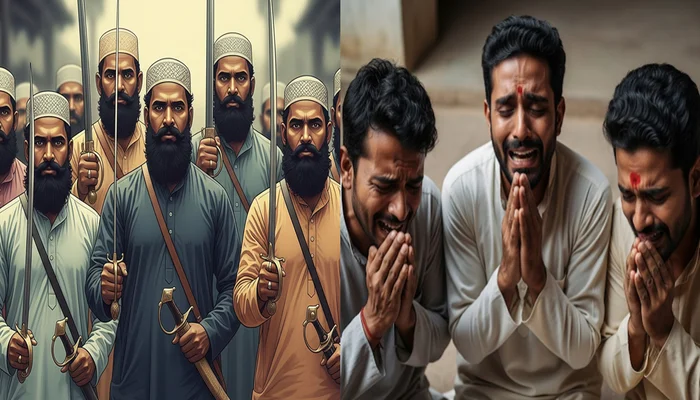
Case Summary
In Kankatti Bazar, East Champaran district, Bihar, a Hindu man named Ajay Kumar Rai was hacked to death, along with his brothers, who were brutally attacked with swords by Muslim men during the Muharram procession. Ajay, along with his brothers Dhananjay and Naval Kishore, went to watch a Tazia procession. Ajay was brutally attacked and hacked to death with a sword while watching a Tazia procession. When his brother Dhananjay Kumar and cousin Naval Kishore Rai tried to intervene, they too were brutally assaulted. Ajay succumbed to his injuries during treatment at the hospital, while others sustained serious injuries. The murder was carried out in public, taking advantage of the crowd gathered for the Muharram procession, using the sword that was used in the procession. A local named Vipin Baitha had already reported to the police that there could be violence. However, the administration failed to take preventive measures, which has sparked controversy over the negligence of the police. As of the date of writing this report, two people were detained in connection with the case. The investigation was ongoing. Notably, Ajay's brother contested the Panchayat elections and had an ongoing dispute with a person named Nizamuddin. Police stated that a prior clash occurred between the same parties 15 days earlier, and an FIR was also registered. Disclaimer: Some reports also mention the name of the victim as Ajay Yadav. However, most of the reports have named the victim as Ajay Rai, and hence we have chosen to go ahead with this name for the purpose of documenting this crime in the Hinduphobia tracker. Upon receiving confirmation about the name, this case will be updated.
Why it is Hate Crime ?
This case has been added to the tracker under the primary category of: Attack resulting in death. Within it, the sub-category selected is: Communal clash/attack. Communal clash is a form of collective violence that involves clashes between groups belonging to different religious identities. For a communal clash between Hindus and non-Hindus to qualify as a religiously motivated hate crime, the trigger of the violence itself would have to be anti-Hindu in essence. For example, if there is a Hindu religious procession that comes under attack from a non-Hindu mob, and after the initial attack, Hindus retaliate in self-defence, leading to a communal clash between the two religious communities. While at a later stage, both communities are involved in the clash/violence, the initial trigger of the violence was by the non-Hindu mob against the Hindus and therefore, it could safely be termed as anti-Hindu violence. Further, the trigger would also have to be religiously motivated. In the cited example, the attack by the non-Hindu mob was against a religious procession and therefore, can be concluded to be religiously motivated. In some cases, the trigger may be non-religious; however, it develops into religious violence against Hindus at a later stage. In such cases, too, the foundational animosity towards Hindus becomes the motivating factor of the crime, and therefore, it would be classified as a religiously motivated hate crime against Hindus. Under this category, cases where the attack led to the death of the Hindu victim/s would be documented. The second sub-category selected under this is- Attacked for opposing radicals to trying to save victim. In several cases, Hindus are attacked for opposing religiously motivated crimes being committed against a fellow Hindu or simply for voicing an opinion opposing radical elements, who either have in the past or continue to persecute Hindus. In such cases, the initial attack against the victim, against which the Hindu was trying to defend the victim, would also need to be classified as a religiously motivated hate crime. Since the initial crime itself was religiously motivated and the subsequent crime of attempting to save the victim or speaking against the radical elements ends up inviting a violent attack, it would also be classified as a religiously motivated hate crime. Under this category, cases where the attack led to the death of the Hindu victim/s would be documented. This case has been added to the tracker because the Hindu man was hacked to death by Muslim men during the Muharram procession, while his brothers were attacked with a sword while trying to save their brother. Although it is known that a history of personal enmity existed between the Hindu victims and the local Muslim youths, the deliberate choice to launch the attack during the Muharram procession, along with the use of religious symbols such as swords carried in the Tazia procession, indicates a conscious religious framing of the assault. The murder wasn’t just an act of personal revenge; it was more of a public execution during a religious procession, to send a message and assert psychological control over the local Hindu population. Muharram, a solemn Islamic occasion marked by public demonstrations and martial symbolism, was exploited by the assailants to escalate a local dispute into a collective religious confrontation. In the ideological framework of Islamic supremacist thought, non-Islamic territories (Dar-ul-Harb) are viewed as zones to be subjugated or converted into Islamic domains (Dar-ul-Islam). Within this worldview, even local feuds can be weaponised through religious festivals to assert communal dominance and intimidate the Hindu community. The disproportionate nature of the violence, the conscious use of religious processions as cover, and the targeted attack against Hindus all point toward an underlying intent to terrorise and humiliate the Hindu community. It is this calculated religious targeting and the ideological motivations that classify this incident as a hate crime and warrant its inclusion in the tracker. It is important to note here that while the police described the killing of Ajay Kumar Rai as stemming from a prior dispute, this explanation dangerously downplays the religious and communal dimensions of the incident. The murder did not occur in isolation or in private but was carried out publicly, during a Muharram procession, using swords typically associated with the Tazia ritual. This setting was not coincidental. The attackers chose a religious procession as their cover, ensuring maximum visibility and symbolic weight. Such disproportionate violence, a public execution using a religious weapon during a religious event, carries far more than personal implications. It becomes a communal message: one of intimidation and assertion of dominance. The use of a sacred Muslim procession as the setting for the killing of a Hindu man indicates a deliberate fusion of religious symbolism and targeted aggression, which cannot be dismissed as a mere private feud. By treating it as an interpersonal dispute, authorities risk ignoring the broader pattern of how Islamic religious occasions are increasingly used to carry out attacks on Hindus. The police, in many such cases, where the motive behind the crime is obvious but not explicitly mentioned, deny that the crime committed was in any way motivated by a religious bias or say that there was ‘no communal angle’ to the crime. Several factors are generally at play here. Many a time the police downplay incidents of low-level communal crime because it is their jurisdiction that comes under question. The police also often say that there was ‘no communal angle’ to a crime when there was one because they wish to ensure that owing to the crime already committed, there is no further flare up in the area. Likewise, the Left media and the leftist elite are also inclined to emphasise this "no communal angle" trope, especially wherever the victim of the crime is a Hindu. However, only a police statement or a media report, for instance, cannot be enough to determine whether there is a communal angle present in the crime that has been committed. In fact, to determine whether the crime is communal in nature or not, we need to give emphasis to the ground realities. For example in the case of Rinku Sharma, the Bajrang Dal activist who was mercilessly stabbed in his house in front of his family members in Delhi’s Mangolpuri area in the year 2021, the leftist media and the leftist ecosystem had tried to peddle that there was no communal angle to the crime. Even the police denied that the crime was communal in nature. However, Opindia spoke to several people who are on the ground with the family of Rinku Sharma, and we were told that the communal tension in the area is palpable. The family of Rinku Sharma has said that the Muslims of the area held a grudge against Rinku ever since he celebrated the Ram Mandir verdict. Like the case of Rinku Sharma, those cases where even if the police have denied a communal angle or the leftist media have gone on an overdrive to peddle the ‘no communal angle’ trope, the ground reality, like the victim’s family or relative's testimonies, make it clear that there was an obvious religious bias that led to the crime, will be documented in this tracker. Going by the same logic, since local Hindu residents testified that the police had been alerted in advance about the possibility of violence, and because the attack on the Hindu men was deliberate and not accidental, this case has also been included in the Hinduphobia Tracker as a religiously motivated hate crime.
Victim Details
Total Victim
3
Deceased
1
Gender
- Male 3
- Female 0
- Third Gender 0
- Unknown 0
Caste
- SC/ST 0
- OBC 0
- General 3
- Unknown 0
Age Group
- Minor 0
- Adult 3
- Senior Citizen 0
- Unknown 0


Case Status
Case sub-judice


Perpetrators Details
Perpetrators
Muslim Extremists
Perpetrators Range
From 10 to 100
Perpetrators Gender
male
 Sources




