Hindu deities abused and Hindu villagers targeted for conversion with false healing promises at Christian conversion drive in Kushinagar
 Kushinagar, Uttar Pradesh, India
  5 July, 2025
Case Summary
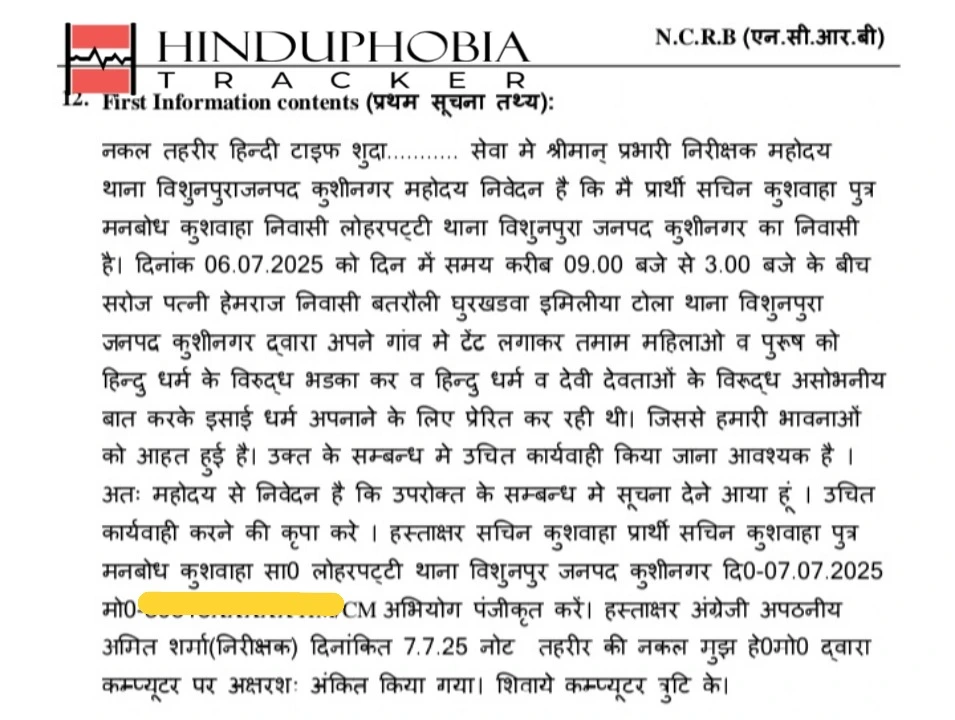
In the Batrauli Dhurkhandwa village in the Vishunpura police station area of Kushinagar district, a Christian missionary prayer gathering was organised at the home of Saroj Devi, wife of Hemraj, where attempts were made to convert local Hindu residents to Christianity under the guise of curing illnesses. The accused used derogatory language against Hindu deities. Hinduphobia Tracker obtained a copy of the FIR. It is filed by Sachin Kushwaha, son of Manbodh Kushwaha, a resident of Lohrpatti, Vishunpura. According to the FIR, the event involved a tent being set up and a large gathering of men and women who were provoked against Hindu Dharma. The organiser used derogatory language against Hindu deities and encouraged people to abandon Hinduism and adopt Christianity. The complainant reported that this deeply hurt the religious sentiments of the local Hindu community and demanded immediate legal action. Activists from the Rashtriya Bajrang Dal, upon receiving information about the event, informed the police. By the time police arrived, the Christian pastor had fled the scene, but Saroj Devi and three others were taken into custody for questioning. At the time of writing this report, the investigation was ongoing. Vishunpura Station House Officer (SHO) Anil Singh Yadav confirmed that after initial investigation, an FIR was registered against Saroj Devi under appropriate sections.
Case Images
Why it is Hate Crime ?
This case has been added to the tracker under the primary category - Predatory Proselytisation. The sub-category relevant in this case is - Attempting to convert/converting by denigrating Hinduism. In several cases, Hindus are converted or an attempt is made to convert Hindus by denigrating their faith, Hinduism. In such cases, the Hindus associate with the non-Hindu perpetrators often by choice and then, the attempt to convert them by insulting their faith, showing the faith down etc begins. An example of this would be a non-Hindu gathering where the Hindus are attending the gathering of their own free will. However, once they attend the gathering, there is an explicit attempt to convert them by abusing their faith and hailing the faith of the perpetrator. The denigration of the Hindu faith is often based on misrepresentation of the Hindu faith, its doctrine and scriptures and insult to espoused traditions if not blatant lies about Hindu beliefs and ways. Such conversions or attempts at conversions are driven by animosity towards the Hindu faith and are therefore documented as religiously motivated hate crimes. The other sub-category selected is - Proselytisation by grooming, brainwashing, manipulation or subtle indoctrination. Religious brainwashing essentially means the often subtle and forcible indoctrination to induce someone to give up their religious beliefs to accept contrasting regimented ideas. Religious grooming or brainwashing also involves propaganda and manipulation. It involves the systematic effort, driven by religious malice and indoctrination, to persuade “non-believers’ to accept allegiance, command, or doctrine to and of a contrasting faith. Cases of such grooming or brainwashing are far more nuanced than direct threats, coercion, inducement and violence. In such cases, it is often seen that there is repeated, subtle and continual manipulation of the victim to induce disaffection towards their own faith and acceptance of the contrasting faith of the perpetrator. While subtle indoctrination is widely acknowledged as predatory, an element which is often understated in such conversions or the attempts of such conversion is the role of loyalty and trust which might develop between the perpetrator and the victim. Fiduciary relationships are often abused to affect such religious conversion. For example, an educator transmitting religious doctrine of a competing faith to a Hindu student. The Hindu student is likely to accept what the teacher is transmitting owing to existence of the fiduciary relationship. The exploitation of the fiduciary relationship to religiously indoctrinate victims would also be included in this category. Since the underlying animosity towards the victim’s faith forms the basis of predatory proselytization, such cases are considered religiously motivated hate crimes. The other sub-category selected is - Conversion/attempts to convert by inducement. Predatory Proselytisation is not just limited to threat, harassment, force and violence, but it also has contours of stealth. In several cases, the Hindu victim is exploited to convert, with non-Hindus taking advantage of their poverty. In such cases, the Hindu victim who is suffering financially is offered monetary benefits, including lucrative offers for jobs, health treatment, education, etc, to induce the victim into changing his/her religion. In such cases, the religious identity of the victim and the aim to disenfranchise him from his faith form the heart of the crime. Also, taking advantage of and exploiting an individual’s economic vulnerabilities is widely acknowledged as exploitation, forms of which are often penalised by law. Such cases therefore are considered religiously motivated hate crimes since the victim’s religious identity forms the very heart of the crime itself. In this case, as per the FIR, the organiser, Saroj Devi, used abusive and derogatory language against Hindu deities and Hindu Dharma in front of a gathering. The participants were deliberately provoked against their own religion and were pressured to convert to Christianity. Insulting or mocking deities is not merely offensive—it is a targeted attack on the core of Hindu identity and belief. In Hindu Dharma, deities are not abstract figures but living embodiments of the divine that are deeply integrated into daily life, worship, community traditions, and personal spiritual experience. To abuse them in public—especially in a communal setting designed for conversion—is to intentionally degrade and invalidate the religious worldview of the gathered Hindus. This fosters shame, psychological dislocation, and coercive pressure to dissociate from one’s faith. This form of verbal violence is not incidental or isolated—it is instrumental in the broader strategy of religious conversion. The denigration is designed to weaken the victims’ emotional and spiritual ties to Hinduism by portraying their deities and traditions as inferior or meaningless. This is a hate-driven act, aimed at making Hindus feel their religion is not worthy of respect, and thus nudging or forcing them to abandon it. As such, this behaviour goes far beyond mere disagreement or debate. It weaponises religious contempt, using psychological and social manipulation to effect religious change. Because it specifically targets Hindus for their faith, insults their sacred traditions, and seeks to forcibly sever their religious identity, it qualifies as a religiously motivated hate crime. The underlying aim was to create disaffection towards Hindu Dharma and induce acceptance of Christianity. The approach used was not overt coercion or threat, but manipulative spiritual rhetoric that sought to convince attendees that adopting Christianity would provide relief from the suffering. By exploiting people’s desire for healing and their trust in spiritual authority, the organisers subtly pushed an anti-Hindu narrative, presenting Hinduism as ineffective or false, while projecting Christianity as a solution to their problems. This is not a neutral act of preaching; it is an ideologically driven brainwashing to weaken Hindu identity and replace it with another religious worldview through psychological manipulation. Healing from illness was used as the promised benefit for those who would convert. The promise of miraculous cures—a recurring inducement tactic in many proselytisation drives—exploits the desperation and vulnerability of poor or ailing Hindus. The spiritual hope offered in exchange for conversion operates as a form of coercion masked as compassion, which plays on the hardships of individuals in economically or medically difficult circumstances. This inducement is not neutral or benign—it is an attempt to dislodge the victim from their Hindu faith using material or emotional lures. Because the religious identity of the victim and the objective to convert them away from Hinduism are central to this act, it qualifies as a hate crime under this category. Hence, this is a hate crime because it involves the deliberate denigration of Hindu deities combined with manipulative brainwashing tactics—including false promises of healing—to induce Hindus to abandon their faith.


Case Status
Case sub-judice


Perpetrators Details
Perpetrators
Christian Extremists
Perpetrators Range
Unknown
Perpetrators Gender
both
 Sources




