Indigenous Hindus defamed in Arunachal: Christian MLA labels them ‘violent’, glorifies conversion to Christianity
 Itanagar, Arunachal Pradesh, India
  6 March, 2025
Case Summary
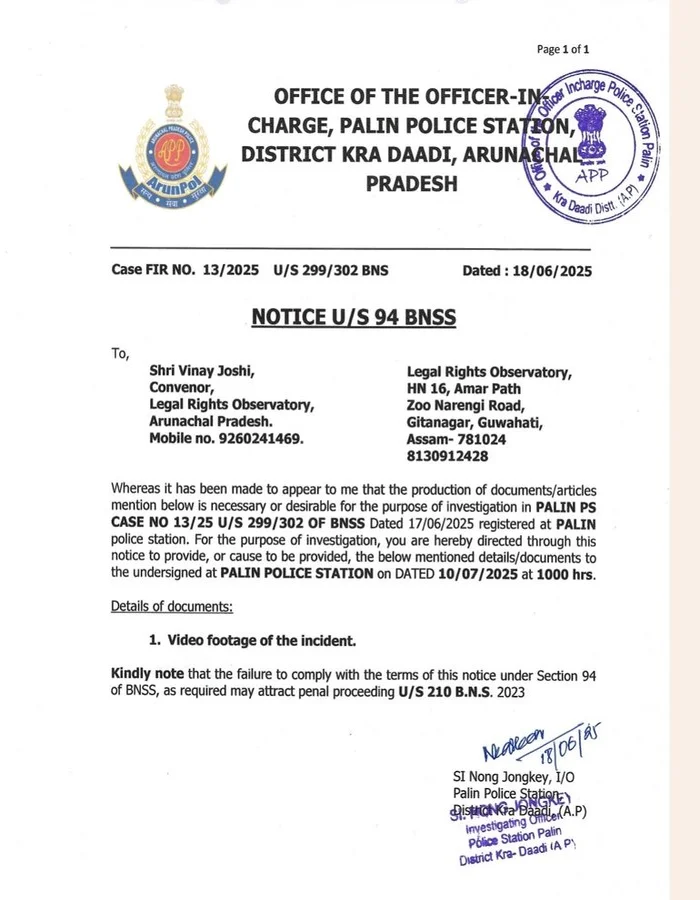
In Arunachal Pradesh, Hindu tribal people were insulted, and their faith was disrespected by a Christian MLA Nikh Kamin, from the Bordumsa constituency. During an interview with the media, Kamin was opposing the Arunachal Pradesh Freedom of Religion Act, 1978 (APFRA), where he said that before the advent of Christianity, the tribal communities of Arunachal Pradesh practised only "head hunting" and that there existed a system of revenge among the Nyishi community. He further stated that violence was prevalent among tribals, and it was Christianity that brought peace to the region and made it civilised. He stated that Christians only want peace and are indigenous to Arunachal and questioned the need for the revival of APFRA, which had been lying dormant for 40-50 years. The APFRA, enacted in 1978, prohibits religious conversions by force, inducement, or fraudulent means and was designed to protect the religious practices of the indigenous communities, primarily Hindus, including Donyi-Polo, Buddhism, and Vaishnavism. As of the date of writing this report, an FIR was registered against Nikh Kamin, based on which further legal action would be taken against him.
Case Images
Why it is Hate Crime ?
This case has been added to the tracker under the primary category of: - Hate speech against Hindus. Within it, the sub-category selected is: - Anti-Hindu slurs, mocking faith. Anti-Hindu slurs and the deliberate mocking of the Hindu faith owing to religious animosity involve the usage of derogatory terms, stereotypes, or offensive references to religious practices, symbols, or figures. One of the common anti-Hindu slurs used against Hindus is “cow-worshipper” and “cow piss drinker”. The intention of using this term is to demean and mock Hindus as a group and their religious beliefs since Hindus consider the cow holy. Additionally, some symbols and the slurs attached to them have a historical context that exacerbates the insult, hate, stereotyping, dehumanisation and oppression against Hindus. Cow worship has been used for centuries to denigrate Hindus, insult their faith and oppress Hindus specifically as a religious group. There has been overwhelming documentation about how cow slaughter has been used to persecute Hindus with cow meat being thrown in temples and places of worship. There has also been overwhelming documentation where cow meat (beef) has been force-fed to Hindus to either forcefully convert them to Islam or denigrate their faith. Apart from cow worship, the Swastika – which holds deep religious significance for the Hindus – has also been misinterpreted and distorted to use as a slur against Hindus. Similarly, the worship of the Shivling has been used by supremacist ideologies and religions to denigrate Hindus owing to religious animosity. Such slurs and denigration stem out of inherent animosity and hate towards Hindus and their faith, therefore, it is categorised as hate speech targeted at Hindus specifically owing to their religious identity. The second sub-category selected under the above primary category is- Anti Hindu subversion and prejudice. Hate speech is defined as any speech, gesture, conduct, writing, or display that is prejudicial against a specific individual and/or group of people, which is leading to or may lead to violence, prejudicial action or hate against that individual and/or group. Media plays a specific and overarching reach in perpetuating prejudicial attitudes towards a community owing to unfair, untrue coverage and/or misrepresentation/misinterpretation, selective coverage and/or omission of facts of/pertaining to issues affecting a specific religious group. This type of bias can dehumanise the victim group, making it easier for others to justify harmful actions against them, which aligns with the objectives of hate speech laws aimed at preventing such harm. It is often observed that the media takes a prejudicial stand against the Hindu community driven by their need to shield the aggressor community which happens to be a numeric minority, however, is the one perpetrating violence against Hindus. For example, the media is often quick to contextualise religiously motivated crimes against Hindus, omit or misrepresent facts that point towards religiously motivated hate crimes, justify and/or downplay religiously motivated hate crimes or simply present fake news to stereotype Hindus. Such media bias leads to the denial of persecution and is often used to dehumanise Hindus, leading to justification for violence against them. For example, the media covered several fake allegations of Hindus targeting Muslims and forcing them to chant Jai Shree Ram. Most of these cases were proved false and fabricated after police investigation. These fake news reports were subsequently never retracted or clarified. Such fake news led to the justification of violence and dehumanisation of Hindus based on the argument that since Hindus targeted Muslims and forced them to chant Jai Shree Ram, the dehumanisation of Hindus and violence against them was par for the course and merely a retaliation. Such media bias leads to prejudicial portrayal of Hindus and offers a justification for violence against them and therefore, is considered hate speech under this category. The second primary category selected here is: - Predatory Proselytisation. Within it, the sub-category selected is: - Proselytisation by grooming, brainwashing, manipulation or subtle indoctrination. Religious brainwashing essentially means the often subtle and forcible indoctrination to induce someone to give up their religious beliefs to accept contrasting regimented ideas. Religious grooming or brainwashing also involves propaganda and manipulation. It involves the systematic effort, driven by religious malice and indoctrination, to persuade “non-believers’ to accept allegiance, command, or doctrine to and of a contrasting faith. Cases of such grooming or brainwashing are far more nuanced than direct threats, coercion, inducement and violence. In such cases, it is often seen that there is repeated, subtle and continual manipulation of the victim to induce disaffection towards their own faith and acceptance of the contrasting faith of the perpetrator. While subtle indoctrination is widely acknowledged as predatory, an element which is often understated in such conversions or the attempts of such conversion is the role of loyalty and trust which might develop between the perpetrator and the victim. Fiduciary relationships are often abused to affect such religious conversion. For example, an educator transmitting religious doctrine of a competing faith to a Hindu student. The Hindu student is likely to accept what the teacher is transmitting owing to existence of the fiduciary relationship. The exploitation of the fiduciary relationship to religiously indoctrinate victims would also be included in this category. Since the underlying animosity towards the victim’s faith forms the basis of predatory proselytization, such cases are considered religiously motivated hate crimes. The other sub-category relevant here is- Attempting to convert/converting by denigrating Hinduism. In several cases, Hindus are converted or an attempt is made to convert Hindus by denigrating their faith, Hinduism. In such cases, the Hindus associate with the non-Hindu perpetrators often by choice and then, the attempt to convert them by insulting their faith, showing the faith down etc begins. An example of this would be a non-Hindu gathering where the Hindus are attending the gathering of their own free will. However, once they attend the gathering, there is an explicit attempt to convert them by abusing their faith and hailing the faith of the perpetrator. The denigration of the Hindu faith is often based on misrepresentation of the Hindu faith, its doctrine and scriptures and insult to espoused traditions if not blatant lies about Hindu beliefs and ways. Such conversions or attempts at conversions are driven by animosity towards the Hindu faith and are therefore documented as religiously motivated hate crimes. This case has been added to the tracker because the indigenous tribal Hindus of Arunachal Pradesh were publicly defamed by a Christian MLA named Nikh Kamin. In his statement, Kamin called the indigenous communities inherently violent and uncivilised. He stated that before the arrival of Christianity, they engaged in practices such as "head-hunting" and "revenge killings." He essentially implied that Christianity brought civilisation and modernity to the region, portraying it as having rescued the tribals from savagery. This idea draws parallels from the idea of Britain's civilising mission, where native populations are dehumanised and depicted as backwards in order to justify religious conversion and cultural erasure. In this case, the role of Christianity is being portrayed as a force of salvation, while the indigenous faiths, primarily Hindus, are painted as violent, outdated, and unfit for modern society. Furthermore, Kamin also deliberately falsified information and portrayed Christianity as indigenous to Arunachal Pradesh. This was a deliberate distortion of history in an attempt to legitimise the dominance of Christianity in Arunachal, thereby undermining the local Hindu traditions. The main reason he was opposing APFRA was that it protects the vulnerable indigenous community from being converted to other faiths through deceit or manipulation. Thus, AFPRA puts restrictions on aggressive proselytisation activities by Christian missionaries, which the MLA intended to oppose. Additionally, by labelling Hindu tribals as inherently violent, the MLA was not only insulting their faith but also psychologically conditioning them to feel inferior because of their own faith, while simultaneously portraying Christianity as a saving grace. By manipulating history, he subtly planted seeds of resentment in the minds of indigenous people about their own belief systems. The goal of such actions is to gradually detach the victim from their own faith so that their future conversion becomes easier. The Christian faith, by its very theological foundations, places a strong emphasis on proselytisation. In pursuit of conversion objectives, Christian evangelists often employ unethical means, ranging from emotional manipulation, historical falsification, and psychological pressure to achieve conversions. These tactics are designed as tools to engineer religious change under the guise of social upliftment, particularly among vulnerable and underprivileged communities. Kamin's remarks are not isolated speech but an instance of religiously motivated hate speech combined with subtle proselytising intent. Since exploiting vulnerabilities for the explicit purpose of conversion is purely based on animosity towards the victim's faith, this case has been categorised as a religiously motivated hate crime.


Case Status
Complaint registered


Perpetrators Details
Perpetrators
Christian Extremists
Perpetrators Range
One Person
Perpetrators Gender
male
 Sources




