100-year-old Hindu temple demolished and temple idols discarded by Muslim men
 Akola, Maharashtra, India
  11 June, 2025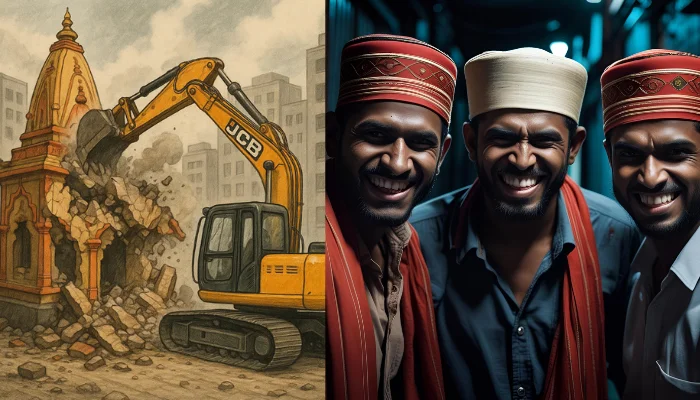
Case Summary
In Khadki, Akola, Maharashtra, a 100-year-old Hindu temple was demolished by two Muslim men and their two accomplices, who then discarded the temple idols. According to reports, the main accused, Jibrail Ibrahim Diwan, aged 60, along with his son and two other accomplices, used a JCB to bulldoze the temple. After the demolition, the group desecrated the idols by throwing them into a drain. When local Hindus learnt of the incident, they were angered and gathered at the site to demand action against the accused. The police were informed about this incident, and they registered a case in this matter. However, despite the police registering a case against Jibrail Ibrahim Diwan, no arrests were made, even two days after the incident. This led to criticism of the police by the local Hindu residents for their inaction. The local Hindu community stated that if the police did not act quickly, they would organise demonstrations demanding justice. Local Hindus also called for the reconstruction of the temple, the restoration of the idols, and the arrest and punishment of those responsible. The police stated that they had begun an investigation and that they were looking into the CCTV footage. They assured that they would soon apprehend all the accused responsible for the demolition of the temple. This news circulated widely on social media, prompting further demands from Hindus for the authorities to arrest the accused for deliberately hurting religious sentiments and to rebuild the temple on the original sacred site.
Why it is Hate Crime ?
This case has been added to the tracker under the primary category- Attack on Hindu religious representations. The subcategory selected is- Attack on Temples. In Hinduism, a temple is the abode of the Deity. The Deity in the Temple is consecrated, thereby, making it a real, breathing entity. Hindus believe that not just the Deity but the temple premises itself are sacred to Hindus since Hindus hold the faith that the entire Temple space is an amalgamation of the divine energy of the deity. Given the central significance of Temples in Hindu Dharma, any attack against a Hindu Temple or its peripheral premises is an attack on the faith itself and is born out of animosity towards the faith, of which, the Temple is a central tenet. Any manner of attack against a Temple and/or its premises would therefore be considered a religiously motivated hate crime. The other subcategory selected is- Desecration of the Hindu religious symbol. Icons and symbols or a religious representation of a spiritual ideal are widely revered in Hinduism. Iconography is of vital significance in the Hindu milieu. It helps connect people’s spiritual beliefs with the real world. Iconography within the Hindu faith takes several shapes and forms. Murtis are of most significance to Hindus, to which daily rituals, prayers and offerings are done. Besides the murtis, there are several other symbols which have deep significance in the Hindu faith – the Om and Swastika for example. Since these Hindu religious symbols hold paramount importance in Hinduism, any desecration of symbols, icons, murtis, religious representations and manifestations, is driven by animosity towards the faith itself which manifests itself through these murtis, icons and symbols. Therefore, any desecration of these Hindu religious symbols and representations is considered religiously motivated hate crimes under this category. The deliberate demolition of the Hindu temple by Muslims in Akola represents a deliberate act of religious hostility that qualifies as a hate crime against the Hindu community. For Hindus, temples are not just mere physical structures; they are sacred spaces where the divine Hindu deities reside. A temple and its sacred idols carry immense spiritual and cultural value. The act of destroying a temple is seen by Hindus as deeply offensive and sacrilegious. Any act of violence against temples is not an isolated incident of destruction but reflects underlying religious hostility toward Hindu beliefs and identity. The attack also involves the deliberate desecration of Hindu religious symbols like temple idols. The Muslim perpetrators desecrated the idols by discarding them in a drain. In Hinduism, deities’ idols are not just artistic representations but are deeply revered manifestations of the divine. Their desecration in this manner is seen as a direct affront to the religious sentiments of Hindus and an act of profound disrespect towards Hinduism. As this assault was directed at both sacred icons and a consecrated place of worship, it is classified as a religiously motivated hate crime against the Hindu community. Such actions of violence against Hindu temples are rooted in disdain for the Hindu community and their religion. Since this case fits the parameters of a religiously motivated crime, therefore, it's being categorised under the hate crime database.


Case Status
Complaint filed


Perpetrators Details
Perpetrators
Muslim Extremists
Perpetrators Range
From 2 To 5
Perpetrators Gender
male
 Sources




